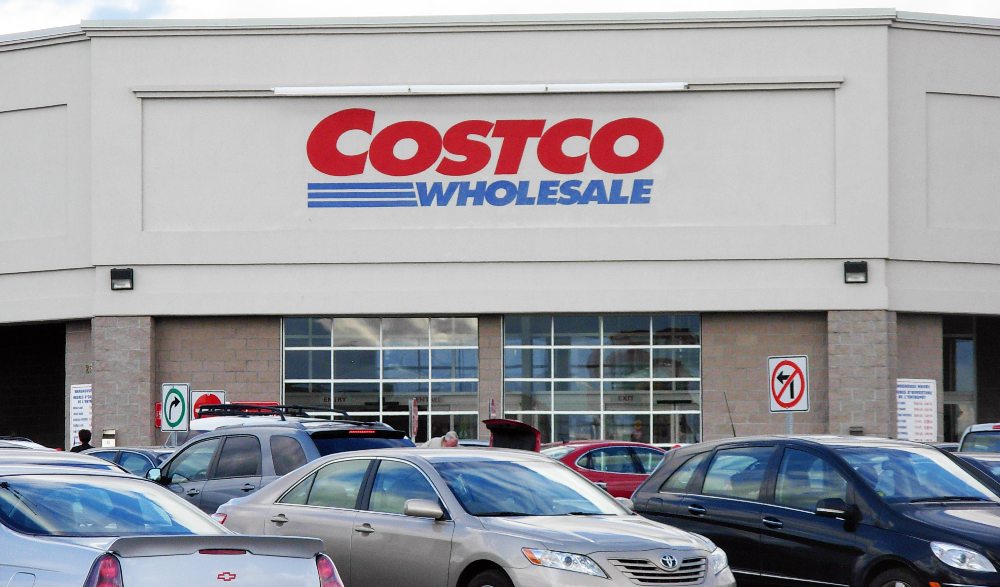

It’s nice to see a big Seattle-area company with the political cojones to defend its customers. I refer to Costco Wholesale, which is demanding refunds of the Trump tariffs it has had to pay. Costco is not the first company to sue for refunds — Kawasaki, Revlon and Bumble Bee Foods did it earlier. But among big U.S. retail chains, which have been hit hard by the tariffs, Costco is the first to stand up to the president in a federal court.
For years, I’ve heard Seattle progressives say America is ruled by the corporations. Why, then, have so many fat cats bent the knee to Donald Trump, picking up the tab for his White House ballroom? They’re dancing to his tune. The big companies around here — Boeing, Microsoft, Amazon — have a strong interest in free trade, as do their stockholders, employees and customers. Most of America’s big companies — now including the auto companies — are tied to customers and suppliers around the world and have no interest in the constipation of commerce.
Years ago, when I was a reporter of business news, I could see that business was not politically bold. Its world is commercial. A corporation might farm out the political stuff to a trade association with a lobbyist in Olympia or Washington, D.C., but when it came to publicly protesting government decisions, it was quiet. A family company might make a stink because the owner felt that way, and he was the boss, dammit, but the bigger the company, the smaller its courage. Especially the retailers. It might anger a customer.
How to explain the boldness of Costco? The DNA of its unusual founder, Jim Sinegal, is part of it. Another answer, from a stock analyst, was that the Issaquah company has developed a “cult following.” “Loyalty” is the better word, though Costco’s $1.50 hot dog and 20-ounce drink does have a following bordering on devotion. The hot dog deal, established by Sinegal 40 years ago, has an entry on Wikipedia and even a fan-based web page, costcohotdog.com. Call it a cult if you will; to me, it’s a badge of a company that looks out for customers. And the customers are the ones who ultimately pay for taxes on imported goods.
Whether Trump’s tariffs stand, or the Treasury will disgorge any of the tens of billions collected, will depend on the ruling in Trump v. V.O.S. Selections Inc., a case argued a month ago at the Supreme Court. V.O.S. Selections, an East Coast importer of spirits and wine — is one of those family companies willing to make a stink because the owner feels that way. On its web page, it says the company has built an ecosystem of relationships with its suppliers, its customers and its neighbors, and Trump’s tariffs threaten to wreck it. “We believe in free markets, fair process, and standing up when something is wrong,” it says. “That’s why we’ve joined in a legal challenge to these tariffs.”
V.O.S. is challenging Trump’s novel interpretation of the International Emergency Economic Powers Act of 1977. Passed during the Jimmy Carter administration, the law gives the president the power to “regulate” transactions — block them — during an “unusual and extraordinary threat” to national security, foreign policy or the U.S. economy. Carter used the law during the Iran hostage mess. He never imposed tariffs, and the law says nothing about that. In arguing that “to regulate” includes “to impose a tariff,” Trump is saying that Congress granted the president that power over 48 years ago, and nobody noticed. The amicus curiae brief from the Cato Institute makes the mocking suggestion that the White House lawyers unearthed the gift of power after digging through old laws “like Indiana Jones in the Raiders of the Lost Ark.”
Not having discovered such a treasure, the President’s lawyers were forced to declare that tariffs are regulations. At the Supreme Court, Justice Sonia Sotomayor was not buying it. “You say tariffs are not taxes, but that’s exactly what they are,” she said. And the Constitution gives the “Power to lay and collect Taxes, Duties, Imposts and Excises” to Congress.
If the Court rules against Trump, it will likely be because the International Emergency Economic Powers Act does not include the power to tax. But there’s also a question about his emergencies. Regarding Mexico, China and Canada, in April Trump declared a fentanyl emergency. Regarding the whole world, the president declared an imbalance-of-trade emergency. Neither of those are emergencies; the smuggling of fentanyl is a problem, but it’s not a reason to raise taxes. Trump’s declarations of emergency are excuses to exercise power.
He’s hardly the first. Every president in the past 50 years has declared emergencies — 86 of them, according to the Brennan Center for Justice. Maybe you didn’t notice all the emergencies we had; I didn’t. In the past 20 years, presidents have declared emergencies about “unusual and extraordinary threats” from Russia, China and North Korea. Those might have been expected, but our two Democratic and two Republican presidents of the past 20 years declared emergencies about stuff going on in Belarus, Ukraine, Afghanistan, Syria, Hong Kong, Somalia, Ethiopia, Yemen, Palestine, Burundi, Cote d’Ivoire, the Central African Republic and the Democratic Republic of the Congo. In the case of Cote d’Ivoire, for example, George W. Bush declared in 2006 that a civil war in that West African country “constitutes an unusual and extraordinary threat to the national security and foreign policy of the United States.”
When the current case was at the U.S. Court of International Trade in New York, Senior Judge Jane A. Restani, a Reagan appointee, asked whether, under the law as now interpreted, the president could declare an emergency over a shortage of peanut butter. The Trump administration’s attorney, Eric Hamilton, said that would be a political question. In other words, the president could declare a peanut-butter emergency if he liked, and no judge could say otherwise.
There are real emergencies. In March 1933, President Franklin Roosevelt closed all the banks in the United States after declaring an emergency under the Trading With the Enemy Act. It was, arguably, the misuse of a wartime law, because the nation wasn’t at war — but it was an emergency, and his bank holiday did work. But for every real emergency, there are dozens of mere problems jumped up into crises. Maybe the president should have to get an O.K. from a majority of the Supreme Court, even one justice (but not one appointed by him). We don’t allow cops to search our homes unless they can convince a judge they have probable cause. Maybe the president (this president, for sure) should be treated the same way. And if the objection is made that this would hamstring the president of the United States, maybe the answer is, “That is what we need to do.”
At the Supreme Court, the big questions on the tariff case are political, having to do with the separation of powers. In Puget Sound country, the effects are economic.
We have a successful economy here. Washington state has the highest median income for two-person households, $102,278, of any state west of the Rockies. More than most other states, our economy is connected to the world. It relies on the free movement of goods, services and money — and also the ability to bring in foreign talent.
Consider the big players. Boeing sells to the world, as does Microsoft. Paccar finances truck sales in 26 countries. Starbucks operates in 80 countries; it has more than 6,500 stores in China. Costco has warehouse stores in Canada and Mexico, and also in China, Australia, Sweden, Iceland and Spain. T-Mobile is owned by the Germans, and Puget Sound Energy is owned by the Canadians and Dutch. Alaska Airlines flies to Mexico. The University of Washington educates thousands of students from China, Taiwan and South Korea. Our tech companies have thousands of employees from India, China and other countries making products sold around the world.
Like the family-owned wine importer suing Donald Trump, each of those organizations has an “ecosystem” of relationships with suppliers, customers and employees. Each has an interest in protecting those relationships from the president’s whimsical use of federal power. This is a president who threatened Canada with an increase in tariffs on account of a TV ad run during the World Series. Yet from most of our companies the response has been silence.
It’s time for some boldness — or, to use one of labor’s terms, solidarity.


Well said by Bruce Ramsey. It all comes down to his final sentence. Because so much of what Trump is accomplishing with his tariffs, and because so few countries are making bold statements of their negative effects on the companies and consumers, it is time for these companies to speak up boldly. Trump is not a strong thinker. Basically, he’s a 12 year old stuck in an old frame. Not to be admired, nor feared. Speak up, those companies that are impacted. Let it be known that these tariffs are unfair and very hurtful to both companies and consumers. They are especially hurtful to companies in our northwest.
Jeff Brotman evidently fell in a hole.
I admire Costco but I wonder if Ramsey is reading in more than necessary?
From what I’ve read, Costco had an obligation to sue because of an impending deadline. It really had no choice unless it was going to lose its right to obtain a refund on tariff duties if the Supreme Court ruled against Trump .
According to one Google source, FWIW,
“The suit was filed in early December 2025, just before a critical December 15 deadline for liquidating imported goods entries.“
Yes, but that is also true for all the big companies that didn’t sue. Costco is the only big company looking out for the consumer.
Good column, Bruce!