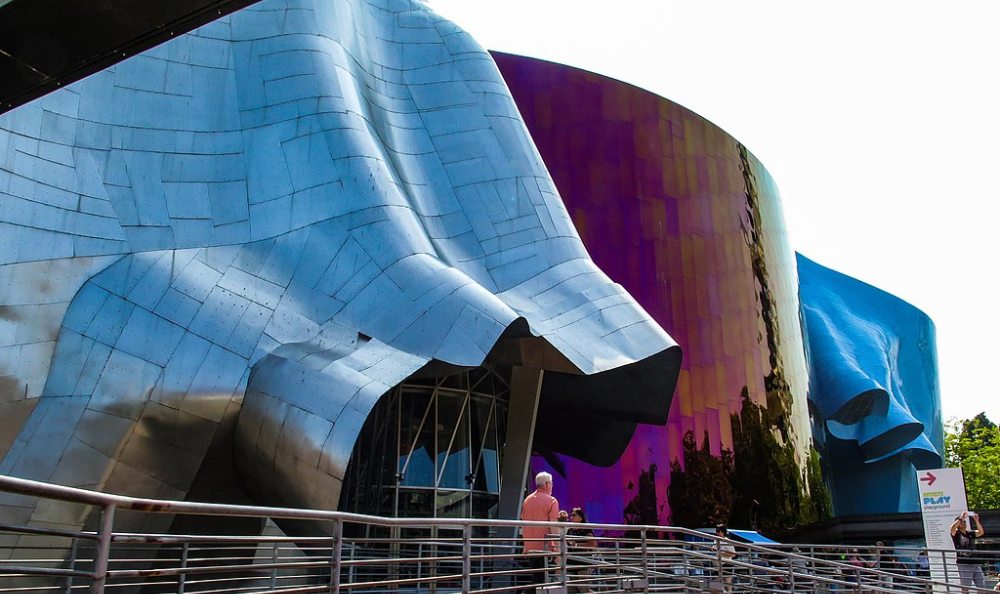

Seattle is graced with three buildings designed by the late superstar architect, Frank Gehry. The most famous is the Museum of Popular Culture (MoPOP) (2000), the extravagantly sculptural celebration in architecture of rock ‘n roll imagery, a spectacular but controversial building designed by Gehry at the height of his fame with ample funding from Paul Allen.
The most recent is the Meta office building in South Lake Union (2016), a far less flashy, but nevertheless creative design, featuring large, adaptable workspaces with many quirky and colorful Gehry touches and a grand rooftop park where employees can stroll among 400 trees.

But the first project Gehry took on in Seattle is rarely identified as his. It is the modest and mostly conventional retirement community building of Loyal Heights Manor (1980), which continues to serve its original function 45 years after its opening. This building dates from a period when Gehry was moving from designing what he called “straight stuff” to the incorporation of curious shapes and odd materials. A catalogue of Gehry’s works shows Loyal Heights Manor as a drawing, but notes that the finished building was not constructed as designed. The absence of a photograph of the final product in the catalogue implies that the architect had basically disowned it.
When comparing the drawing to the built structure, one sees that the former has sheets of corrugated metal hanging on the exterior of the building whereas the built structure has none. Since these proposed panels played no structural role, we would classify them as ornamentation. But how strange is that? Corrugated metal for decorative effect? One can understand why a developer might decide to just leave them off. Yet it is likely that in the architect’s mind the panels were what made the building a Gehry building.
The Loyal Heights project got under way around the time that Gehry completed the second remodel of his own residence in Santa Monica. Purchasing a traditionally styled home, he and his wife had gotten the notion of leaving the house intact but building a very different kind of structure around it, creating an open shell of plywood and corrugated steel, forming idiosyncratic shapes with wood beams and glass, and doing altogether unheard-of things with chain link. The kitchen was moved to where the driveway had been and the asphalt was left as its floor. A number of interior walls were opened to show the beams and studs within them.
This crazy-quilt building became a monumental success du scandal and one of the most argued-about buildings in all of American architecture. A regular parade of people came by to ogle it, and often enough they would be invited in and shown around. Gehry’s one regret about those early days of controversy, he said many years later, was that he did not sell popcorn.
In this building Gehry had created a style that he called “cheapscape architecture.” It exploits the sculptural potential of the kinds of materials that we buy at big box hardware stores. American homes and yards are filled with these materials — plywood, chain link, corrugated fiberglass and metal. They’re cheap but they do the job. Why not get creative with them?
Although today when we think of Gehry’s style we imagine the glorious titanium and limestone of the Bilbao Guggenheim, one could argue that it is the cheapscape aesthetic that constitutes Gehry’s most influential contribution to architecture. If the REI flagship store sports great beams, stones, and log columns jumbled together with industrial materials; if our opera house is clad in metal panels and features a massive chain link installation above its exterior walkway; if you see corrugated metal adorning retail stores, schools, apartment buildings, restaurants, and churches, it is because Gehry first made such things permissible, and took a lot of heat doing it.
Although Gehry’s 2016 Meta office building at Dexter Station bears the features that made his early work shocking — exposed mechanicals, reams of bare plywood and raw concrete, quirky juxtapositions of spaces and imagery — these features hardly cause a ripple today because the architect’s vocabulary has been so ubiquitously reproduced.
Gehry always praised the informal comfort of his Santa Monica home. It felt accommodating and spatially coherent. This is true of most of his buildings. They make intuitive sense. No matter how wild the appearance is, your bodily habits help you through the space. It is relatively easy to find the bathroom and even easier, if it is a museum or concert hall, to find the gift shop (he began in retail, after all!).
This intuitive quality is a function of the design process. Gehry would begin by translating a project’s program into a collection of boxes coherently assembled to work well together and would then design the sculptural features around this assembly. The procedure wreaks havoc with the modernist doctrine that buildings must honestly express their structure, yet it sacrifices nothing of structure or functionality in its enhancement of expressiveness.
The Museum of Popular Culture, inspired originally as a home for Paul Allen’s collection of memorabilia from Jimi Hendrix and other rock greats, has suffered the fate of being persistently divisive. People have strong feelings about the building, but rarely feelings of simple appreciation. Jody Allen, Paul’s sister, had the inspiration to recruit Gehry for the project, and at first patron Paul and architect Gehry worked hard to come together imaginatively, despite the fact that Allen was more conservative in his architectural tastes and Gehry more conservative in his musical ones.
Allen pointed to the “swoopy” qualities in Gehry’s works that he thought appropriate and Gehry began working with the metaphor of the smashing of a Stratocaster guitar that had been part of Hendrix’s act. Allen and Gehry negotiated over how literal this metaphor should be. In the process it was abstracted, generalized, and combined with other imagery to become something hard to pin down — a combination of visions, one might say, or more negatively, a compromise.
Meanwhile criticism came pouring in from the first days of construction. Just as Gehry’s global fame was moving into the stratosphere, in Seattle it was as if he was back defending his Santa Monica house, and by now he was in no mood to sell popcorn. If one attends to the details of MoPOP’s exterior one can appreciate many astounding sensual qualities in the sweeping, fabric-like shapes, the layering of colors on shimmering surfaces, and the sheer scale of its whimsy.
The interior has all the intrigue, artistry, and intuitive organization of Gehry’s best buildings. Yet MoPOP seems to be unable to overcome its failure to satisfy a basic expectation that viewers inevitably bring to architecture: that a building should stand up and cohere. This building will always strike one at first as falling down and coming apart. In the end Allen put a good face on the situation, calling the museum a masterpiece that occasions the same kinds of mixed reactions that the brash and confrontational art of rock and roll does.
After the publication of James Joyce’s Ulysses, every novelist had a decision to make: whether to write straight stuff or to engage in some variation on the new Joycean idiom. Gehry has had something of an analogous effect in architecture. His work will always stand as a monument to what is possible, both in artistic ambition and in
creativity under constraints.
Today when the demands of climate change mean that we cannot build in the old ways, there may be a special need for Gehry’s cheapscape sensibilities, channeled now into reusing, repurposing, recycling, and adapting old buildings and materials so as to curb the greenhouse gas profligacy of new construction.
As our buildings aspire to ambitious new sustainable functions, his freedom with form can match those new functions with an expanded appreciation of what a building can be and how it can look.
Discover more from Post Alley
Subscribe to get the latest posts sent to your email.


I love your Gehry-Joyce comparison and notion that architects and authors who came after those two Greats have had to choose whether to do “straight stuff” or engage with the new. Perfect.
Not a fan of the MoPOP building. I agree with the NYT architecture critics’s famous (and funny) description of it as “something that crawled out of the sea, rolled over, and died.” My thought when I first set eyes on it is that the structure has all the kineticism of watching a dog vomit while you’re peaking on acid (having had lived experience of this, I do not recommend it). Gehry did some great buildings, but this is not one of them.