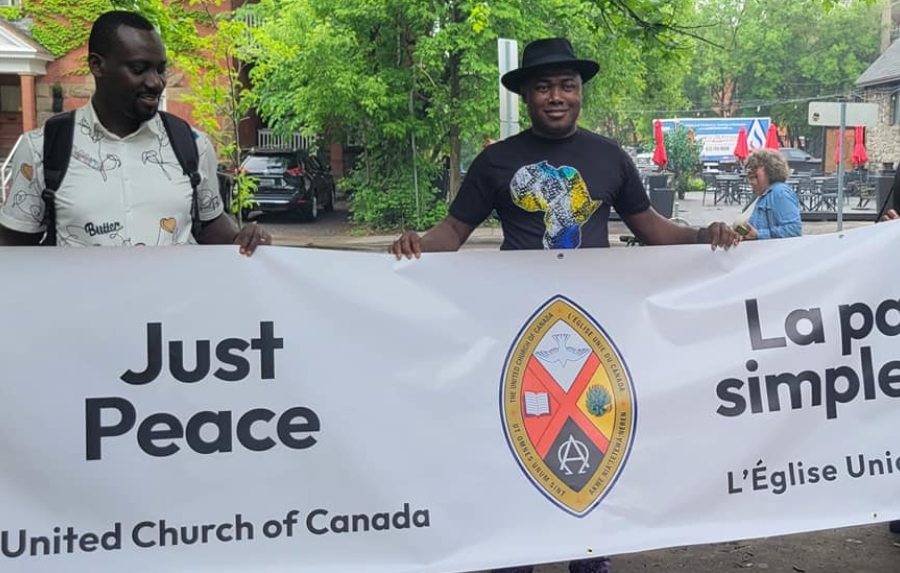

Over the past year and a half I have been working with the eight theological schools of the United Church of Canada (the other U.C.C.) as these schools looked at the possibilities for collaboration in their collective endeavor of preparing church leaders. I was the “Project Manager” for “Re-Imagining Theological Education.”
When the Lilly Endowment for Religion announced a new “Large Grant Initiative” this past January, my work shifted, and I became a grant writer. My research became the basis for the U.C.C.’s grant proposal submitted to Lilly in June. In late November I was gratified to learn that our grant proposal was funded to the tune of $10 million USD.

That’s a big vote of confidence from this important foundation. I am excited for the United Church of Canada. I hope this funding and the work it makes possible a transformative effect on theological education, and the church, in Canada.
Lilly’s priority is two-fold: to prepare excellent pastoral leaders for Christian congregations, a priority I enthusiastically share. And, second, for institutions of theological education to do this work collaboratively. In the case of the eight related schools this means approaching their work more as a system, rather than eight competing silos.
Our proposal envisions placing a great deal more emphasis on recruitment of excellent candidates for pastoral ministry. Part of being an “established” church, as the U.C.C. can be described, is that you don’t think you have to work much at recruiting or promoting the value and satisfactions of church leadership. You default to a passive approach, assuming great people will find their own way to you and to this vocation.
If part of the grant emphasizes the front end, recruitment, another major focus is the back end — building the supports and accountability that keep pastoral leaders alive and loving the work after they have left formal theological training.
Beyond those elements, the work the grant will make possible intends to “disrupt” a narrative of decline, that has settled like a dark cloud over most mainline/liberal denominations and seminaries, certainly including the United Church of Canada. While that decline is real, it’s too easy to consider present reality to be future destiny. That said, disrupting both the narrative and reality of decline that will require, well, disruption — sometimes painful disruption — of existing assumptions and practices.
There’s a related element, a challenge facing these schools and the churches they serve. The fancy name for it is “the hermeneutic of suspicion.” It is part and parcel of the hegemony of post-modern/critical theory of which I have written in my last post, where I quote Rachel Haack on its role in the growing incidence of “family cut-offs.” As Haack writes, “Postmodernism taught us to question authority and dismantle universal truths. Critical theory taught us to look for oppression and power in every relationship. Both were useful lenses at first, until they became the only lenses.”
As my colleague, Richard Topping, President of the Vancouver School of Theology, put it in a recent article, academics these days are formed in and by this “hermeneutic of suspicion.” He writes, “Academics and the theologically trained find collaboration hard to achieve. Why? I think collaboration takes trust, and this is difficult when the room is filled with people schooled in and formed by the hermeneutics of suspicion.”
Topping explains: “Theologians and clergy are [now] trained in suspicious reading. It means we read texts and situations for subtexts and assumed worlds. That mindset seeps into the whole of life and becomes a barrier to collaboration . . . newcomers to academia undergo catechesis in critical theories that stoke suspicion as a — if not the — principal interpretative aptitude.
“Suspicion is a default of the Western academy, where many theological schools are embedded. The cost of privileging this vinegary approach to reading a text or a situation is high. To change the world, we need an ‘I have a dream’ speech, not an ‘I have a complaint’ speech.”
This default to suspicion — which can be very heady and provides not insignificant affective satisfactions for academics — not only impedes collaboration but, even more seriously, robs churches and clergy of the confidence and joy of faith. Who wants to hear preachers de-construct Scripture and Christian faith week after week in the name of superior enlightenment? It’s not an approach that gives people in the pews (or the pulpits) a lot to go on in a tough, often harsh, world.
In my judgment the prevalence and default to this hermeneutic of suspicion (I prefer the word skepticism) has contributed to the decline of the church, as well as to the narrative of decline. My work on this particular project is now completed, and I will watch with interest as others take the next steps.
Discover more from Post Alley
Subscribe to get the latest posts sent to your email.


Hear hear!