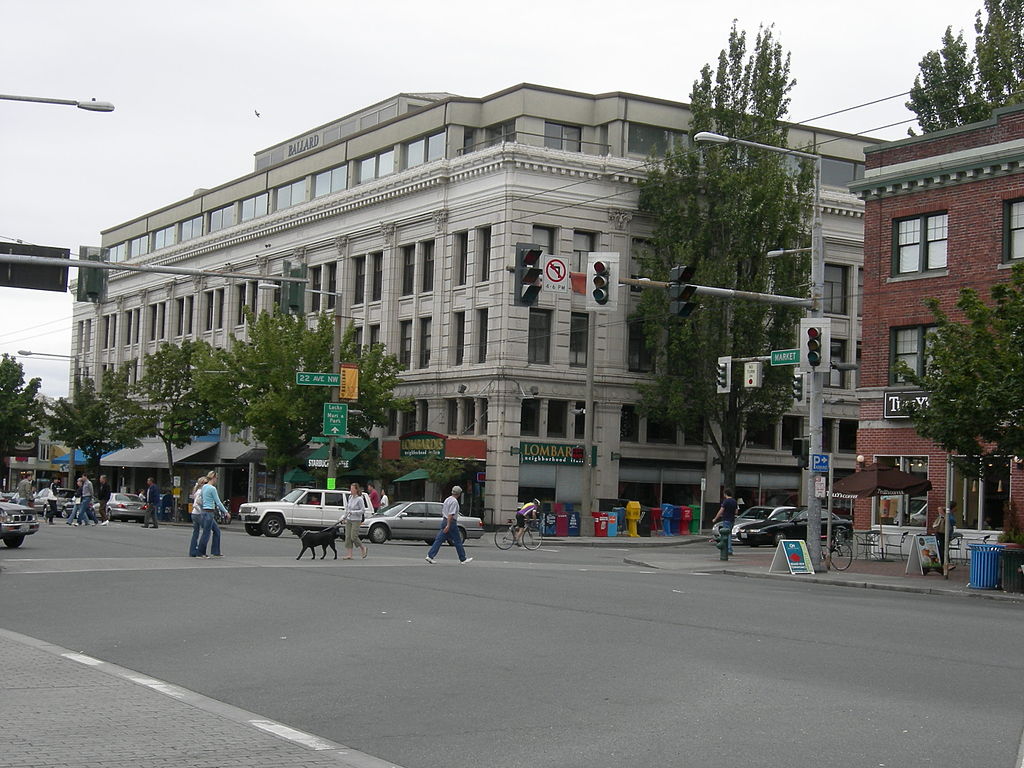

I’ve written often about the social disorder, crime, and drug use in Seattle. I’ve come to the conclusion that the northwest Seattle neighborhood of Ballard, where we live, must have a higher degree of such problems than many other parts of the city.
We lived for 25 years in the Columbia City neighborhood of southeast Seattle and never experienced anything close to this. Judging from correspondence received from readers in Laurelhurst, Wedgewood, Capitol Hill, Montake/Madison Park, among others, Ballard seems to be an outlier to which city government and Seattle Police seem indifferent. Yes, “Little Saigon” may be worse, and I’m sure Ballard isn’t completely unique. But it’s bad.
Here’s a recent message from a single, working woman, a neighbor here in Ballard. This is not a person who “goes off” on such topics or sends messages of constant outrage. No, this is reasonable person and solid citizen, a resident Seattle needs. She writes:
“I walk my dog up to the first entrance into the Shilshole Marina each morning and have been reporting to Find It Fix It what started as a couple of RVs illegally parked since September, no action taken. Of course this grew to 8-10 vehicles (unlicensed) so have been reporting dual violations, parking, and encampment.
“Included are pictures of illegal dumping, blocked sidewalks, public urination (and worse), discarded piles of food, rodents, as well as hundreds of feet of wire-casings and drug use, no action taken. Today, at 7 am the sidewalk was covered with casings again, a man was folded over in the fentanyl pose in the middle of the sidewalk and I could smell gasoline from a 100 feet away. I called 911.
“Police and fire department came, a cop called back, confirmed the gas (puddling and draining into a manhole leading into the Sound). There were weapons, equipment, total ‘shop’ for copper wire theft. The cop said they couldn’t prove they stole the copper wire, so nothing. I believe they hosed down the sidewalk.
“Tonight the vehicles are still there, as well as the stolen copper wire, one RV inside lights on, full blown drug lab, two people passed out in the truck in front of the RV. No arrests, no impoundment from what I can see.
“I think I’m done with a city that perpetuates this level of addiction and lets the citizens deal with the consequences and aftermath.”
This is exactly what I also see on walks in Ballard on Seaview Ave., among other locations. This morning in downtown I crossed paths with a dishelved person waving a bolt-cutter. No cops anywhere.
Another Ballard resident recently had a piece in The Seattle Times on what his neighborhood needs from Mayor-elect Katie Wilson. Again, it was a thoughtful, well-stated, non-hysterical plea, which to date has fallen on deaf ears from the City and Police. I hope you’ll read the whole excellent piece (use the link above). Ballard resident David Amschler begins his piece this way:
“I’m a father, a husband, a veteran and a longtime blue-collar resident of Seattle who has watched this city change in ways that have left many feeling unheard, unprotected and honestly, forgotten.
“This isn’t about politics. It’s not about left or right. It’s about the reality families like mine live with every day. It’s about the neighborhoods we raise our kids in, the homes we work so hard to afford, and the basic sense of safety that every resident should be able to count on. I love Seattle. But what’s happening here is breaking people down.”
Amschler notes what any of us who live in Ballard also see or really don’t see — that is police presence. It is vanishingly rare to see any police here at all.
As Amschler puts it, “Right now, the Seattle Police Department has one of the lowest ratios of officers per capita in the country. And it shows. We rarely see patrol cars. We rarely see traffic stops. We rarely see someone held accountable for even obvious, visible crimes.”
He concludes with three asks:
“We are not asking for the impossible. We are asking for three basic things: 1. Accountability for behavior that harms others: Compassion cannot survive without structure. Helping people is noble. Allowing chaos is not. 2. A police department that can actually respond to residents: Even a small increase in presence would change how neighborhoods feel overnight. 3. A real, long-term plan for homelessness that does more than relocate people: We need housing, treatment, outreach, and yes, expectations and rules.
“I believe this city can be better than what it’s become. People like me — the blue-collar families, the veterans, the workers, the parents, the folks who stay here through all the hard times — we need to be heard. We need safety. We need accountability. We need our city back, and I hope Katie Wilson is the leader who helps us get there.”
If I am right and Ballard is a worse-case scenario, why would that be? I only have guesses. First guess is who lives in Ballard. Despite an influx of Amazon workers in a lot of new developments on the main thoroughfares, Ballard is still a working class neighborhood and so may not have the clout or pull of a Laurelhurst or a Madison Park or even Capitol Hill, which has far lower crime numbers.
Another guess would be that Seattle has increasingly become a two-class city. There are the very wealthy and there are the very poor. The vanishing middle and working classes, the kind of people that live in Ballard, are apparently no longer on anyone’s screen.
Additionally, there’s a long-standing narrative in Seattle that resources go more to the whiter north end than the more racially diverse south end of the city. Having lived in both, I’m not sure this is accurate. I suspect the North Police Precinct, where crime rates are highest, may be on the short end of the resource stick because of the persistence of that north-south narrative.
Another factor is that Ballard still has a lot of industry, particularly along the ship canal that runs from Lake Union to the Ballard Locks. These non-residential areas provide more space for encampments than is true in other Seattle neighborhoods.
In any event, Ballard is a mess. There is no excuse for the ineffectiveness of Seattle city government and Seattle Police in responding to concerns here. It’s out-and-out wrong and dangerous.
Discover more from Post Alley
Subscribe to get the latest posts sent to your email.


I’ve read repeatedly that the explanation for the higher rate of Ballard is the ~one-hour distance from the SPD North Precinct.
Tony,
You touch on a major contributor to the problem in the next to the last paragraph. It’s areas where there is little or no adjacent, street-facing housing. The first neighbor you quote is describing the line of RVs on Seaview Ave. NW across from the Port’s Shilshole Bay Marina. About 4 years ago we experienced a similar line of RVs (30 of them) along N. Northlake Way between Dunn Lumber and Gas Works Park. It took a storm of Find It Fix Its and letters to the Mayor’s office by Dunn staff, marina managers and condo residents but finally the city removed them. Before that, we also experienced part 2 of the problem: crime, drug dealing and theft, break-ins at businesses and condo and rental buildings. Importantly, the crime problem exists because the police department does not have enough officers (detectives?) to actually stake out and investigate and arrest drug dealers working out of RVs, separating the bad actors from the needy homeless. That’s clearly still the problem today where lack of street-facing housing lets RVs congregate.
Thanks Dick, Helpful comments and report. I’d like to see SPD deploy a visible mobile unit/ office, say a trailer, in some Ballard areas. There could be a social worker in the unit to help sort out, as you say, “the bad actors from the needy homeless.” But a visible presence seems as if it might help. I’ve observed similar mobile units in other countries.
I think Dick’s absolutely right. Industry (maritime and otherwise) will do that. It’s why what pockets of RV living exist in Magnolia are along Gilman and Thorndyke Avenues W, i.e., alongside the BNSF tracks.
As for “Ballard is still a working class neighborhood,” I’m not sure that can be said about any neighborhood in Seattle anymore, except maybe South Park and Georgetown… and maybe not even then. Zillow says there are 13 residences for sale in Ballard under $500,000.
Thanks Benjamin. As regards “working class” and current home prices, I think there are working class people in Ballard who have been here for decades, so current home prices aren’t the only indicator. Also I base my impression on my wife being a school principal in Ballard.
Fair point, but I think it’s also accurate to say that working class people are no longer able to afford to *move* to Ballard, at least.
Agreed
Interesting but troubling. The substantiation for the premise of higher crime in Ballard is anecdotal evidence from letters and stories backed by personal observations from the author that bolster his thesis. May or may not be true, particularly when posited against the statistical evidence from Little Saigon and the International District in total.
It would help if this type of personal opinion allegation were backed up with statistical evidence from the Police Department and/or Courts.
Peter Hereford,
Whoa?
This is Post Alley.
We don’t need facts or statistics!!!
For years I have suggested to Harrell and city council members what other cities do. One area with ALL services. Not on Seaview, 3rd Ave or any other public area. Yes, many considerations and hurdles in that concept, but better than ramshackle pockets of blight ruining neighborhoods.
Thanks Peter. There is statistical evidence of the higher crime rates in the North End at the Seattle gov. and SPD sites. I was trying to give more on-the-ground as well as a sense of the frustrations/ disappointments of residents who cope with all this daily.
Too many car accidents and people getting run over. People there learned to drive at the Ballard Driving Academy. https://youtu.be/nyz6mkvlEgA
Ballard resident here; thanks for writing this piece. As regards “visible policing,” you can have cop cars with lights ablaze from 15th Ave NW to Golden Gardens and the Locks up to NW 85th St and it won’t make a lick of difference unless:
1. Cops arrest
2. Prosecutor charges
3. Judge sentences
And oh, by the way, #3 can’t be a 99-time cycling through some Lisa Daugaardian fever dream of diversion. Material accountability needs to be part of a real solution for Ballard.
RE #3: Judge sentences. THIS ALL DAY! While everyone complains about the lack of cops and, when they do interact, they don’t arrest: it’s because they know that Judges won’t hold people accountable. So why bother?
Rather than the incredible amount of fixation on who gets elected to City Council and the Mayor’s office, we need to turn that fixation around and have a full-on onslaught of news and detailed records on the Municipal and Superior Court Judges and their campaigns. Only when we flip THOSE seats will we get this area cleaned up.
I don’t think Ballard’s problems have much if anything to do with it being a traditionally working-class neighborhood. We lived in Ballard for 15 years, starting in 2006, and while we were there the problems with homelessness, addiction and related crime steadily worsened.
I think one big factor is St. Luke’s feeding program that attracted many campers to the area, to the point that Ballard Commons across the street was repeatedly overtaken by tents and garbage and became dirty, unsafe and virtually unusable (meanwhile, the city council doubled the parks levy paid by taxpayers). That happened two or three times while we lived in the neighborhood. There was also a lot of vehicle camping in the area. Vehicles would park in the same spot for literally months on end and the city did nothing about it.
Secondly, Ballard is one of the few areas of the city with an industrial zone where RVs can legally park overnight. Predictably, that has led to an influx of RV camping and associated problems.
Ballard also has a concentration of homeless services – besides St. Luke’s, there’s the Urban Rest Stop down the street, Nyer Urness House, which is a Housing First facility, the food bank and Neighborcare Health. It also a group of homeless activists that have pushed for more homeless services in the neighborhood. Build it and they will come, and they have. Ballard has attacted homeless people from other states (two examples are the homeless sex offender from Arizona who tried to rape a woman in the bathroom at Golden Gardens and the couple from Tennessee who were heroin addicts and were camping around Ballard before the boyfriend stabbed the girlfriend to death in their RV parked off Leary).
Add to that a permissive, hands-off culture and inadequate levels of policing, and what you get is exactly the sort of problems Ballard is having. We eventually got so sick of being constantly confronted with homelessness, addiction and crime that we moved out of the neighborhood four years ago and are much happier living where we are now.
There is a societal need for civil commitment, to force repeat offenders into treatment. Where we are now, I see no other path. An individual does not have a right to public intoxication that abuses their neighbors. An addiction that leads one to live in their own filth, engage in crime and violence is more than enough evidence of mental illness. As some have stated, these camps are primarily drug camps and should be treated as such.
Half agree, but forcing people into treatment is notoriously ineffective.
I think the only way out, is something most people wouldn’t regard as very realistic, and maybe it isn’t: lure them away. Carve out isolated communities and in them create environments that will appeal to failed people. Feed them, give them drugs, etc., will be far cheaper for us than replacing catalytic converters. It’s expensive to deal with them on our terms, but it’s far more expensive to deal with them on theirs.
A few people who go into these refuges will start to heal when relieved of the stresses that they’re dealing with now, and if only a few, that likely adds up to more than you’d get with forced treatment. Many will be too far gone, particularly if they have methamphetamine damage, but that’s another virtue of this approach – when we supply the drugs, they’ll be better quality and less destructive.
Since when does Post Alley publish this unprofessional junk? This piece reads like an agitated Fox News grandma found a copyeditor to review her latest post on Nextdoor.
Anthony, you interpret data in an incorrect way by broadly applying North Precinct data to Ballard specifically. Surely you wouldn’t say Blue Ridge is “crime-ridden”, yet it’s also in the North Precinct. And since Aurora Avenue, the North End’s crime hotspot, isn’t even close to the neighborhood boundaries of Ballard, your main data point is propped up on lies.
Considering how you like false narratives, it’s no surprise your background is in the religion industry!