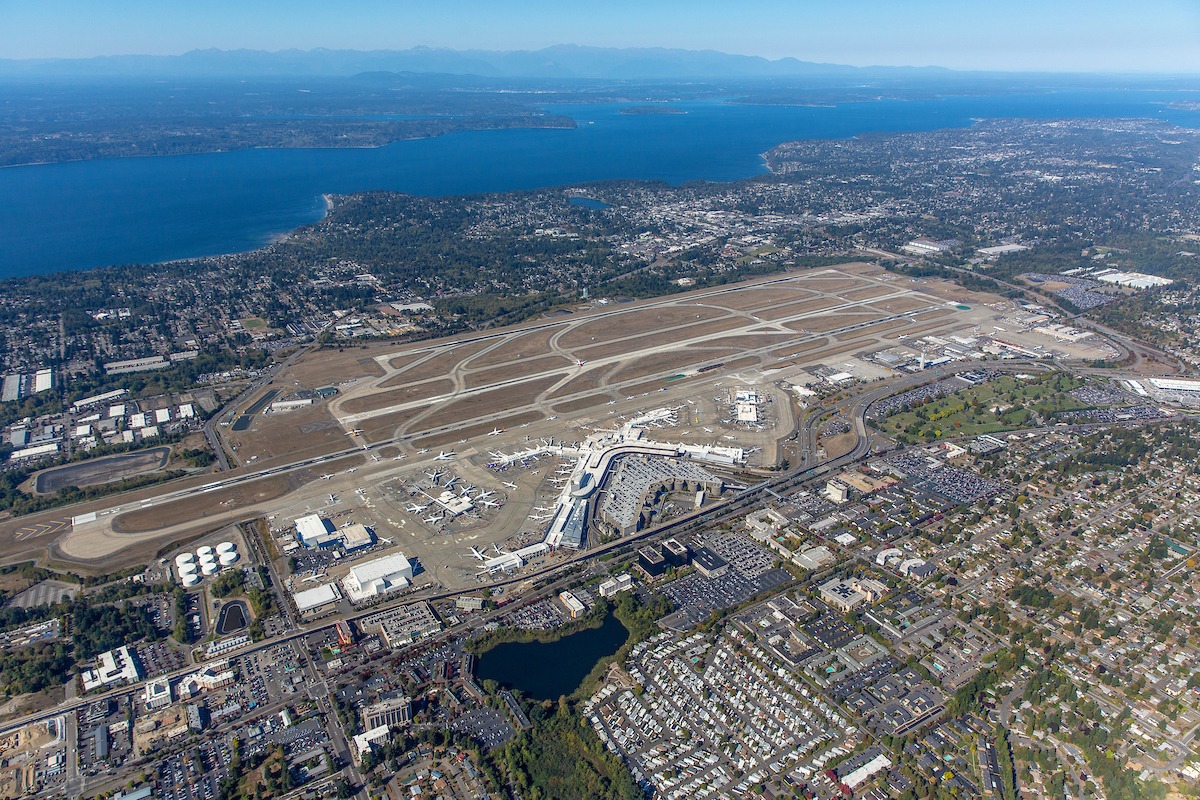

The Port of Seattle has embarked on a much-needed, massive Seattle-Tacoma International Airport expansion. But the plan is far from taking off.
The projects, including a new passenger terminal with 19 new aircraft gates, still must undergo another year of environmental review and win approval by the Port Commission. Even then it could be a decade or more before the growing crush of passengers see relief from congested gates, long security lines, and traffic back-ups. Delays in the study have pushed back the scheduled completion of the projects from 2027 to 2032. Litigation by environmental opponents might stretch that timeline even further.
A bigger worry is a potential cash crunch that may cause some projects to be delayed, pared back, or shelved altogether. A $5 billion spending blitz on improvements in the existing terminal over the past five years, coupled with high inflation and a weakening economy, could leave the Port short of funds to pay for badly needed new capacity.
Among the many projects recently were the new international-arrivals facility, modernization of Alaska Airlines’ ticketing area at the north end of the terminal, a new security checkpoint, and the launch of an expanded Concourse C structure, adding offices and new retail space. All were aimed at improving passenger movement, efficiency, and adding new amenities. Even so, no new aircraft parking gates have been added since 2021.
Some within the Port, as well as outside critics, are asking whether so much money should have been spent on terminal renovations that added no new capacity to handle growing passenger volume. “It will be a huge challenge to finance it,’’ one former Port executive said of the future projects.
Even after more than a decade of planning, the Port has not published an updated cost estimate or construction timeline for all the projects. An estimate of about $5 billion several years ago could today easily double that figure, or more.
The financial challenges are forcing Port leaders to trim spending and take a second look at some ambitious projects, including a $1 billion renovation of the aging South Satellite, renamed the South Concourse. “For the first time, in my experience, expenses are exceeding revenues. We’re trying to bend that curve,’’ said Port Executive Director Steve Metruck. “Now it’s time for us to reprioritize, to figure out what we need and what we want to do.”
Soon after the airport’s Third Runway was completed in 2008, Port planners realized that Sea-Tac’s single passenger terminal, roadways, runways, and taxiways would fall far short of accommodating the explosive growth in air traffic, here and around the nation. Sea-Tac’s constrained footprint – 2,500 acres — is among the smallest of the nation’s major airports, yet it has become one of the nation’s fastest growing. By comparison, Denver International is 33,531 acres.
Serving the entire Northwest and Alaska, Sea-Tac’s growth is fueled by the region’s economic health, anchored by Microsoft, Amazon, COSTCO, and other major employers. The airport’s top two carriers are Seattle-based Alaska Airlines and its chief competitor, Delta Airlines. Atlanta-based Delta, the second largest in the U.S., established Seattle as its primary Asian hub, supported by numerous domestic feeder flights.
Planners knew that this expansion would be the last major renovation of Sea-Tac, given the constraints of its small footprint and congestion in the crowded airspace above.
Sea-Tac is now in a race against time: The airport handled a record 52.6 million passengers in 2024, which is expected to rise to 57.2 million in 2032 and nearly 60 million by 2037. Although the need for a second regional commercial airport has been known for years, efforts to find a suitable site have been stymied by community opposition.
For its Sustainable Airport Master Plan (SAMP), the Port drafted concepts for 31 projects termed near-term (by the 2030s). Among those considered most essential: a new terminal to the south with 19 aircraft gates, realigned roadways, new cargo facilities, and numerous runway, taxiway and airport-support facilities such as a new fire station. An elevated busway would link the new rental-car facility, new terminal, and main terminal. Today, the airport has about 90 aircraft gates, including 10 added with the North Satellite (now North Concourse) project finished in 2021. The international arrivals facility project upgraded several gates but didn’t add new ones.
The federal environmental assessment for recent projects took 10 years, far longer than expected. The work was interrupted by the COVID pandemic and further delayed by consultants and FAA reviewers. The work took so long that some of the operational forecasts became outdated and had to be re-done.
In the end, the FAA gave the project an unqualified environmental blessing. In September, the FAA issued a “Finding of No Significant Impact and Record of Decision.” In federalese, that means the impact of the 31 projects that make up the master plan is judged to be little different than the effects of doing nothing at all — because passenger travel and air operations will increase regardless of Port actions. By law, the airport cannot deny service to airlines.
Even with more flights, air pollution for measured toxics and greenhouse-gas emissions will not be harmful or exceed regional air-quality standards, the assessment concluded, although the FAA did order the airport to pay for improvements at several nearby street intersections due to added traffic. The FAA report conceded that the consequence of no action, will be even more highway congestion, longer security lines, flight delays, and generally poorer travel experiences. In the long term, the report said, noise impacts would actually lessen because of quieter aircraft serving the airport.
“I’m actually concerned about the people who will be sitting on the tarmac, stuck in traffic getting to the drives,” said Port Commissioner Sam Cho. “There’s an argument to be made here … that not doing these projects could possibly result in more greenhouse gas emissions, because not doing the runway improvements, the cargo facilities, not widening the arrivals drive, might result in more people idling at the airport. By doing nothing, you could actually exacerbate the situation because we know growth is coming regardless.”
Sea-Tac’s airlines, along with the region’s top businesses and unions have lined up solidly in support of the future plans, arguing expansion is needed to keep pace with customer demand. Airlines, which pay the lion’s share of construction costs, enthusiastically endorsed the projects even without a firm price-tag or construction schedule. “Alaska Airlines is committed to the success of SEA and supports significant and substantial infrastructure development to meet the growing aviation demands of our region,’’ wrote Senior Vice President Shane Jones.
That statement reflects a turnabout for Alaska, which several years ago opposed a second terminal when it was locked in a battle for survival with Delta Airlines as it started its big push into the Seattle market. Delta has long advocated an aggressive expansion plan. But now Alaska is an international player that needs more capacity after its acquisition of Hawaiian Airlines and its new Tokyo and Seoul routes. The Port met a key demand of the Seattle-based airline by promising a secure connection between the future terminal and the North Concourse (formerly North Satellite) recently renovated for Alaska.
Business and tourism officials chime in, saying the region depends on Sea-Tac’s wide domestic and international connections. The airport “is a critical economic linchpin for Seattle,’’ said Brian Surratt, CEO of Greater Seattle Partners, which markets Seattle to international businesses, and Mayor-elect Katie Wilson’s new deputy mayor. The SAMP expansion plan “is essential for keeping our region competitive,’’ said Microsoft representative Barb Wilson.
Sea-Tac is not alone in the expansion game. Most major U.S. airports have recently completed or are embarking on huge new projects, including Los Angeles International’s $30 billion capital plan of terminal improvements and a new passenger transit system.
Not unexpectedly, the federal environmental review has not quelled community opposition to airport growth. Airport communities, which waged a long and costly fight against the Third Runway, are collaborating on their own environmental review of the federal assessment. They argue that the review failed to adequately examine the impacts of steadily increased jet noise and pollution.
Critics point to a 2020 report by Seattle-King County Public Health that identified growing health impacts on surrounding disadvantaged communities. “Prevention and mitigation of airport-related pollution exposures is critical for these communities, given their increased risk. People living in airport communities are more likely to be exposed to airport-related air and noise pollution,” health department report said. “They are more likely to have underlying conditions like diabetes, heart disease, and respiratory conditions, which increases vulnerability to more serious health outcomes resulting from pollution exposures.”
Community opponents also cite a University of Washington study of ultra-fine particles, a product of burning jet fuel, present in the air around the airport. Some studies link exposure to breast cancer, heart disease, prostate cancer, and a variety of lung conditions.
The federal environmental review, however, said those criticisms fail to account for the many other sources of air pollution that might contribute to ill health effects. Disadvantaged low-income communities have poorer health than their wealthier neighbors. Regarding the ultra-fine particles, the review said, “the science is not fully mature, and health impacts due specifically to aviation have not yet been demonstrated.” The federal government ordered the deletion of sections in the report dealing with climate change and environmental justice, but those topics will be examined in a separate environmental review under state law to be completed early next year.
State Sen. Tina Orwall, who has represented the 33rd District for 16 years, has long pressed the Port to do more for the poorer communities around the airport. “There’s a lot of harm being done,’’ said Orwall. “The Port hasn’t really addressed the impacts of current operations.”
One source of conflict is the Port’s residential noise-insulation program, which paid for noise-dampening windows and doors in 9,400 homes since 1985. Many residents reportedly complained about windows and doors that do not close properly or become fogged due to insulation failure. Ordered by the Port Commission to investigate, staff examined a sample of homes but found nearly all met federal acoustic standards and thus are not eligible for repairs.
Orwall and the Port helped secure state funds to repair noise-insulating windows and doors installed since 1985. She said the SAMP projects should be delayed until the community impacts are better addressed. Installation of high-performance air filters in schools and other community centers is one idea. “We need more research and an action plan before the plan moves forward,’’ she said.
Cities around the airport face the reality that despite their concerns about air and noise impacts from the airport, Sea-Tac is the economic engine of south King County and will continue to grow. The airport employs about 27,000 workers, many of them unionized, and has been a steady source of opportunity for recent immigrants.
Unlike the effort to stop the Third Runway, the emerging community strategy is to use the leverage they have to persuade the Port to step up mitigation efforts and channel money directly to neighboring cities. The Port has “ignored all the concerns from the community,’’ said Sarah Moore, deputy Burien mayor and chair of the city’s Airport Committee. At the same time, she said, “we all know the airport is a benefit for the region. It’s not going away.’’
Moore said some steps the Port could take include more limits on night-time flights, air filters, repairs of noise insulation, along with additional grants to cities to offset impacts. Some critics say air-cargo flights should be diverted to other airports. Sea-Tac is pressing the Port to turn over North SeaTac Park, developed as airport mitigation in 1990, to the city. Burien and other cities look with envy at the City of SeaTac, which reaps millions of dollars in taxes on airport parking and direct Port payments for public-safety impacts.
In fact, several years ago the Port launched special funds earmarked for South King County economic development and environmental improvements. The election of Sam Cho, Hamdi Mohamed, and Toshiko Hasagawa to the Port Commission signaled a significant expansion on those efforts. In 2026, the Port will spend $21.5 million on job creation, workforce development, and equity efforts throughout the county, up from $19 million in 2023. Moore said the airport cities “are starting to prioritize’’ building better relations with the Port. “They (port commissioners) are welcoming it, as far as I can tell,’’ she said.
The Port, however, is severely constrained by federal law from spending airport revenues on programs without direct airport benefits. Commissioners have more flexibility with property-tax revenue — the primary source of community funding — but Port heavily relies on the levy to fund capital improvements and pay off debt.
But before concrete and steel can start rising, the Port must complete planning and design (estimated at $300 million) for the 31 projects, determine their priority, and figure out how to pay for them. The Port has not announced an updated estimate but given the rapid escalation in construction costs the final figure could be $10 billion or more. The new 19-gate terminal will be 40 to 50 percent of the total cost.
But as the big bill for future projects looms, airport finances are under pressure from rising costs, debt service, and slower growth in revenues. Airport revenues overall are rising, largely through airline operations. But forecasts show softening returns from another major source of income — non-aeronautical businesses, such as parking, dining, and retail due to shifting customer behavior. Passenger enplanements, which had been above 2 percent annually, are expected to slow to 1 percent by 2030.
At the same time, airport spending on payroll and other operational expenses has been accelerating. The bills also are coming due from the airport’s recent building boom. Debt service on borrowing to finance main terminal improvements will grow from $260.5 million next year to $447.5 million in 2030.
As a result, the costs charged to airlines for their share of airport operations are rising sharply. Airline costs per passenger enplanement will rise from $21.11 next year to $30.40 in 2030. The combined challenges of rising costs, debt, and softening revenues are putting Port officials in a financial squeeze as they figure out finance plans for a multi-billion-dollar SAMP.
“Rising costs, inflation, we’re no different than anyone else,’’ said Metruck, who has been sounding the alarm about the airport budget for several months. He will not question the decisions made years ago to modernize the 1970s-era terminal, which brought major improvements in baggage handling, passenger services, and amenities at a cost of $5 billion. “Hindsight is not productive,’’ he said.
Now his focus is on ensuring the future projects do not run short of cash. “This is the forecast, if we don’t do anything,’’ Metruck said. That means trimming costs and reviewing proposed projects, including the billion-dollar South Concourse renovation. “We have to figure out what we want to do, what we need to do, and how we are going to pay for it,’’ he said.
Metruck said the consequences of failing to meet growing demand are apparent — by looking at today’s crowded access highway and security lines. “You can see what congestion looks like. Even if we don’t build the projects it won’t stop the demand,’’ he said. “The airport continues to be the economic engine of the region. The airport connects our region to the world, and the world to us.”
Discover more from Post Alley
Subscribe to get the latest posts sent to your email.


Excellent work, Mike.
Wow, fascinating piece. And what an illuminating statistic — Denver Intl is more than 13x larger than Seatac.
Denver Airport is an outlier, and a poor choice for comparison.
A better comparison would be Atlanta, at 4700 acres, or San Francisco at 5200 acres. The point still holds: Sea-Tac is small and constrained.
The new Denver Airport replaced the old Stapleton, and was moved a great (many thought prohibitive) distance away from downtown Denver specifically so that it could be so large because the unique aspects of Denver required it. First, the altitude (famously a mile high) requires longer runways for takeoff during hot summer days. Second, the airport was designed to be able to stay open during harsh winter weather, which required large separations between active runways as well as runways facing both north-south and east-west to minimize the effect of crosswinds. Third, its central location on the continent was thought to make it ideal as a “wayport” during the height of the hub-and-spoke model of airline flight scheduling, so it was built with runways on opposite corners aligned in the same direction so that incoming planes would taxi only a short distance upon landing and outgoing planes would taxi only a short distance before takeoff — maximizing efficiency of ground operations. And yet, it took many years for the local amenities — including hotels and gas stations to refill rental cars — to be built out to support the new airport. Even longer for mass transit to reach from Denver out to the airport.
The making of Denver Airport is an interesting story, but it’s a poor point of comparison with Seattle’s context.
One of the conclusions from the study evaluating a second site for a regional airport was that projections were uncertain due to the advances that may occur due to the advent of electric personal air mobility vehicles.
Vehicles such as Beta Technologies ALIA and Archer Aviation’s Midnight will provide extremely low cost to operate and low environmental impact. As of today, Beta has already demonstrated ranges of 290 miles for the vertical take off (VTOL) version and 386 miles for the conventional take off (CTOL) version. Beta’s engineering philosophy is to demonstrate capability and not hype like is typical in the Silicon Valley/Venture Capital finance world. So these numbers should be taken at their face value. Not only that but the numbers can only get better as new battery technology emerges and energy densities increase.
What we see here then is that these highly capital intensive and long-lead infrastructure projects might be white elephants when completed because the projected demand just won’t be there. Lower cost, more frequent and flexible, and getting you closer to your destination is going to win every day. Furthermore, the passengers that are most likely to use these personal air mobility vehicles are the ones also willing to pay first/business class prices which are needed for profitability in commercial airplane operations.
There is no replacement for long haul and Seatac is the best place in the US for flights across the Pacific as it is the shortest route to anywhere in Asia, whether that is Tokyo, Beijing, Hong Kong, or Singapore. In 20 years though, I expect there to be nodes acting like transit hubs throughout Cascadia region to provide low cost, convenient, and less time transportation. The initial uses might just be shuttling passengers from Gig Harbor and Bremerton to Seatac to make those long haul connections.
It is disruptive technology.
The other important thing to consider when it comes to capital investment like this is whether it makes sense in a low carbon economy. Every decision should be consider whether the investment is aligned with a lower carbon economy. Sustainable Aviation Fuels are limited and expensive and they are going to stay that way. Is air freight going to continue to grow when it is predicated on low jet fuel prices? There is a lot of air freight that can be sent by slower surface ships or rail or trucks or just won’t be sent at all, e.g. produce, cut flowers. Spending billions for infrastructure carries a lot of risk here.
One would think that our tech business leaders, like Microsoft’s Brad Smith, would understand this. But that doesn’t seem to be the case as he continues to be the face of the Ultra High Speed Rail project that has projected cost greater than $100 billion.
In my opinion, it’s not possible to reduce climate impacts, let alone noise and pollution impacts to the population around the airport (and beyond) and allow the airport to grow. I’m sorry, but it sickens me – all the concrete poured, the emissions. People don’t have to fly – please tell me what percentage of the air traffic from SeaTac is actually necessary, i.e., required as opposed to elective? It comes down to making money rather than being committed to less impactful alternatives. Why can’t this project wait five more years, to see where the technology goes? I call this a terrible waste following outdated planning.