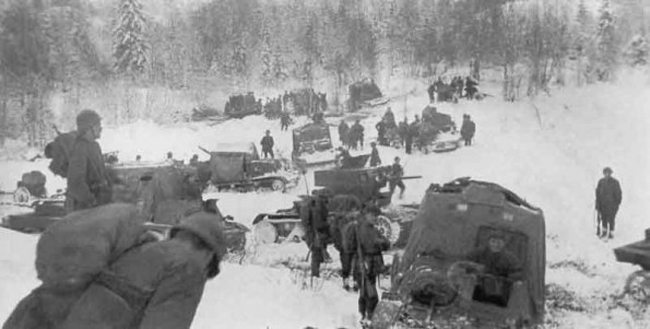

Vladimir Putin’s war against Ukraine is remarkably similar to Josef Stalin’s war against Finland — the Winter War of 1939-1940 — which began on November 30, 1939, 86 years ago this week. Putin’s war is similar to Stalin’s war in why he started it, how it went and what the world thought of it.
It could also be similar in how it ends. After three and a half months of war, Finland gave up 11 percent of its territory and allowed the Russian navy to have a large base on the southwestern Finnish coast.
At the time, the settlement was denounced as a surrender. James A. Wood, associate editor of the Seattle Times, saw nothing good in it. “Finland was compelled to capitulate to Russia and accept terms of extraordinary severity,” he wrote in the March 15, 1940, paper. Finland, he wrote, is “at the mercy of Russia.”
In 1940, several countries found themselves at the mercy of Russia. For Latvia, Lithuania, Estonia and eastern Poland, none of which had fought like the Finns, the attentions of Russia were deadly. For Finland it was not. The loss of territory was permanent: the frontiers established by Stalin are Finland’s frontiers today. The Soviet Union maintained the navy base in Finland until 1956, three years after Stalin died. And until 1989, Finland was neutral — “Finlandized.”
But as historian Sean McMeekin writes in Stalin’s War (2021), “Finland had held out, preserving its independence.”
Could Ukraine do the same? The parallels between the two wars offer a hope. Like Finland, Ukraine had once been part of the Russian empire. When Finland was attacked in 1939, it had been independent for 22 years. When Ukraine was attacked in 2022, it had been independent for 31 years. And just as Stalin worried that Finland could allow in troops from Britain or Germany to threaten Russia, Putin fears a Ukraine in NATO that would threaten Russia.
When it invaded Finland, and also when it invaded Ukraine, Russia expected an easy victory. Both the Finns and the Ukrainians were outnumbered, Finland grossly so. But in Finland, the Russians were not prepared for a war in the snow. The war on Finland cost the Russians about 130,000 dead, compared with 26,000 Finns. Still the Russians pushed the Finns back, and Finland agreed to a painful settlement.
The Finns fought for three and a half months. The Ukrainians have fought for three and a half years — a period as long as the time America was officially in World War II. Like the Finns, the Ukrainians have made the invader pay: Russian casualties are said to be 950,000 to 1 million dead and wounded, compared with 400,000 for the Ukrainians. But unlike America in World War II, Ukraine has not been winning. Russia has seized — and kept — 22 percent of its territory. A settlement comparable to the one with Finland 85 years ago would be to lose this land to Russia, but leave most of the rest of the country untouched.
At this point, a Ukrainian might hope for a deal like that. But the politics are different. Finland was alone, but it negotiated for itself. Ukraine is at the mercy of its armorers. We and the Europeans hold the cards on Ukraine’s side, and Trump holds most of them. Volodymyr Zelensky has no good ones.
Trump ran in 2024 on the promise of ending this war, and he should do it. It is a terrible war, and there is no profit in continuing it. The Ukrainians won’t like the settlement, but at least they will be alive. They might remember the Finns.
Discover more from Post Alley
Subscribe to get the latest posts sent to your email.


There is a obvious flaw in this reasoning. Namely the Ukranians have been at war with Russia since April 2014 when Russian para-militaries seized several towns in the Donbas region of Ukraine. And when Putin inserted “little green men” and bribed local officials to occupy Crimea.
As Russia is known to do, it launched the war through proxies providing plausible deniability to the war to avoid the political consequences.
To focus only upon the 2022 invasion exclusively is to ignore the reality of what Ukraine has endured. Much like the United States and Pearl Harbor, Ukraine is motivated by the memory of sacrifices endured during those initial months after the Maidan “Revolution of Dignity”.
Namely,
– Battle of Donetsk airport by the Cyborgs of the Ukrainian army
– the battle for Mariupol in May-June 2014 by Ukrainian nationalist’s Azov brigade, who have subsequently been incorporated officially into the Ukrainian military
– the battle of Ilovaisk in August 2014 where Russian military (not separatists) reneged on agreement permitting Ukrainians to retreat from occupied Donbas with the loss of roughly 1000 dead over a 3 week battle.
– the shooting down of Malaysia Airlines Flight 17 by a Russian SA-11 Buk missile from the Russian 53rd Anti-Aircraft Missile Brigade
Objectively Russia had paid a very steep price to obtain territory since the initial 2022 invasion that is of little strategic value–open plains and steppes. It’s stockpile of Soviet era weapons is depleted. It’s Black Sea fleet is either sunk or holed up in Russian ports. Inflation is rampant. Foreign exchange from oil exports has dropped off a cliff. Manufacturing in some industrial sectors down 50% with suppliers and worker not being paid. Convicts have grown wise to offers of reduced jail time and no longer sign contracts to fill Russian “meat wave” assaults. Russia is reliant upon North Korean mercenaries and artillery shells. Ukraine is creating gasoline shortages through deep strike drones, which unlike Russia actually strike military targets not civilian apartment blocks.
It is a war of attrition and I’d expect no resolution until either Putin’s death or his removal.
Finland is a NATO member.
Yes, since April 4, 2023.