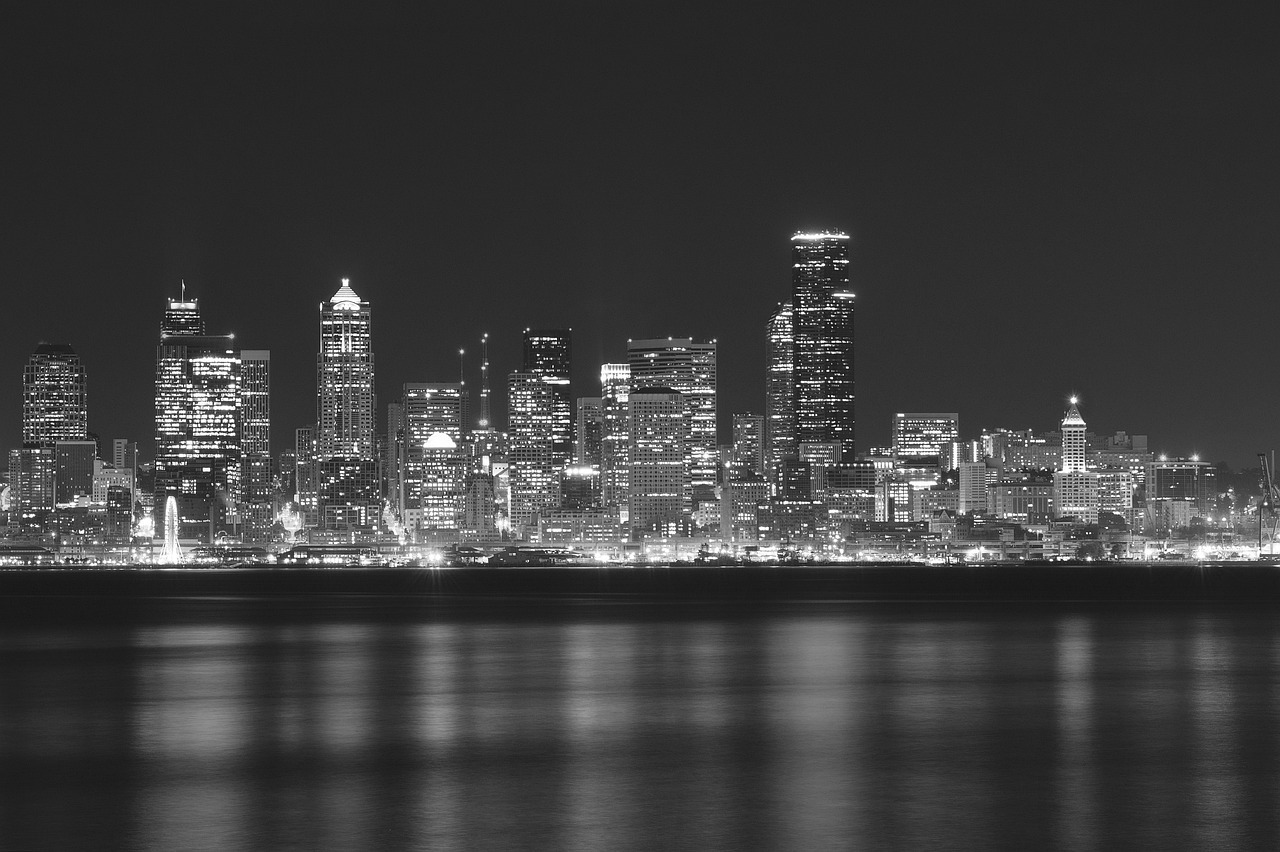

Downtown Seattle’s glittering skyline of office towers, so lovely when seen from across Elliott Bay, is in big trouble. Those towers are ghosts of their former selves, with a third to a half of the office workforce missing. Office workers are to downtown city life what salmon are to the ecosystems of the Pacific Northwest–a foundational species.

Their continuing absence is driving a collapse in property values, steep reductions in revenue for city government and our transit operators, the prospect of severe losses for property owners, serious bad debt problems for lenders, and significant problems for other downtown activities which depend on those workers–retail, restaurants, culture, and entertainment. This is a looming crisis which does not seem to be getting the urgent attention it deserves outside the small circle of the most-affected. Many of those at greatest risk would prefer to keep it quiet. How bad is the problem, and can it be solved?
Downtown Seattle can include, depending on who’s asking, the Central Business District, Belltown, Pioneer Square, The International District, Lower Queen Anne, and South Lake Union. All of these have high vacancy rates right now, averaging about 35%. Today our particular topic is the CBD, which has a staggering oversupply of office space: 36.5% vacancy as of Q3 2025, and slowly rising. It’s not as bad as it was during the peak of the pandemic, but still severe, and not improving. For reference, the CBD vacancy rate in San Francisco is 33%, in Portland it’s 31%, and in Vancouver, BC it’s 15%. Downtown Seattle’s current office vacancy rate doesn’t count space that’s still being leased but not used, and square footage is still being emptied out faster than it’s being filled up.

The de facto vacancy rate is almost certainly higher than 36.5%, and vastly higher than the vacancy rates in previous economic downturns, even though we’re not in the middle of a downturn. Overall, the city’s population is growing and faring pretty well economically. The city’s vacancy rate is also much higher than that of the Eastside and in Seattle’s other suburbs, which runs at or a little above 20%.
Driven by high downtown vacancy, the Seattle Metro Area has the highest overall vacancy rate in the country for major cities, a far cry from what it was a decade ago. Many downtowns across the country are facing the same issue, but Seattle’s is the most acute.
Seattle is unique among cities of its size for how concentrated its commercial office space is in downtown towers. Our pre-pandemic downtown employee population was 7th-largest in the US, even though our metropolitan area is 15th in size. Over half of all office space in the city of Seattle is located downtown, and about half of greater downtown’s office space is in the CBD: nearly 25 million square feet.
We absolutely dominate neighboring cities in the number of very tall buildings we have: Seattle has 53 buildings at least 400’ tall, of which 21 are over 500’ tall. These numbers are nearly 50% greater than the tall buildings found in Portland, Bellevue and Vancouver BC combined. Tall buildings, by and large, stand on wider footprints, which means that our towers contain great volumes of deep space, far from windows, which makes conversion to residential uses difficult.
Other uses are conceivable (see below), but most would bring fewer people downtown than offices do, and it’s the lack of people which is blamed for many of downtown’s other issues: pedestrian safety anxiety, closed or struggling restaurants and retail, shrinking tax base, and shrunken ridership on light rail and buses.
Four big questions loom:
- Why has the vacancy rate remained so high?
- What are the consequences of sustained vacancy?
- Will office workers ever come back, and if so, when?
- If not, what can be done to address the problems over which our ghost towers preside?
Why so vacant?
There are several underlying causes.
First, as we all know, the pandemic sent knowledge workers home, where working remotely became a new normal. A combination of existing and emerging technologies made this possible on a previously-unimaginable scale. Among the occupations most amenable to remote work are four which are particularly concentrated in downtown Seattle: technology, finance, law, and general business administration. By some measures, Seattle had a higher proportion of tech workers in its downtown office population than any other large city in the world by 2020 when the pandemic arrived.
As the pandemic faded, employers discovered that many of their employees preferred remote work, and allowing it became a recruiting tool. Most companies would prefer to have workers on site, for the benefits of in-person collaboration, but they lost a lot of leverage once the pandemic proved that, for some kinds of workers, a work-from-anywhere workforce could perform reasonably well. Since then some firms have required a certain amount of in-office time, most often 3 days/week, variably enforced.
Tech firms such as Microsoft, Amazon and F5 have been giving up space in Seattle’s downtown towers. So have elite law firms such as Perkins Coie. As companies and their employees settle on a ratio between work done in the office and work done at home, the quantity of office space needed will stabilize, but it’s hard to say what that quantity will be, or where it will be; total demand for CBD space may remain about where it is.
The second reason for persistently high vacancy rates could be AI: the same occupations which can easily be done remotely also seem to be amenable to AI replacement: technology, finance, law, and business administration. This doesn’t mean that your next lawyer will be a robot, but it means that software engineers, financial analysts, attorneys and business managers may be able to produce more work per capita thanks to AI, thereby shrinking the body count while increasing the work product delivered. The big tech companies are trying very hard to make this work, and they are among Seattle’s biggest employers.
Tech companies across the industry have been cutting their workforces, to the cheers of Wall Street. Partly this is right-sizing after bulking up during the online-intensive COVID years. But AI is increasingly shifting workforce needs. Just this week, Amazon announced reductions of 14,000 in its global corporate workforce, and Reuters reports that Amazon’s intentions go well beyond this figure. As Seattle downtown’s largest employer, that could make a big dent.
Third, downtown Seattle experienced a vigorous building boom during the twenty-teens, and it seemed set to continue, with many more buildings permitted or proposed just before the pandemic arrived. The office worker population downtown grew more than 50% between 2010 and 2020. At one point, it was claimed that Seattle had more construction cranes on its downtown skyline than any other American city.
This scramble to build more office space could be paused but not instantly turned off when COVID arrived. Although many projects which were on the drawing boards or in the permitting process in 2020 have since been canceled or postponed, many were already under construction, and most of those buildings were finished once work could resume. The last three were completed earlier this year, none of them with major tenants lined up. There are precisely zero new office buildings under construction in downtown Seattle now, but the building boom that was going full tilt until 2020 still added millions of square feet of empty office space as it overshot into the first half of this decade, keeping the vacancy rate high even as some workers have returned.
Fourth, part of the appeal of working downtown traditionally has been access to unique retail: flagship stores, luxury stores and niche stores that aren’t found elsewhere in the region. The triple whammy of online shopping, the pandemic, and the unsettling presence on the streets of people living rough has battered downtown’s retailers, thereby reducing the appeal of unique retail to office workers. At the same time, retailers away from downtown have upped their game: University Village is thriving as a destination experience.
Fifth, more speculatively, is that perhaps the business reasons to build clusters of skyscrapers are weakening, and the ideal form for tomorrow’s functions may not favor such concentrations of vertical space. Skyscrapers are a relatively new invention, and clustering them makes it possible to scale the benefits of proximity between co-workers, vendors, clients, customers, partners, investors, and so forth.
Downtown Seattle, when full, would allow roughly a quarter-million people to work within a few minutes of each other. The price of that capacity is long commutes, traffic congestion, and expensive rents. If the cost/benefit equation is shifting–if technology is enabling the benefits of proximity without as much actual proximity–downtown may have a more fundamental problem on its hands as it tries to compete with a mix of remote work and lower-density offices spread across a wider landscape.
Consequences
Since the number of people who come downtown to work every day is far less than needed to fill up the office space built to support them, employers are vacating leased space, and buildings are earning less rent than their owners projected. This decline in rental income has been somewhat cushioned by long-term leases (tenants still paying for space which they’re no longer using), but as those leases end or are negotiated away, rental income continues to fall.

The pandemic changed corporate thinking about how much office space businesses need and where they need it. For the owners of these downtown towers, for the lenders expecting repayment from these owners funded by rents paid to the owners, for city government hungry for tax revenue, for tenants seeking to sublet their unused space, for downtown retailers, restaurants and cultural institutions starved for customers, for property owners elsewhere in the city who have benefited by how much tax revenue came from downtown property owners instead of from them, for the transit operators who carried those workers to and from downtown, and for citizens of greater Seattle who are better off with a vibrant downtown whether they go there or not, downtown’s office space crisis is a dangerous dilemma.

Here’s why it’s such a vexing problem. Typically, office buildings are constructed or purchased with debt financing, the loans are serviced out of rental income, (often with interest-only payments), and the principal is repaid at the end of the term of the loan. The landlords cover payments out of the rent they collect and cover the principal at the end of term either by refinancing or selling the property. In good times, their rental income not only covers their debt service, but also operating expenses and profit.
Even better, sometimes they can increase the value of their property (by raising rent, for example, or just by being in a hot market) such that when they sell or refinance it to pay off the principal at the end of the loan, they enjoy capital gains. In bad times, if the tenants disappear and the landlords fail to make payments, the lenders can take possession of the properties. Of course, if the under-occupied property isn’t earning enough rent to cover the interest-only payments to service the loan, why would the lender want to own it? Well, to sell it to recover what is owed them by the non-performing landlord.
Alas, the value of commercial property is completely determined by its financial performance: buyers will only pay what makes sense given the rent they believe they can collect. So buildings with high vacancy rates are worth less–often a lot less–than the principal owed on them. Some creditors will take the building anyway, but others would rather whistle past the graveyard. That is, they tacitly accept the wishful story the landlord tells them about how they expect to attract new tenants very soon at the same rent, fill the building up, resume making payments on the loan, pay back rent, and have a building that can be sold for at least enough to cover the principal at the end of the lease.
This story, told for many downtown properties at once, is pretty obviously a fairy tale at this point, but everyone in the whistler’s chorus is hoping that if they can avoid a financial haircut now, maybe they won’t need one later. Nevertheless, haircuts are here for some: In 2024, Martin Selig defaulted on a loan backed by two prominent downtown buildings, Unico defaulted on the loan backed by the Colman Building, and two properties–Pacific Place Mall and the Dexter Horton Building–were sold for far less than they’d been purchased for.
Meanwhile, the tax assessor’s valuations on these buildings are falling, thereby reducing the amount of property tax the owners will owe the City of Seattle. For tax year 2025, the assessed value of office buildings in downtown (including Belltown) dropped between 34% and 40%, a number that echoes the vacancy rate. Commercial property taxes are a big revenue stream for the city, Seattle’s most valuable commercial properties are very concentrated in the downtown area, and Seattle city government is currently facing a real financial crisis anyway, with election-year arguments under way about how to reduce deficits, find new income, and allocate money to competing priorities.
Of course if landlords can’t fund debt service anymore, they’re also less likely to make timely tax payments, not to mention paying for maintenance, building improvements, etc. Since the assessor is required to find money somewhere, property tax valuations outside of downtown have been going up on all properties, not just commercial ones. If you’re a homeowner and your property tax bill jumps up, downtown’s property owners thank you for your service. If you’re not a homeowner and wish to become one, the price of buying in is going up.
Fewer office workers commuting to and from downtown also means fewer fares paid into our transit system, which, of course, is hard-wired in a hub-and-spoke geometry to carry many people to and from downtown. It also means fewer customers for downtown restaurants, retailers and entertainment venues, and fewer people on the streets to keep each other feeling safe. The Downtown Seattle Association, using cell phone data, reports increasing numbers of office workers downtown, but the vacancy rates are still inching upward as newly-constructed space and newly-vacated space come on the market faster than returning workers can occupy them. Downtown is roughly 100,000 workers shy of a full load.
For the wider metro area, the risks are relatively invisible at first, but, as once-proud cities such as Detroit can tell us, having a hollowed-out and dysfunctional downtown can be a huge drag on a metro area. Many of the downtown landlords are property developers. If they are healthy, they are in the business of using the returns from successful projects to fund more projects–they build residential properties, office buildings, industrial facilities, etc. They pay a lot of taxes. They employ a lot of people. When they experience financial wipeouts, the whole region suffers from their absence.
Will office workers return?
This is the multi-billion dollar question. There are still reasons why some businesses choose to flock together in downtown settings–transportation access, scale of available space, ease of moving to expand and contract, access to a large pool of workers, availability of trophy space, and so forth. It may be that, over time, data will emerge that makes a stronger case for insisting that workers come to work more often, and, in a cooling job market, companies might be able to replace their sit-or-die homebodies with more office-friendly workers of comparable talent.
It may also be that working from home will eventually get old even for some of those who love it today: in that case, they might be drawn to spending more time in the office to literally get out of the house. Companies might find ways to make the “office experience” more appealing. Downtown might find ways to make itself more appealing.
Over time, growth in the region might increase the demand for high-end downtown offices. None of these mights and maybes is a sure thing, and none of them addresses the big AI unknown: if AI makes each worker more productive, how much of that productivity will take the form of reduced headcount, and how much will take the form of increased work product? It’s worth noting that the two biggest employers in the region, Amazon and Microsoft, are currently reducing headcount and moving employees away from downtown Seattle while sinking billions into AI.
In Microsoft’s case, as its campus buildout in the mothership in Redmond has created more space, they have been pulling headcount to on-campus offices and letting go of space elsewhere, including downtown Seattle and downtown Bellevue. Amazon has been quietly shifting more of its workforce from Seattle to Bellevue, in part to avoid having to cope with the city of Seattle’s enthusiasm for Amazon-targeted taxation. So far the return to downtown office use has been anemic even as COVID dwindles in the rear view mirror, and any trend toward refilling those spaces could happen on a pretty gradual timescale. A gradual timescale is not what the property owners are praying for.
What can be done?
Here are some starting points, setting aside for the moment concerns about immediate practicality. These are not mutually exclusive.
- Keep the faith. This option simply assumes that, sooner or later, there will be enough of a market for downtown office space to refill these buildings, and if enough of the stakeholders agree to be patient, the problem will slowly scab over, and then heal, with workers tip-toeing back into their sky cubicles on little cat feet. As mentioned above, increased demand for downtown office space might also come from long-term and substantial economic growth of the region, some of which would end up increasing demand for downtown office space. In this scenario, a dogged devotion to continued downtown improvements will slowly bring the fundamental forces that make downtown appealing back into play, and, in time, the offices will once again be filled with office workers. This model is expensive in foregone rent and bad debt, but requires little other expenditure except mothballing a fair amount of unused space for a while. Obviously, it also incorporates a bet that the fundamental model of a dense, highly vertical office district isn’t going to be challenged by some new relationship between form and function.
- Let market forces do their brutal work. Let the valuation of these buildings fall until there are buyers for them, a scenario in which the strong eat the weak in OG red-toothed capitalist fashion. Owners and lenders would suffer for their sins and city government would struggle with solvency, but eventually all the un-repayable debt would be off the books, and the buildings, now much cheaper to own, could compete for tenants by offering lower rents, or the new owners might find that the cost of even radical conversion to new uses makes sense economically. In the long run, downtown’s health would be restored, under new management.
- Promote “work-near-home” as an alternative to the binary choice between work-from-home and return-to-the-office. If going to work in a downtown office were really easy, office workers might actually like the idea of doing more of it, and maybe getting their extra bedrooms back. The downtown residential population is growing, and currently sits just below 60,000. Triple that and you’re getting somewhere. Part of the flurry of pre-pandemic tower building was in residential towers rather than offices on the edges of the CBD, enabled by a zoning change in 2006 that permits residential buildings up to 440’ tall. Enabling a serious work-near-home strategy would require greatly increasing attractive residential opportunities in and near the CBD, which might include:
- Converting some office buildings into residences (although many are not easily convertible);
- Changing zoning codes and permitting processes as needed to encourage higher density residential development in the neighborhoods closest to downtown: First Hill, Belltown, South Lake Union, the western half of Capitol Hill, Sodo, The International District, Lower Queen Anne, and so forth.
- Persuading the Port of Seattle to reinvent itself as an imaginative real estate developer on its property along the waterfront south of downtown. One idea would be tuck in a whole new residential village with easy connections to the downtown core, as Rod Stevens recently proposed in the pages of Post Alley. There are certainly issues with such a plan, not least the condition of the soils underneath this port property, but perhaps it deserves a fresh look. The Port is a complex participant in Seattle’s land use, and serves a complex mission which is being buffeted by changing international trade. Post Alley’s Mike Merritt is an excellent source of information on the Port’s present and future, most recently here.
- Developing necessary civic infrastructure, both public and private: transportation, schools, utilities, parks, playgrounds, daycare, retail, libraries, and more.
4. Find one or more whole new uses for big chunks of the now-empty space. Post Alley co-founder David Brewster suggests persuading the University of Washington to use some of the downtown space it now owns for academic purposes again.
Perhaps we could scale this idea up and add a whole new college or university right downtown. Would one of the world’s elite universities be tempted to create a whole second campus in downtown Seattle if the offer was sweet enough? Could some of our phenomenally wealthy citizens be persuaded to provide sweetener? Could we launch a whole new private university, or lure one here lock, stock and barrel from the weather-challenged Midwest or inland Northeast?
Outside of education, what other uses could be made to work in those spaces? Vertical agriculture? Vertical warehousing & distribution? Startup incubators? Research labs? Clean industrial activities? Entertainment venues? A special-purpose public high school? There are steep challenges to every option: demand for college education is softening, adding a big non-profit landowner would reduce property tax revenue, these buildings have a lot of windowless deep space, vertical agriculture demands a huge amount of radically cheap electricity, and warehousing hates traffic congestion.
Some of these uses don’t require very many people, and so don’t do much for downtown’s other needs. Still, this broad topic area deserves some serious attention. If Washington can designate “Creative Districts” around the state, perhaps Seattle can create a “Something-or-Other District” in its downtown core.
5. Tear down the excess capacity and replace it with structures optimized for uses for which there is demand, and amenities which increase demand for space in the buildings that remain. This could leave the remaining towers with enough occupancy to be financially healthy again. This would be radical and extremely expensive, and inflict a great deal of pain, but perhaps it would work, as radical surgery, to restore good health to a reimagined downtown area and lay a foundation for future growth.
As cities age, they periodically rebuild, and sometimes cycles of rebuilding enable them to respond more easily to demand for new usage patterns. This option would be politically and economically very difficult to pursue unless stakeholders were persuaded that the era of maximum skyscrapers had passed and that there were no better alternatives. It might be a good idea to invite some truly visionary architects and urban planners to think waaaay outside the box, and draw up ideas for a new Seattle downtown.
Paris did this from 1853-1870, implementing Baron Georges-Eugène Haussmann’s vision, and Rome did something like it in 1978, in a project called Roma Interrotta. A dozen renowned architects each took a section of the city (based on a Baroque map) and let their imaginations run wild. Alas, Seattle has no Emperor Napoleon III to order the city rebuilt, and no Baroque map to inspire dreamers, but we’re also a bit more flexible than Rome in terms of what needs to be preserved.
Seattle has not, as a rule, been overly fond of long-term planning, but from time to time rouses itself to undertake major projects:
- In 1889, after fire obliterated much of the city, it rapidly rebuilt itself into the beginnings of today’s less-flammable metropolis;
- In 1909, it staged a world’s fair, the Alaska-Yukon-Pacific Exposition, which bequeathed us the current University of Washington campus;
- In 1952, the Alaskan Way Viaduct was built along Seattle’s Waterfront, making Highway 99 a much faster way of zipping through Seattle.
- In 1962, another world’s fair, Century 21, raised Seattle’s national and global profile and left us the Seattle Center, the Monorail, and the Space Needle.
- Between 1962 and 1967, I-5 was built through Seattle, transforming every neighborhood it touched.
- Between 1958 and 1971, a flurry of energizing reforms led to the clean-up of Lake Washington, the development of a regional bus system (driven by Forward Thrust, which hoped for rail), the creation of Discovery Park, the preservation of the Pike Place Market, a new Charter for King County, and a complete turnover on the Seattle City Council which installed more progressive candidates, through a political project called CHECC (Choose an Effective City Council).
- In 1995 and 1996, an ambitious plan to build The Commons, a large park in South Lake Union, narrowly failed twice at the polls. Paul Allen ended up with the property and used it to accelerate the rapid evolution of that part of the city into a tech and biotech hub.
- Following the opening of a new tunnel and the demolition of the Alaskan Way Viaduct in 2019, Seattle’s Waterfront has been transformed by a new promenade, new park on a pier, expanded aquarium, broad pedestrian promenade, new roadway, and a spectacular overlook walk connecting the waterfront to the Pike Place Market. Most work was completed by 2025.
Developing a visionary plan for downtown Seattle and persuading the stakeholders–not least the voters–to implement it would be the biggest project in the city since the rebuild following the 1889 fire. We’re a vastly bigger city in a vastly different world now, and as several recent books argue, it’s really hard these days to get big stuff done in the United States, especially, in some cases, in blue cities and blue states.
It’s most unlikely (fortunately!) that another fire will wipe the slate clean to force major redevelopment. However, the Seattle Fault, which passes just south of downtown Seattle, has the potential to deliver an earthquake with magnitude of 7.0 or greater, and it hasn’t slipped for 1,100 years. In a worst-case scenario, it could bring down about a thousand buildings in Seattle, 80 bridges in the region, and much of the infrastructure of the Port of Seattle.
If Seattle proceeds as it usually does, without a bold plan backed by a big civic movement, we’ll probably see a mix of strategies 1 and 2, above: keep the faith and let the market work. These are both already underway by default. The Downtown Seattle Association is doing its job by promoting cheerful reports about the real, if modest, return of workers to downtown, which has been happening even if the data is a little slippery.
Some foreclosures and fire sales of office buildings have happened, some new tenants have arrived. This process could grind along for years to come. If demand for offices in a dense cluster of tall buildings is reactivated, the buildings will eventually be filled and Seattle circa 2030 or 2035 will pick up where Seattle 2020 left off. If, however, the world has changed in ways that make such office space simply less appealing relative to the downsides of working downtown, Seattle could suffer ongoing stagnation of its downtown for much longer unless bolder options are pursued. If bolder options may be required, now would be a good time to start thinking about what they might be, and how to achieve them without depending on a Magnitude 7 earthquake.
Discover more from Post Alley
Subscribe to get the latest posts sent to your email.


Great article, Tom. The city boasts that crime downtown has declined by a third. You’ve explained why.
Office skyscrapers probably are relics akin to IBM Selectric typewriters.
I’d add a point to this fine column — after only 20 years office space becomes B (or C) grade. There is little demand for lower-tier office space, and 70% of downtown Seattle’s office buildings already have “aged out.”
It is time for the downtown boosters to give up the ghost on office workers “coming back” the way they were. The economy around knowledge work itself is evolving rapidly, and in hindsight may be a historical exception, not the rule we saw it to be in 1990s-2010s Seattle. Many incredible cities around the world do not rely on a district of skyscrapers to churn their economic engine. Let’s let the risky decision to overbuild office space run its course so the buildings can be repurposed for something else and create a more resilient downtown economy than what we have (it’s been an unsteady 9-5 economy for decades if we’re honest with ourselves). Meanwhile, Seattle neighborhoods continue to be where the real action is in terms of great restaurants, parks, and amenities. That’s a win.
If a university wants to invest in college education in downtown skyscrapers, that would be terrific. UW sure wouldn’t be that university, as education seems rather far from their plans, but a few years ago they were talking about (UW Master Plan) a massive medical research build-out, basically getting more into where the money is in research. Though they have medical research space downtown, new office space would likely be in the University District unless the city effectively bars that.
Great article, Tom. In 1970 I attended a conference at which Spokane futurist Robert Theobald said that “one day, communication will replace transportation as the way we get together and do work.” (The resultant epiphany changed my trajectory from law school to communications graduate school.) The development of the internet and AI make it clear to me that workers are not coming back to downtown in sufficient numbers to revitalize it. The pandemic was the accelerant.
One also has to appreciate the irony of the region’s two largest employers leading the way to obviating the need for employees.
A mere 7.0 earthquake would actually be a blessing in disguise. The overdue ‘Big One’ is more likely to be north of 8.0 (in other words, at least ten times worse). Tom’s well-researched overview does a great job of ‘splaining the problems and their root causes (to which I’d add developer greed, wretched city governance and optimistic projections for endless growth that were destined to hit the reality wall sooner or later). But this former city dweller sees no genuine path to return to anything like the vibrant, art-friendly, small business-friendly, pedestrian-friendly Seattle I knew and loved in the last two decades of the 20th century. Not in this lifetime at least.
You left out a key point – the lack of strong leadership in City government that supports business. The City Council has repeatedly demonstrated that they view businesses as a cash cow (employee head tax is one example). Given this lack of support, why would any business owner choose to locate in Seattle?
Thank you for this succinct summation of a very big problem that has been looming for a decade, sidestepped for too long, and now has to be faced because it’s too late to mitigate it without some pain.
I put most of my hope in the live-near-work solution since it has been my strategy for as long as I’ve lived here. But that doesn’t work as well as it used to since the cost of living in neighborhoods near the CBD has now become so expensive that no one but workers in highly paid jobs can afford to do it. We won’t have a vibrant lifestyle in the center of the city again unless the people who work in restaurants, retail, arts and entertainment can work downtown without spending most of their time and money getting their every day from where they can afford to live.
Building more affordable workforce housing in the CBD—the Port of Seattle land does sound like a good place to start—seems like the most practical and pleasant option. It will certainly be less expensive and traumatic than tearing down the excess skyscrapers office buildings or waiting until an earthquake does it for us.
I have a different experience walking around downtown almost daily. There are indeed people coming back to work downtown in those buildings, though maybe not as fast as you would like, and there is a lot of pedestrian activity. By the way, Lower Queen Anne became Uptown some time ago.
I couldn’t agree more
A ton of this is garbage
Thanks for your report, Heather. I too am on foot a lot downtown. It’s certainly true that there’s more foot traffic now than there was even a year ago, and that’s a welcome thing. Tourism has largely rebounded, and some office workers have returned. Still, the capacity of the office buildings is far greater than occupancy, and that gap accounts for the financial problems I discuss here, and for the high retail vacancy rate. Walk into the Columbia Tower, for example, and you’ll see vacant storefronts in the building’s retail levels, because there aren’t enough workers in the building itself: vacancy in that particular building is about 40%, and the assessed value, accordingly, has dropped more than 50%. Moreover, the trend across downtown doesn’t seem to be upward: the vacancy rate is at best holding steady, and in fact rising a bit from one quarter to the next. Yes, Uptown has been another name for Lower Queen Anne for many years and is prominent now. Lower Queen Anne is more descriptive for people who don’t keep up as much as you do.
This article is missing several key factors that prevents job growth and job return to downtown. They are due to a combination of politics and tax policy. It’s going to take honest leadership to inform the voters of the consequences of their policies. For a long time downtown funded a disproportionate share of the city’s budget – lots of tax dollars from property taxes and sales taxes while not consuming many services.
Growth downtown got blamed for rising housing costs (though that’s a county-wide and even nationwide issue.) Seattle’s leaders implemented several rounds of attacking jobs in downtown, with Jumpstart taxes and high earner taxes. Seattle’s leaders have literally prices Seattle out of the market for job formation. Why should a business pay a large premium to put a job in Seattle when that same job can be on the Eastside. Companies may not have moved right away, but the handwriting is on the wall, and companies large and small are moving their jobs out of Seattle. On top of that are minimum wage increases, and not dealing with the unpleasantness of people camping on sidewalks, retail closures as a result of lack of prosecution of crime, etc.
Until the voters prioritize making the city attractive for employers and employees, don’t expect these jobs to come back. That either means electing different candidates or having the leaders come to their senses. It doesn’t appear that the city is heading that way, and it’s likely that the city’s leaders are going to double down on policies that drive out job presence from the city. It’s a waste of the office building infrastructure and in the long term it’s self-defeating to have the net tax resources that high wage jobs and the buildings housing them provide.
Even with the poor occupancy rates downtown the highways are still packed and congestion is as bad as it ever has been. It is wishful thinking if downtown property owners believe that occupancy is going to increase on its own with that being the situation. Business is not going to lease out floor space when it can’t provide a work environment where employees are spending two or more hours per day commuting back-and-forth to work.
Many of us realize that Seattle is at a juncture and needs to take more radical action on zoning reform, but the city’s planning department is stuck in rut that increased density will occur along transit corridors and not in neighborhoods. Living on a busy street and away from parks appeals to no one. It is not the type of place that people envision themselves settling down for the long term. Definitely not family oriented. And yet this is what our mayor and his business backers are foisting with the current unambitious Seattle One Plan. The city is on a death spiral because of NIMBYism in our single family neighborhoods.
Jeff, you’re closed but not spot on.
The One Seattle Plan fails for two reasons:
The buildings that developers want to build in the LR zones do nothing to attract and retain families with children.
And secondly, the buildings developers want to build in the NR zones are over priced, and out of reach for most young families.
After months of canvassing neighborhoods and reaching out and listening to people who live in a single family home in Seattle, it is not Nimbyism, but anger at developers who mow down trees and build ugly, wildly huge and overpriced homes that folks are mad about.
The One Seattle Plan is the Private Equity vision of Seattle with a two tier housing market dominated by rentals.
Don’t blame homeowners for trying to defend their investment.
Though last I heard, developers aren’t really all that hot to build, in LR or elsewhere. “Seattle dropped key NIMBY rules. Why aren’t developers swarming?”, Seattle Times June 29.
It’s almost like this passion for zoning reform is a little misdirected. If and when the developers rediscover their enthusiasm, will they jump on the newly upzoned land to reach new record production levels? Not likely.
An excellent and sobering overview, Tom! Political leaders, developers, tourism interests, and foreign investments have created a downtown bubble that was bound to pop. So far, we have a policy that hopes for its return, but not some firm steps to create a new downtown. One big problem is what to do about the deadly Third Avenue busway; another would be a tax policy that rewards the return of housing and shops to downtown; and a third would be a master plan for the core 10 acres of the University Tract. Personally, I favor an eds and shops strategy for reviving downtown, such that people will want to live there.
The solution is obvious. We don’t have enough housing and we have too much office space so convert office space to housing. Does it cost a lot to convert?Yes it does. It costs more to have empty office space. All of the numbers are known except for the one unknown number which is when or if office workers will return. Because all the numbers are known, a redeveloper can easily determine what they would actually charge for a given residence on a given floor of a given building that’s currently empty.
But who will pay?
And how much?
And I’m sure the Author doesn’t want a tax hike…
.05%
The article mentions the “unsettling” presence of people living rough, but then fails to mention any of the realistic and humanitarian resources needed to address the issue. Seattle’s tactic to date has been “Shove them elsewhere and destroy their stuff”, in an effort to make downtown residents and workers “unsettled”. Heavens forfend we just give people adequate shelter.
As a Fire Life Safety professional, now retired, I believe the City of Seattle’s attitude towards Amazon, Google and all the taxes the City imposed or threatened to impose, makes the climate for large businesses unsustainable. Check out Bellevue welcoming these employers and see that their occupancy is higher than Seattle.
I think you are correct that we need to wait, but until the City of Seattle supports all businesses, we will most likely drag behind other Cities that embrace businesses large and small.
I believe there is more: The high minimum wage has trickle down impact, the high crime rate, what some perceive are the highest business taxes in the country and now the Dumocrats passed an estate tax (highest in country) so business owners are leaving FAST. Common sense please.
You’re missing the biggest thing
You can’t actually “live” downtown
It’s like Manhattan
Where is my grocery store?
Downtown is for work/entertainment/tourists
Clean the streets
Get businesses back
About 60,000 people actually do live in downtown Seattle, but it’s absolutely true that for a larger residential population you need grocery stores, schools, and other residential necessities. BTW, the residential population of Manhattan is 1.6 million.
Other people are right too
I’ve worked downtown for about 6ish yrs
It is better now
Not perfect, but never will be
This is life
And it’ll only get worse until we vanish the Socialists
Mismanagement by people who have no bussiness running a hot dog stand much less a city. Let’s get rid of the cops then hire them back a twice the amount, over tax companies we should be kissing their boots. Just 10 years ago it was great.
Really interesting article. I hope the worst-case scenario doesn’t take place. For my part, for several years off and on I had to commute to downtown Seattle and Covid shifted me to an ongoing work-from-home environment. It was probably the best thing that ever happened to me during my recent career. I’m just as productive as I ever was but I’m not losing 3-4 hours a day out of my life from the commute. It remains a godsend.
Does anyone ever consult the actual _workers_ involved in these situations? I found the downtown office culture dystopian and alien. Ranks of otherwise extremely smart people virtually walking in insensible lines down each block gazing into their phone screens during their breaks. This was also when Apple’s stupid Bluetooth AirPods became a thing, so just about everyone was wearing those too (shudder). Conversations were impossible. You couldn’t buy a lunch for less than $20 without walking several blocks.
Amazon recently started a forcible return-to-work policy which has had the effect of wiping out many of their most senior technologist staff, along with their badly misguided embrace of AI automation of high-end workloads. Their frankly toxic work culture cranks up the pressure on those who remain, and their RTO staffing counts are very much as the author reports here. I was there when it was at its peak and I don’t miss it. Again, great article, even if it brought back bad memories 😅
Blame Seattle’s anti-business policies , lax enforcement of criminals and the City Council for this. Why do you think Bellevue’s office expansion is exploding. Amazon, Meta, Salesforce, Snowfake, Databricks all choose Bellevue.
You forget the horrible taxes enacted by the city council. Add the fact, there is a GOOD chance a socialist will win as Seattle mayor, who will TAX the bejeebus out of businesses.
No, Seattle is BEGINNING a doom spiral that a LOT of lefties are ignoring, because it goes against their narrative.
Couldn’t happen to a more deserving city. THEY created this, on who they elected. Soon, all of Amazon will be in Bellevue.
You failed to mention the impact of increased of taxes on businesses. 22,000 jobs went to Bellevue just over Seattle’s head tax and they just laid off another 14000.
Thanks to a number of people who point to to taxes and other dis-incentives for businesses to locate in downtown Seattle. These are certainly factors, but every American city with highly-concentrated office towers and tech-heavy workforces is experiencing similar vacancy rates, whether they have taxes similar to Seattle’s or not, so there are deeper issues.
Enact a New Deal type work program where the homeless and unemployed are able to join a workforce that helps to renovate these unused office buildings into residential units. In exchange for their work, they are given long term or permanent housing in the places they help to rehabilitate.
Portland has the same problems which are causing “tax compression” and reducing city revenues as reported in the Willamette Week. https://www.wweek.com/news/2025/10/29/portland-city-council-gets-a-lesson-in-tax-compression-courtesy-of-big-pink/
Well-researched and written article, Tom. We watched incredulously as Portland unraveled from a series of bad decisions, both at the City and State levels. The final “nail” was inflicted with Covid and the George Floyd riots. We finally pulled up stakes and just left the whole state – and are EXTREMELY HAPPY for it.
I don’t work downtown, but I am down there a lot for cultural events (Paramount, Fifth Avenue, art happenings, SAM, Benaroya, etc.), and for me it is no longer a pleasant experience. I do not ever feel safe walking in that area anymore. I used to really enjoy shopping, lunching, meeting friends in downtown Seattle, the Christmas activities there, etc. Sadly, it now mostly just feels scary, not a destination I choose, and somewhere I just want to leave asap.