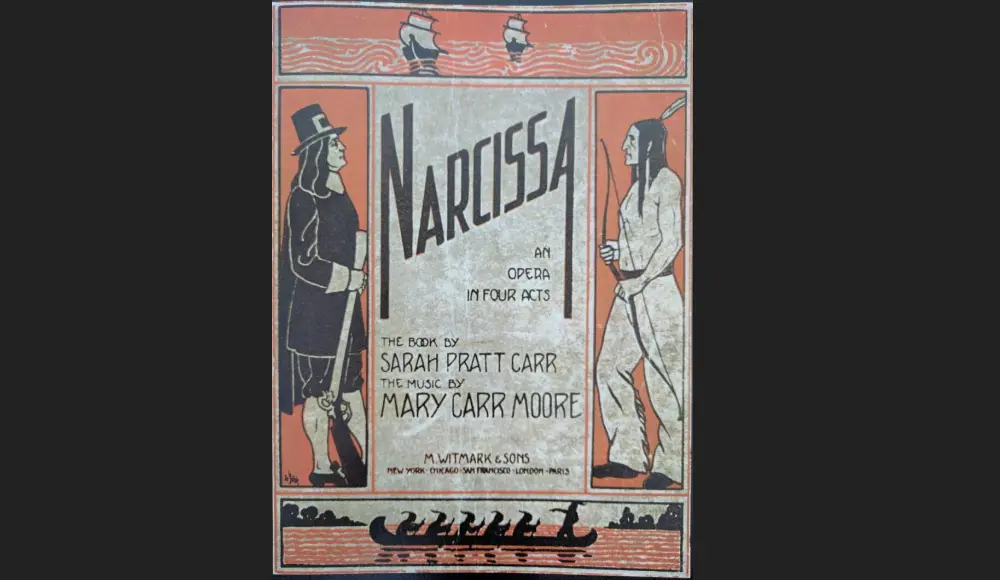

In the early 1900s composer Mary Carr Moore lived in Seattle. She and her mother Sarah Pratt Carr wrote an opera called The Cost of Empire. It was also given a second name: Narcissa. It was based on the story of missionaries Narcissa and Marcus Whitman and their life and death in the Walla Walla Valley.
Puccini’s 1907 opera, The Girl of the Golden West, had been performed in New York City on December 10, 1910. Critics praised the music but noted that very little “Golden West” could be found in Puccini’s libretto. The Metropolitan Opera offered a $5,000 prize to the American composer who wrote the best American opera based on an American historical theme. Composer Mary Carr Moore and her mother, a librettist, took up the challenge.
Heavy with Presbyterian significance, and offering lyrics based on Biblical passages, the opera’s lead roles were to be sung by a dramatic tenor (Marcus Whitman) and an equally dramatic soprano (Narcissa). Male Native characters were to be baritones, and a chorus performed throughout the four-act production.
Staged by the famous Seattle showman John Cort, the opera ran for 12 Seattle performances at the Moore Theatre in 1912. A cryptic hand-written note in a program from that time reads: the opera “was much appreciated but not a financial success.”
Narcissa failed to garner the Met’s prize, but it did win several other awards in 1930. Mary Carr Moore continued to compose (over 100 songs, 10 operas, and several orchestral and chamber works).
When Whitman College in 1947 planned a centennial anniversary of the so-called 1847 “Whitman Massacre” at Waiilatpu Mission, the college made inquiries about reviving Moore’s opera. An elderly Mary Carr Moore was located in Los Angeles. She was willing, but worried about doing the re-copying herself (original bound copies had been lost in a fire). She also warned that the score might present problems to an “unfamiliar conductor.” Further, Moore noted that she was suffering from “headaches” and noted the “expensive scenery” and “difficult” ensemble for the last act.
Eventually and regrettably the clock ran out, and Whitman College decided that the enterprise was too large to produce in the short time remaining.
Mary Carr Moore, though expressed in gentle prose, was apparently very disappointed. In perhaps her last letter to Whitman College on the subject, dated 3 November 1947, she hoped that a later opportunity would arise when the college or another institution would produce her opera. She also wrote plaintively that Narcissa had once made a “profound impression” on both audiences and critics, who, she observed, “as a rule do not take kindly to female American composers.”
Discover more from Post Alley
Subscribe to get the latest posts sent to your email.


Thanks for this Junius, and for your continuing wonderful pieces which are much appreciated. I have no idea where you are presently, but if in on your Seattle with delight and having a lunch, coffee or visit.