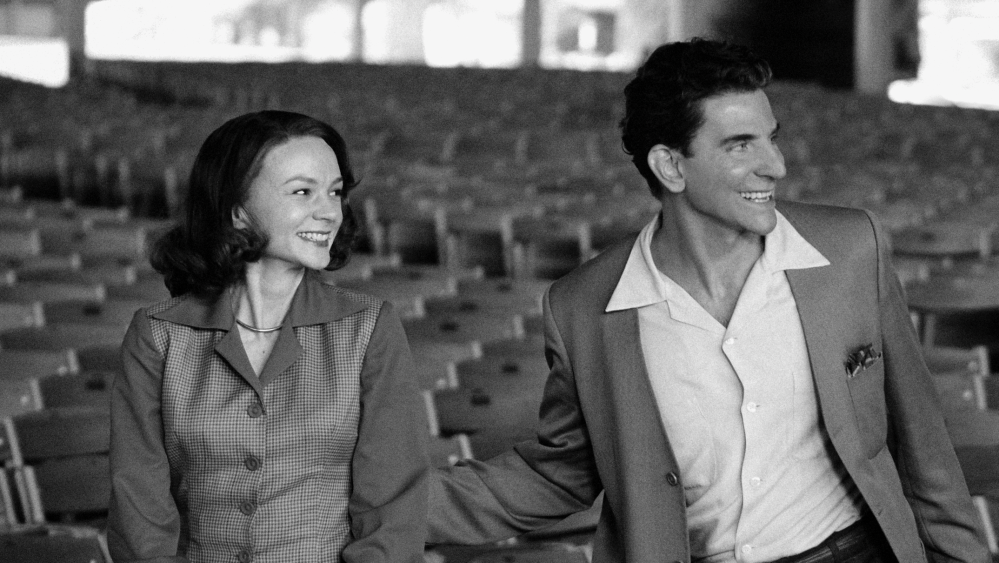

It’s a trap to review the movie a filmmaker didn’t make. A difficult temptation, as it turns out, with Bradley Cooper’s Maestro, the director/writer/actor’s passion project about Leonard Bernstein. Maestro isn’t really a movie about Leonard Bernstein or his career, or even about music per se. It’s not really a “biopic,” in the traditional Hollywood sense of the word.
In the absence of all this, Cooper has explained it’s really the story of a marriage between Lenny (as everyone called him), and Felicia Montealegre, the Broadway and TV actress, who were married from 1951 until her death from cancer in 1978.
Bernstein, of course, was the first American-born music director of the New York Philharmonic, the composer of West Side Story, the glamorous and charismatic music educator who captured the public imagination, and a high priest of the arts in the ’50s and ’60s when it seemed like the arts might aspirationally matter to the American public.
Even calling the movie Maestro is a bit of a head fake. The word “maestro,” once an honorific for conductors signifying their exalted status, has somewhat fallen into disuse in the classical music world. As the “lone genius” notion fades and the authoritarian style of the classic maestri goes out of fashion, the word is a lingering artifact of an art form that’s moving on.
Though Bernstein certainly fit the image of maestro in the popular imagination and was unquestionably the most famous American conductor of his day, he was oddly something of an artifact himself. Despite the early fame – that last-minute substitution conducting the Philharmonic that made him famous, and later writing the score for West Side Story, an unqualified Broadway hit — he grew to resent the West Side Story success, which followed him everywhere, eclipsing the more serious work he wanted to be known for.
Though he wrote a catalogue full of serious music, it never achieved the success of his Broadway work. He had been sure he would be the next Copland, the American Brahms; he feared he would be “merely” a Gershwin. While a celebrity conductor in America and in Europe, he was never music director of another major orchestra after the Phil, and maintained a busy guest-conducting schedule while being a strong political activist for causes he believed in – civil rights, nuclear disarmament, and AIDs research, among many more (an activist side of his life not mentioned in Maestro).
Maestro pays little more than lip service to Lenny’s extravagant career – the music and a parade of leading artists of the day make appearances as useful props, or maybe more like furniture needed to fill out the room. Figures like the conductor Serge Koussevitzky show up for half a second or so, often unreferenced by name, and their relationship to Bernstein largely unexplained. Betty Comden and Adoph Green perform at a random party, Copland and Jerome Robbins hang out in the background. And so on. More perplexingly, young “Tom,” a Lenny protégé shows up halfway through the film, an awkward and unexplained presence. Unexplained we get, and suggestive he is, but there’s nothing here to further explain Lenny’s enduring interest in having him around. Just another piece of furniture.
The scenes themselves are less events joined together into a story as they are wispy fragments woven into suggestive subtexts. The subtext is so diffuse however, that on some level, Cooper had to know he had a problem with finding a line through it all. At a couple of points in the film, everything halts while someone lists off Bernstein’s accomplishments to date, updating the resume as it were so the upcoming bits make sense. The first time, Felicia does it after the couple has just met; Cooper’s Bernstein listens as if she’s talking about a stranger, waving her off as if indifferent to the successes. Later, an interviewer updates the career as Bernstein looks on, similarly detached.
Maestro is clearly a labor of love for Cooper, and he has spent years on it, taking conducting lessons and being coached by Yannick Nezet-Seguin, music director of the Metropolitan Opera and the Philadelphia Orchestra. Cooper wrote and directed as well as acted, and he nails Bernstein’s essence, with the ever-present dangling cigarettes and the endlessly solipsistic musings. The Curtis Institute has an online archive of interview recordings with both Lenny and Felicia and you can hear the uncanny resemblance in the speech patterns.
Cooper’s neon portrayal of Bernstein is manically intense, and he affects a kind of demonic sneer at times (usually when engaging in making music) that suggests he’s communing with a greater force. His turn in front of the orchestra at a famous Ely Cathedral performance of Mahler is the only extended time we see/hear him in front of an orchestra, and it is so deliciously over the top it’s something of a caricature of the famously emotive maestro.
On the other hand, in a scene right at the end of the movie where he’s working with a student who’s emotively trying to direct an orchestra and can’t get the result he’s after, Bernstein deftly steps in front of the orchestra, underplays his gestures and nails the result on the first try. It explains so much about Bernstein’s approach – he was a kinetically flamboyant conductor, but in service to the performance he wanted to produce, even if it only took the smallest arm wave. This was controversial at the time — Bernstein’s gyrations were off-putting to traditionalists who thought them theatrical and self-indulgent. Of course, admiration turns to horror in the very next scene when Bernstein is shown making sexual moves on the young student to whom he had just given such an invaluable lesson.
But if reviewing the movie the filmmaker didn’t make is a trap, and if the maestro of the title isn’t Bernstein-the-conductor, surely it’s Bernstein-the-husband, and Maestro-the-marriage. And here, Cooper has cast the formidable Carey Mulligan as the self-assured Felicia. The two become immediate and enthusiastic soulmates, sitting back-to-back in the park, their intellectual bantering as meandering as the clouds in the sky.
Lenny and Felicia connect at such a rare and deeply intellectual, aesthetic and abstract level that their connection endures even when Felicia finally protests her husband’s extra-marital predilections. Family life is shown as a rich and stimulating foreground to Lenny’s and Felicia’s – herself a successful and accomplished actress — careers, a portrayal clearly taken from oldest Bernstein daughter Jamie’s memoir Famous Father Girl about her dad.
When Felicia finally rebels against Lenny after stumbling upon another of his many affairs, it’s more as an objection to a choice he’s made (and which she innately understands) rather than an anguished cry of betrayal. She is well aware of the demons driving his sexuality and regrets his giving in to them. Still, she can’t quite condemn his bad character. The most horrible thing she can think to say to him is that he’s at war with music, repealing their oft-repeated declaration that everything is about the music.
Later she attends the famous Mahler cathedral performance and, overcome as he exits the stage, apologizes for saying something so fundamentally mean. At the end, when she is diagnosed with cancer he is there for her because of course he is; their bond is elemental, and as she battles her cancer, they return to the park, sitting on the grass back-to-back engaging in the same flights of intellectual fancy that began their relationship. Full circle. Recapitulation.
In journalism there’s a designation for stories that are worthy and important and take resources – “the Pulitzer Story.” They are written to win prizes, and they’ve become easy to spot. Maestro is a deliberately arty movie. The first half is filmed in black and white; transitioning to color seems like such an obvious arty cliché it cries Oscar nominee. Cooper is extraordinary as Lenny, Mulligan easily his match, and they have great chemistry. But neither has won in their categories in the early awards shows. As Maestro hasn’t for Best Picture. I’m betting the Oscars are also a pass in a few weeks despite this project having all the classic winning ingredients.
There’s a fascinating story still to be told about Leonard Bernstein and his struggles with greatness, his deeply-conflicted identity, and an almost singular place in 20th Century cultural life. Alas, while Cooper’s Lenny and Mulligan’s Felicia are a worthy match, Maestro isn’t that story.
Discover more from Post Alley
Subscribe to get the latest posts sent to your email.


I admit I have not watched the movie, but the fact that it left out this seems like a criminal oversight to me. That Leonard Bernstein was the inspiration for Tom Wolfe’s coinage of the term “radical chic” seems more relevant than ever in this day and age, as polarized, educated, upscale progressives in blue bastions like Seattle imagine themselves as a new generation of Che Guevaras fighting valiantly against injustice with each new tweet or lawn sign.
And for those who have never read “Radical Chic: That Party at Lenny’s,” please do click the link. You’re in for a treat!
https://nymag.com/docs/07/05/070529radical_chic.pdf
Nope.
Sorry, Sandeep.
I’m as skeptical (or more so) than you are about the excesses of Wokism, especially in Seattle.
But this piece by Wolfe doesn’t wear well. His voice is as dated and precious as are his subjects’ and that’s not positive for either.
Sacrilege! I love that Wolfe piece, including the stylized prose. I read for the first time only recently, after watching Radical Wolfe, the recent Wolfe documentary (now available on Netflix), when it was screened at SIFF. “Radical Chic” gets a fair bit of play in Radical Wolfe. I do think the piece is so biting it verges close to the line of being needlessly mean — Bernstein’s daughter appears in the documentary to denounce Wolfe for harming her family by writing it — but I don’t believe Wolfe crossed that line because Bernstein’s towering, unconscious class pretension so richly deserved the skewering Wolfe gave it.
There’s a good review of Radical Wolfe here:
https://www.rogerebert.com/reviews/radical-wolfe-movie-review-2023
Wolfe’s article wasn’t about Bernstein but about Wolfe’s attempt to show off his own moral & intellectual superiority. Only somebody as pretentious as Wolfe could recognize Bernstein as a kindred spirit and natter on at such length.
As to Wolfe’s prose, yeah, I guess it could have a certain dated charm.
Thanks for the links.
Sandeep,
I just read the review and I guess the reviewer and I come to parallel conclusions:
”Radical Chic” was not about Bernstein but about Wolfe:
“Lewis also recalls how, as a kid, he pulled a Wolfe volume off his father’s shelf and was struck that the words he read seemed to explode off the page with a force of a singular personality: the author’s.“
I do hope you read this response since the PostAlley notification system is still broken. Alas! Great site with fantastic authors and yet a clunky, crude comment system — the heart of social media. Alas.
I liked the movie for all the complexities and pace. But I did miss another element of the Bernstein story: what a great teacher he was. I felt the movie caught well the American phenomenon, There are no second acts. It is a powerful saga depicting the way celebrity-ness ultimately drags down a great talent.
I, too, enjoyed the movie but would have liked more emphasis on Bernstein’s success in teaching young people about music. As an aside I submitted the accompanying blog piece that comments on that great skill.
Jean,
What’s the difference between the articles and the blog? I’m not sure I understand the Post Alley structure.
This is a great review, Doug! More please.
I just watched the movie and felt it was a thin bio of Bernstein and a vague portrait of the musical genius and a sexually unorthodox man. Carey Mulligan carried the performance.