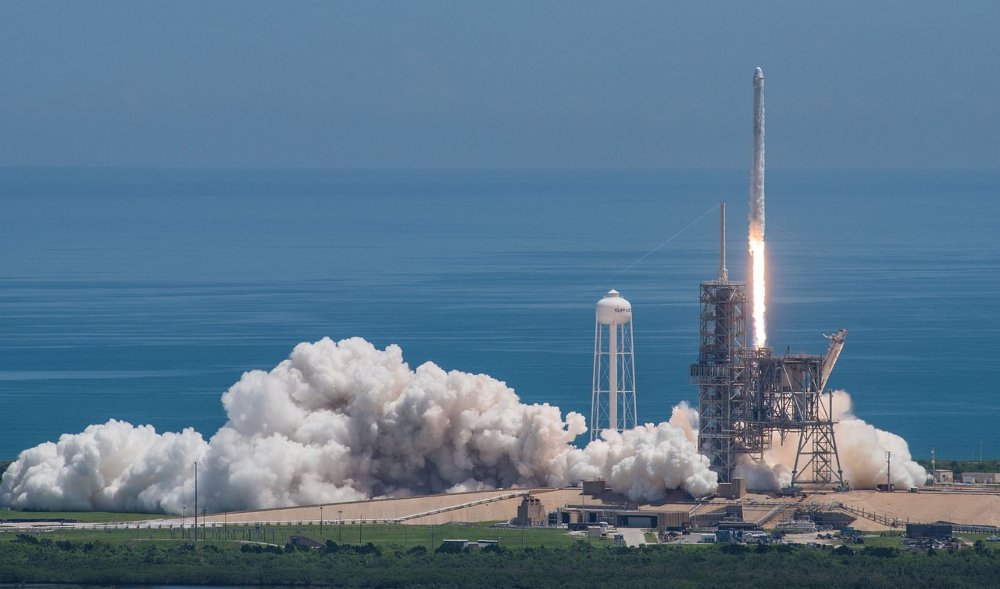

The first reviewers of the new Elon Musk book by Walter Isaacson (Elon Musk, Simon & Schuster, 615 pages, $35) are focused on Musk’s intervention in the Ukrainian war. At one point, he turned off the satellite-based internet service there to disable an attack on a Russian naval base by drone submarines from Ukraine. “No private citizen should be making such unilateral decisions about our national security,” writes Eugene Robinson of the Washington Post, who accuses Musk of trying to play “a superhero or a Bond villain.”

Elon Musk is no Bond villain. (Would a Bond villain try to prevent an attack on a nuclear power?) Nor is Musk just any private citizen. He is the creator of Starlink, the satellite system that provides internet service around the world. He has had more than 5000 satellites built — right here in Redmond — and had SpaceX, his rocket company, launch them into orbit. Maybe from the U.S. government’s point of view, it would have been better had the government launched those satellites. But would internet customers all over the world want their internet service to be under the control of the president of the United States? That might depend on who the president was.
All such arguments stir the pot for Elon Musk, the new book by the celebrated biographer Walter Isaacson. It’s a fabulous story. A quarter century ago, who would have thought that an immigrant from South Africa would become the world’s richest man? And he did it not by selling us cappuccinos or cheeseburgers, but by creating an electric-car company and a rockets-into-outer-space company.
Musk is a nerdy guy who grew up reading science fiction by Robert Heinlein and Isaac Asimov. His ultimate ambition, writes Isaacson, is to take “the fiction out of science fiction” by replacing petroleum-fueled transport, to make artificial intelligence safe, and to send humans to Mars.
Musk’s product most familiar to Seattle is Tesla — this area being one of the top markets in the nation for his iconic cars. A new car company is a rare thing. The last new American car company that survived to adulthood was Chrysler, founded 98 years ago. All later efforts — by Henry Kaiser in 1945, Preston Tucker in 1948, and John DeLorean in 1980 — didn’t make it. It was obvious to everyone that the door to the auto industry was shut. No one, starting from scratch, could break in.
If, to save the earth, we needed to have electric cars, the government would presumably have to command it. Essentially private citizen Musk has done that, and the old auto companies have been losing billions. Tesla is making money, and has been a hot stock on Wall Street. As I write, it has a market capitalization of $837 billion — 18 times that of General Motors. The stock market values Tesla stock at 76 times earnings. To this old business reporter, that’s a scary price — but then again, it’s Elon Musk.
His rocket company, SpaceX, has pushed aside the old suppliers that sold rockets to the government. SpaceX launches its own rockets and sells the transport service to whoever can pay. Musk’s company, Isaacson writes, was “not only privatizing space; it was upending its cost structure.” By designing rockets in a different mindset, and by making them reusable, it made space travel cheaper, which was one step toward going to Mars.
For his biography of Musk, Isaacson shadowed his subject for two years. He interviewed more than 120 sources. A biographer who does that much work will be tempted write too much copy, and at 615 pages, the book is too long. For a subject of such varied fields — from cars to rockets to robots to Musk’s serial loves and kids — the book’s chronological organization means that it jumps around.
But with all that, the book is an easy read. Isaacson tells a good story, and he strikes the right tone, respectful but honest. And Musk respected him enough to let him write his book and not demand to read it. Imagine a politician doing that.
One reviewer wrote that the most interesting part of the book is the last 200 pages, where Isaacson describes Musk’s takeover of Twitter. That was the part the author witnessed himself. It is also the wordiest part. The meat of the book is really about two things: Musk the man and Musk the industrial engineer.
Musk grew up in South Africa as a lonely nerd in a broken family. He claims to have Asperger’s syndrome, which impairs the ability to interact socially. As a child, he recalls, “I took people literally when they said something, and it was only by reading books that I began to learn that people did not always say what they really meant.” As an adult — he’s 52 — he’s blunt to the point that people often find him abrasive and callous. Raised to be self-reliant, he became, says Isaacson, “A visionary who didn’t play well with others.”
“Deference is not in his nature,” Isaacson writes. “He does not like to share power.” Innovators often don’t. Several times in the book Isaacson compares Musk with Steve Jobs, the cofounder of Apple Computer — and also a subject of an Isaacson biography. Musk and Jobs both appear as intense, focused and demanding leaders. Jobs, he writes, “set unrealistic deadlines, and when people balked, he would stare at them without blinking and say, ‘Don’t be afraid, you can do it.’” Musk also specializes in unrealistic deadlines. Judging from this book, working for him is either exhilarating or ego-crushing.
Steve Jobs famously combined engineering with design, personally intervening to make sure the Macintosh computer functioned as good as it looked, and vice versa. The difference with Musk, writes Isaacson, “is that Musk, unlike Jobs, applied that obsession not just to the design of a product but also to the underlying science, engineering, and manufacturing.” Jobs prowled the design studio but never visited his factories in China. Musk has spent countless hours prowling his assembly lines.
To survive, Tesla had to produce enough cars to become profitable. Forty years ago, John DeLorean tried with his gull-winged car immortalized in the Back to the Future movies. DeLorean produced about 9,000 cars before his company died. Before DeLorean there was Preston Tucker, the subject of the Francis Ford Coppola film, Tucker: The Man and His Dream. Tucker produced only 51 cars. Last year, Musk’s company produced 1.3 million Teslas.
By 2017, Tesla was making cars at the rate of 100,000 a year, which was not enough for it to stay alive. The company lost $2.2 billion that year, and it was headed for the corporate junkyard. To save Tesla, he had to at least double the rate of production to 5,000 cars a week, and do it quickly. That meant changing things on the assembly line — a lot of things. He did it by inspecting each operation and making changes.
One example: At one point, the car body was dipped in a bath of special paint. Along the bottom of the car body were small holes for the excess paint to drain out. When the paint dried, workers were covering the little holes with rubber patches — a process that was slowing down the line.
Musk asked: Who required these patches? He summoned the engineer responsible. “What the hell are these for?” he demanded. The engineer’s answer was that if the car got caught in a flood, the patches would keep the floor dry. “That’s insane,” Musk declared. The patches were out. (The book doesn’t say what happened to the engineer.)
Sometimes Musk would take out too many things and have to bring some of them back. His line was that if that didn’t happen at least 10 percent of the time, he hadn’t taken enough things out.
Musk developed a set of rules for efficient production: Question every every step that’s required. If its value isn’t obvious, get rid of it. Simplify what’s left, Speed up things that are too slow. Only after you do this, consider more automation. At Tesla, Musk discovered that he had installed too many robots. The machines were too stupid to do some of the work efficiently. He began ripping out robots and replacing them with human beings.
By doing such things, Musk was able to increase the production of the Model 3 to 5000 a week — and put the company in the black. Judging from this book, it was a heroic effort.
Regarding Twitter, readers may disagree whether Musk’s takeover was a case of heroism or damfoolishness. Musk took it over because he said it was censoring “hate speech” in a politically biased way, undercutting the role the company should play. But Twitter cannot be run with no rules, like a wall of graffiti. Like a newspaper, it needs to have standards of civil behavior — but unlike a newspaper, it is not written by employees under the control of management. Its rules will be looser than a newspaper’s, but what should they be? By Isaacson’s account, Musk took over Twitter without having the answer.
He did have an idea of how he wanted the company run. Isaacson describes Musk’s regime at Twitter as being “one of the greatest shifts in corporate culture ever,” from a culture of warm-fuzziness and “psychological safety” to a “scrappy, hard-driven environment.”
There remains the thought that Elon Musk may be a notable innovator, but he controls more wealth than any one person should be allowed. In a capitalist world, great wealth comes from starting and growing companies. It’s how Bill Gates and Jeff Bezos became billionaires; a century ago, it’s how Henry Ford did it. People who do that have several choices. They can stay at the helm and commit to the hard work of keeping their company on top. Or they can sell out and go play. Or they can double down and risk their capital again — and again, and again, which Musk has done.
Isaacson ends his book with the thought that our world needs people like Musk in order to move forward. In industry, as elsewhere, change doesn’t happen by itself.
Discover more from Post Alley
Subscribe to get the latest posts sent to your email.

Using the car in a flood is not a good example.
Bbut cars do drive-through intense rainstorms, and the bottom of the car does get wet etc. etc.
So I’m not sure I understand that anecdote makes sense technically. You do have to make sure that splash upward to the floor of a car is an issue.
Of course, maybe there are better ways to solve that problem that little patches…