

Every religion has its place of beginnings. At Mt. Sinai, Moses received the Law. Jesus was crucified and transfigured in Jerusalem where, later, Mohammed ascended to Heaven on his horse. Buddhists visit Bodh Gaya in India where Siddhartha Gautama gained enlightenment. Closer to home is the Little Mountain in Burien.
In its newly annexed northern neighborhoods, the City of Burien has acquired a remarkable site celebrated in native Puget Sound mythology. In the 1920s, a Puyallup man, Ste AH bahl, also known as Tom Milroy, narrated several myths to Arthur Ballard, an enthnographer who grew up in the town of Auburn at the turn of the 20th century. Milroy’s stories were set in the Myth Time, “when animals were people,” and they tell about the Elip Tilikum, the “First People,” a race of giants whose actions defined a pre-human mythic world. These First People are analogous to the Titans of Greek myth whose huge bones sometimes eroded out of cliffs.
Milroy recounted: “Water covered the country. It washed away the country. Many people were drifting about… Muskrat was on a stick, very sad.” Their world had been drowned in a great flood. “The little birds, Beaver, Land-otter, and the fishes, all the people, wished to get land from below.” This world had been preceded by two eras destroyed by fire and by disease. Now the third world had been drowned. “Beaver went down [below the flood]. He could not get land.” Birds fly in the sky, fishes swim in the sea, but landed folk like Beaver and Land Otter looked to little Muskrat to save them. “You try: if you find land below, you get it.”
“Very well” said Muskrat, and down he went. He brought up mud in a skin. “Now! He gets the land. He brings the land up and puts it on a raft.” In this way the fourth world began on Muskrat’s raft, becoming Muskrat’s Island.
Like the creation stories in Genesis, events are loosely joined. Another Puyallup man, Wee lah KAY deeb, a.k.a. Joe Young, narrated a myth to Ballard in which part of Muskrat’s Island is given a name: SBAH bah teel, “Little Mountain.” On it lived the Ancients who made the four divisions of the world. The Ancients were the winds.
You can visit this place. Located on the west side of the Duwamish River, the best way to get there is to take I-5 to the South Boeing Access Road and head west to where it turns south as two streets, East Marginal Way and Pacific Highway South. Turn left on Pacific Highway South that turns into Tukwila International Boulevard, cross the Duwamish River and, passing under State Route 99, head up its valley wall on South 116th Way. Turn right on 26th Avenue South. This will eventually dead end, passing small, comfortable houses 50 feet above the Duwamish where it is actually a river.
Travel to the end of the road, west above a riverbend, and you stand on the Little Mountain with 99 roaring below you. In winter you can see through bare tree limbs up the river and lowland to the snowy mountains beneath an often moody sky, one of the better views to be had in these parts.
SPAH bah teel identifies a specific place on Muskrat’s Island. Young said it was the home of North Wind who, after the divisions of the world, “controlled everything.” North Wind’s frigid reign is the subject of several myths about battling Winds in which three are mentioned: Rain Wind, North Wind, and Storm Wind. Their conflict produced Seattle’s wind-tossed weather regime.
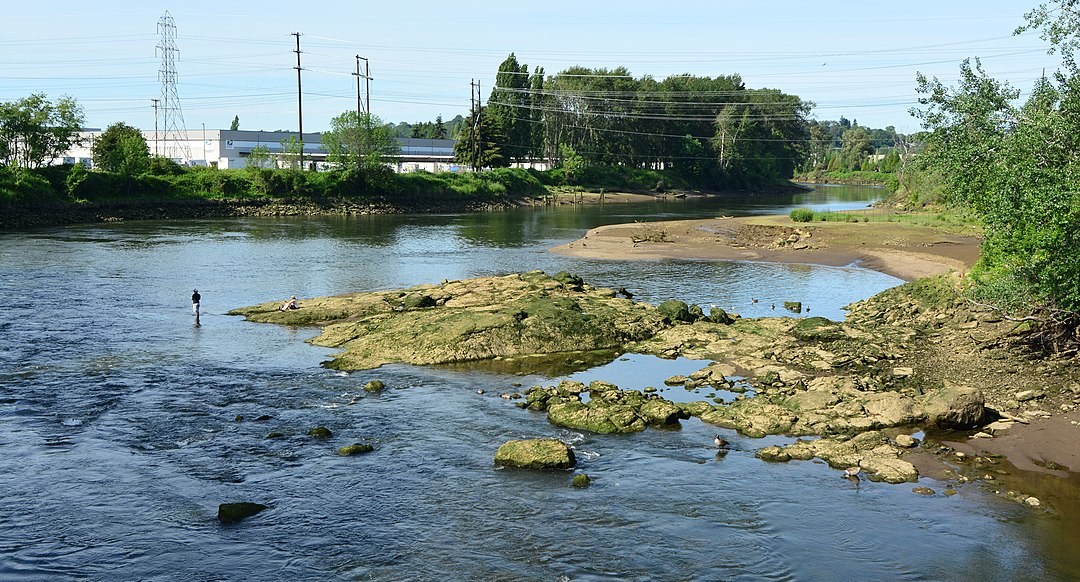
At low tide, an eroded stone shelf is visible in the river from the Little Mountain, reaching from the east bank of the Duwamish to mid-stream. It is what remains of North Wind’s Fish Weir, accessible from I-5 by S. 112th Street, or from West Marginal Way on 27th S. that ends at a parking lot where a foot bridge crosses the river. Here at the foot of the Little Mountain stood North Wind’s village.
Ballard collected seven versions of the myth Northwind and Stormwind from several informants. In them, Rain Wind marries North Wind’s daughter, but North Wind’s people do not like Rain Wind. They kill him and all his people except Rain Wind’s mother who hides on a rocky hill south of North Wind’s village. Rain Wind’s mother has the power to bring spring rain, but to prevent this North Wind directed Raven to roost over her hut and defecate on her face, defiling her so she could not exercise her power. North Wind froze the world and built a fish weir of ice to keep salmon from migrating upstream.
In North Wind’s village his daughter gave birth to Rain Wind’s son, and as the boy grew up, he was warned never to visit a stony hill south of the village. Eventually he climbed it and discovered a beshat old woman inside a hut filled with her woven baskets. She was Sqwu-LAHTS, “Dirty Face,” his grandmother, and she told him how North Wind had killed his real father, Rain Wind, and all his people except her. His name, she told her grandson, was Skah CHAH-lah-chee: Storm Wind, “The Wind that Tears Up the Trees.” The two plotted revenge, and before leaving, he tenderly washed her face so her power could return.
Back in the village, Storm Wind demonstrated new-found strength by casually flipping downed trees over the ice weir with his foot. Fearing that the boy had learned his identity, North Wind tried to buy him off with another daughter (Storm Wind’s maternal aunt, in defiance of marriage tabus), dressing her in beautiful icy bridal ornaments. But when she approached, Storm Wind’s increasing warmth melted her finery.
North Wind attacked Storm Wind, and as the two fought, Grandmother called the rain and poured it from her baskets — mist from waterproof baskets, downpours from storage baskets and torrents from those of open weave. The flood washed away the ice fish weir, and Storm Wind drove North Wind away. But Storm Wind’s maternal grandfather North Wind was not killed but allowed to visit relatives for a short time every year. Thus, winter.
The mythic world ended in a Northwestern Götterdämmerung when the Transformer, DOQ we bahl, turned the First People into wild animals, forces of nature, or stones. As a result, the mythical fourth world is replaced by the fifth world, the human world. Rain Wind comes in November and sends humans indoors for shelter. Frigid North Wind (who has him killed) spills from the Fraser River canyon and causes winter temperatures on Puget Sound to plummet. The Grandmother became a rocky hill upstream from the fish weir, obliterated by 20th century quarrying.
Before its destruction, the hill’s eastern face rising sheer from the river was streaked with dark mineral stains. North Wind’s daughter–Storm Wind’s mother–became a stony hillock crossed by the South Boeing Access Road. The other daughter became a white boulder buried under Highway 99’s fill, and North Wind’s village became the Little Mountain. Storm Wind is the warm spring wind, the “Pineapple Express,” bringing the rain that thaws the land and causes rivers to rise and send their signal to salmon in the Pacific calling them home to spawn.
Muskrat’s Island recalls the last pulse of the Ice Age when the lowland was overridden by the Puget Lobe of the great Cordilleran Ice Sheet covering northwestern North America. Advancing south, it buried Seattle under 3,000 feet of ice and reached a point 12 miles beyond Olympia. There, warmer temperatures brought it to a halt 13,000 years ago. Continued global warming thinned the lobe, and it gradually disintegrated. Meltwater filled a growing recessional lake.
Human beings were present at the time and followed the ice northward in paleolithic hunter-gatherer bands. About 12,500 years ago the lobe’s western edge opened onto the Juan de Fuca Trough allowing lake water to escape and the Pacific to flood deep channels, creating ancestral Puget Sound. A long section of lakebed reaching from Seattle’s Duwamish Head to Edgewood near Tacoma surfaced as a large, flat-topped island—Muskrat’s Island. Other myths describe how it grew.
Tom Milroy, who passed on the accounts, adds in another myth, “How The Whales Reached The Sea,” that east of the island was “all saltwater.” Over time, rivers pouring from the Cascades deposited sediments creating the forerunner of what became the floodplain of the Duwamish, Green, Stuck, and Puyallup Rivers. Muskrat’s Island existed more than 12,000 years ago before the floodplain developed.
The process accelerated around 5,600 years ago when Mt. Rainier’s summit collapsed, and an immense avalanche of rubble, the Oceola Lahar or mudflow, reached the Island. Other lahars and river sedimentation eventually displaced the sea creating the modern flood plain. In local myths, the transformation of sea to swamp to dry land images the growth of Muskrat’s island and the emergence of the Puget lowland. Geologically and mythologically, the appearance of the island can be traced back to the end of the ice age.
The concentration of myth sites at this point on the Duwamish River was spiritually important to nearby native groups. In wintertime, Duwamish women came in canoes with baskets of water to wash the face of Grandmother’s Hill, repeating Storm Wind’s act of restoring her power. At North Wind’s village, boys swung bull-roarers around their heads, the spinning cedar blades painted black on one side, recalling Storm Wind’s cleansing action and his rushing, reassuring voice. It seems odd calling for rain in Seattle’s sodden, chilly winter, but without spring floods salmon will not pick up their home river’s chemical signature and return. The earlier they return, the earlier their robes of flesh are offered to humanity.
History has treated this mythic sanctuary with destructive indifference. Invading Euro-Americans regarded native religion as devil worship, and if a few settlers were fascinated, most regarded it and its sacred association with landmarks obstacles on the road to progress. The land had value only if it could be developed. Forests were axed down for lumber, soil broken for farming, earth ransacked for coal and minerals, rivers fished out, and native people hustled onto reservations to get them out of the way.
Because the Duwamish watershed proved to be the most valuable land in the Puget basin, the Duwamish people received no reservation in its lower part as other groups had on theirs. Chief Seattle told Territorial Governor Isaac Stevens that if the old chief were to sign the treaty relinquishing most of his Duwamish people’s land, they must be treated with justice and kindness and retain access to their traditional burial grounds.
Seattle signed the treaty, but since then virtually all of the Duwamish burial grounds and the myth sites central to their culture have been destroyed. Since then, the Duwamish have become exiles in their own country. Since then, settlers and their descendants have gotten rich selling and developing their land. For a century the federal government has refused to recognize them as a tribe, citing a chronological technicality. Local officials including Seattle’s Mayor Jenny Durkan, have refused to hear Tribal Chairwoman Cecil Hanson make a case for municipal support of their efforts to gain recognition. Quarrying destroyed Grandmother’s hill, North Wind’s daughters are buried under fill or plowed through by highway construction. Duwamish women no longer have a hill to wash and Duwamish boys no longer make bull-roarers — at least not yet.
I often visit North Wind’s Fish Weir, and in the 1980s saw Port of Seattle machinery parked, ready to dredge it out of existence. A call to the King County Heritage people got that stopped, but by then most of the 40 to 50 myth sites I had documented and whose details I had published had been destroyed. When asked how the County planned to protect what remained, the person I talked to said he was not paid enough to care. Those surviving sites can be counted on the fingers of one hand.
Continued prodding led to the creation of North Wind’s Fish Weir Park where the myths are commemorated with handsome native art pieces. And even though the Little Mountain has been terraced for streets and built on, it survives. Mythically it is four times older than the Pyramids or Stonehenge.
I am aware of no other myth site anywhere on earth that, like the Little Mountain, can be directly connected via oral literature to the ice age. Its memory was treasured because the changes it recalled were those that welcomed the first human beings to a region that became their home. Unmarked and uncared for, this sanctuary optimistically celebrates human survival. Right there in Burien.
Discover more from Post Alley
Subscribe to get the latest posts sent to your email.