
When Seattle writer Evelyn Iritani began researching her new book, a screenwriter warned her that the story would be a hard sell. Safe Passage (Farrar, Straus and Giroux, $33) is about the history of the exchange during World War II of civilians between the United States and Japan. In that story, neither government acted in a strictly moral way. “There is no one for the reader to root for or against,” the screenwriter said.

No government, maybe. But this book is more about people. Americans can cheer for their countrymen to come home, even if not all the Americans are going the same direction, and not all are volunteers.
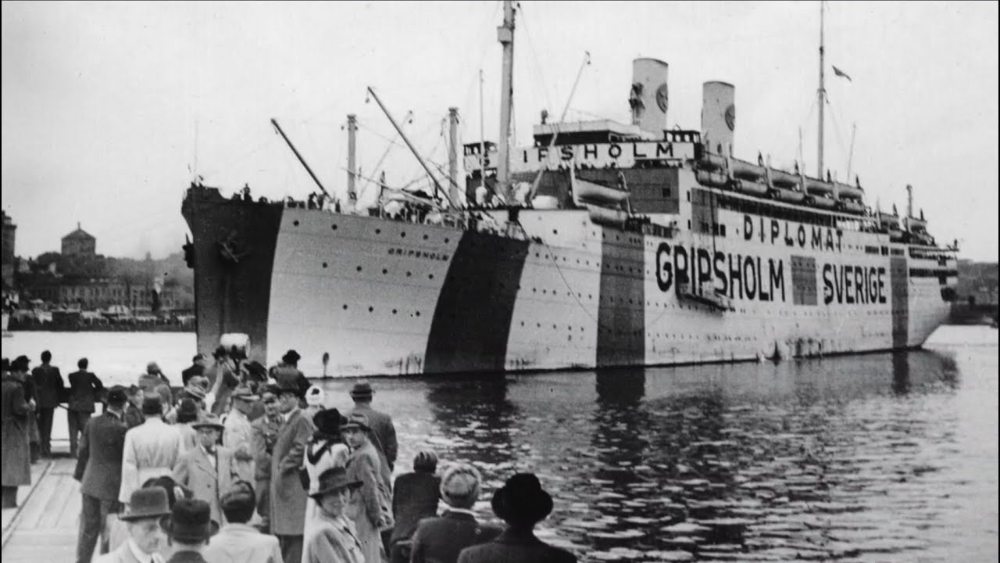
The U.S. and Japan made two big exchanges of civilians during the war. The first, in June 1942, was easier: Japanese diplomats for American diplomats, and a few others. Safe Passage is about the second exchange, in late 1943, when the ships MS Gripsholm and the Teia Maru met in Portuguese Goa, a territory on the eastern coast of India.
To make a one-for-one exchange with Japan, the State Department needed 1,500 people, but it didn’t have that many. To fill the ship, the United States used Japanese that had been rounded up indiscriminately by governments in Latin America. Many of them spoke only Spanish, and had no desire to be repatriated to Japan.
Japan’s ship, the Teia Maru, stopped in the conquered ports of Shanghai, Hong Kong, Manila, Saigon, and Singapore to pick up gaijin and gweilo businessmen, teachers, journalists, and Christian missionaries. These were Americans and Canadians who had chosen to live in Asia for various and personal reasons. On the Teia Maru, they slept on straw mattresses, drank rationed water, and ate rice peppered with cooked maggots. For most of them, it was better than the indignities of prison.
In Safe Passage, Evelyn Iritani tells the story through the eyes of a few individuals. Don Hasuike of Burbank, California was the son of a leader in the Japanese community. His father, who had built up a business, had been in America for 20 years, but the Immigration Act of 1924 did not allow him to become a citizen. On the day of the attack on Pearl Harbor, the FBI came to his home and arrested him as an enemy alien. Fourteen-year-old Don, his sisters and mother (all U.S.-born citizens) were interned several months later under Franklin Roosevelt’s Executive Order 9066. When the government selected Don’s father to be exchanged to Japan, his mother agreed for the rest of the family to go with him. It would keep the family together. Don didn’t want to go; he was in the Boy Scouts, he played baseball and he spoke English. But he was a kid, and he had to go.
Iritani tells the stories of several Americans stuck in the Japanese empire. They were extraordinary people. Daniel Brook McKinnon had been educated at Harvard. Seeking an unconventional life, he had moved to Japan in 1914 and married a Japanese woman. McKinnon, like Don Hasuike’s father in Los Angeles, was taken into custody on the day after Pearl Harbor and accused of being a spy. In prison he was starved. Some of his teeth were knocked out. Two years into the war, he and his Eurasian son — but not his Japanese wife — were traded to America on the Teia Maru.
Iritani is a skilled storyteller, and she knows the history of Japanese in America. Like Don Hasuike, she was the child of a second-generation Nisei and an immigrant from Japan. Unlike Hasuike, her parents lived in Colorado during the war, and were not subject to the internment, which applied only to the West Coast. Several decades after the war, her father, Willy Masao Iritani, was appointed a professor of horticulture at Washington State University, where he became a world authority on the potato.
Evelyn graduated from the University of Washington in 1978 and became a newspaper reporter. In the 1980s and early 1990s, she and I were colleagues at the Seattle Post-Intelligencer, where she specialized in stories about the connections between the Pacific Northwest and Asia.
It was while doing one such story that she met Daniel McKinnon’s son, Richard McKinnon, a professor of history at the University of Washington. She learned the story of the wartime exchanges from him. Years later, after retiring from the Los Angeles Times, her conversations with McKinnon became the seed of Safe Passage, which took her 10 years to research and write.
Iritani learned Don Hasuike’s story by talking to him as an old man. She learned the story of Emily Hahn, a journalist in Hong Kong, from Hahn’s books, her writing for the New Yorker, and from her daughters. Hahn is the book’s most fascinating character. Like Daniel McKinnon, Hahn was a rebel who left America to escape from conventional rules. In prewar Shanghai, she became the concubine of a Chinese poet, lived with a pet gibbon, and held parties that at one time included Mao Zedong.
When Japan invaded China, she moved to British-ruled Hong Kong, where she scandalized the British gentry by having a child with one of their intelligence officers who was married to someone else. The Japanese let Hahn and her daughter leave on the Teia Maru. The father had to stay. They accused him of being a spy, which in that case was true.
Not everyone in Safe Passage is as colorful as this. The book has several chapters on the State Department official, James Keeley, who headed the U.S. effort to make the exchange; Keeley was a bureaucrat, not an adventurer. But he had a fabulous job, security officers at the Pentagon, lawyers at the Justice Department, a stuffed-shirt boss at the State Department and, through intermediaries, Japanese negotiators wary that he was lying — which he sometimes was. Keeley got the job done.
It’s part of a good story, well-told.
Discover more from Post Alley
Subscribe to get the latest posts sent to your email.