
As President Donald Trump searches for an exit from the war in Iran that he initiated, his abandonment of Ukraine to a grinding Russian invasion has shaken Gulf allies’ confidence that the United States will be around much longer to defend them from Iranian retaliation.
Three heretofore U.S. allies—Saudi Arabia, Qatar and the United Arab Emirates—have pivoted to Ukraine for new security and defense cooperation deals that will provide them with state-of-the-art “drone killers” to take down Iran’s Shahed drones now blasting the Gulf region.
Iranian-built and Russian-enhanced Shahed drones have been fired on Ukraine for more than four years as Russian President Vladimir Putin presses his campaign to conquer the former Soviet republic. Nightly barrages of Shahed drones have provided Ukrainian technicians with vast quantities of drone wreckage that they have autopsied and developed counter-engineering for shooting them down before they hit their targets.
The security agreements signed by Ukrainian President Volodymyr Zelensky with Gulf leaders over the past week reflect Ukraine’s evolution from victim of Russia’s staggering war to influential strategist and defensive weapons provider to U.S. allies being targeted in the widening war ravaging the Middle East.
Trump lifted sanctions on Russian oil sales just days after launching the Iran war that has virtually shut down oil exports through the Strait of Hormuz as Iran has threatened attacks on tankers transiting the narrow passage out of the Gulf.
Russia earned an additional 672 million euros ($777 million) from oil sales during the first two weeks of the Iran war, the Centre for Research on Energy and Clean Air reported. Due to the worldwide shortage caused by the blockage at the Strait, the price of a barrel of oil that Russia can charge has shot up from $60 before the Iran war to $90.
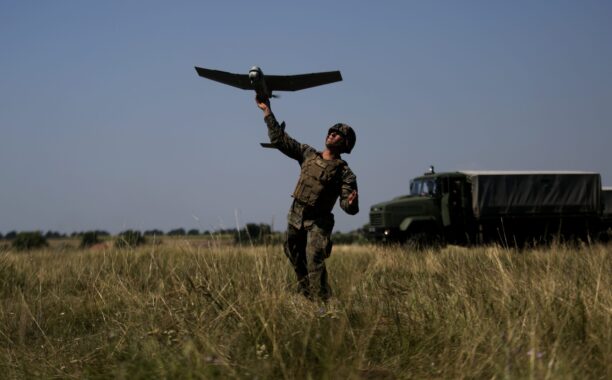
Ukraine has become one of the world’s leading producers of sophisticated drones designed to intercept and destroy the unmanned aerial weapons produced by Iran and marketed to ongoing wars.
Zelensky took his country’s newly acquired expertise in drone technology and operational strategy on tour last week through the Gulf region, where countries with close ties to the United States and U.S. military troops and defenses on their territory have been targeted by Iran since Trump launched his war on Feb. 28.
Ukraine’s survival through four-plus years of unrelenting attacks from Russia is owed to its military and technological resilience as the fighting to preserve Ukraine’s independence has shifted from casualty-heavy frontline combat to aerial assaults with cheap unmanned drones.
Since his return to the White House 15 months ago, Trump has executed an about-face on U.S. policy in Ukraine, scrapping the aid provided to the Kyiv government by the previous administration and other leading democratic states and institutions.
Trump spent his first year in office flogging so-called “peace proposals” that favored Putin’s goal of seizing and annexing Ukraine. Trump also hosted Putin to a red-carpet summit in Alaska in August at which the Kremlin leader rejected the latest peace plan that didn’t satisfy his maximal demands.
Despite Zelensky’s offer to Trump of sophisticated drone weaponry for use in his war against Iran and the same Shahed drones being rained on U.S. assets and Gulf allies for the past month, Trump dismissed the idea. He insisted U.S. engineers know “more about drones than anybody” and said Zelensky was “the last person we need help from.”
The Ukrainian president instead turned to the wealthy Gulf states under attack by Iran. The defense and security cooperation deals signed with Saudi Arabia and Qatar, and pending final signatures with the Emirates, provide for production and strategy-sharing for deployment of Ukraine’s cutting-edge drone interception technology.
Technical details have been sparse since Zelensky disclosed the Gulf security pacts in a Zoom call with journalists over the weekend. He emphasized that these were more than sales contracts, that Ukraine aspired to be partners in enhancing regional security.
“Countries in the Middle East have reached out to us, asking to share our expertise in intercepting Iranian Shahed drones during massive strikes. That is why we have already sent expert teams to three countries. We are ready to help,” Zelensky told reporters on the call. “Everybody understands that no other country than Ukraine can help with its expertise…We are sharing our experience, and they are thankful to us.”
“We want systemic relationships, where exporters earn revenue and Ukraine receives sufficient funds to invest in domestic production.”
He criticized Trump’s lifting of oil sanctions on Russia, pointing out that Putin will use the windfall earnings to continue sharing satellite intelligence with Iran on the location of U.S. armaments and troops in the region. He noted that while he was in Saudi Arabia earlier in the week that the Prince Sultan Air Base in the kingdom was attacked with Iranian drones and missiles shortly after Russia’s satellite surveillance had provided Iran with the location. The attack on Friday injured 12 U.S. military personnel at the base, two of them seriously.
Kyiv dispatched more than 200 air defense experts to the Gulf region but is not planning to send Ukrainian troops, Zelensky said.
Trump said he lifted the restraints on Russia’s oil deliveries to ease the global shortage and gasoline price spikes resulting from Iran’s blockage of tanker traffic through the Strait of Hormuz. By virtue of its high ground above the choke point between the Persian Gulf and the Red Sea, Iran has de facto control of the Strait through which 20% of global oil exports must pass.
While relatively distant from the Gulf region and not directly involved in the Iran war, Ukraine faces grave risks from the U.S.-Israeli offensive that has distracted Western diplomats from the challenge of aiding Ukraine.
Russia’s newfound freedom to sell oil in a desperately short global market allows the Kremlin to replenish its treasury depleted by four years of reckless spending on the Ukraine war. The United States, Israel and Mideast countries are also burning through their missile stockpiles.
The talks between Zelensky and the predominantly Sunni Arab states included discussion of the financial aspects of the cooperation that could help Ukraine weather the delay of a 90-billion-euro ($103 billion) loan from the European Union blocked by Hungary. Hungarian Prime Minister Viktor Orban, like Trump, has sided with the Russian aggressors in the Ukraine conflict and used his EU-member veto power to scuttle disbursement of the loan.
Russia’s economy has suffered tremendously since Putin launched his Ukraine war on Feb. 24, 2022, and incurred withering sanctions on its vital oil and gas exports.
One sign of the dire straits Putin faces after prioritizing a fruitless quest to conquer Ukraine was a reported appeal by the Kremlin leader for donations from his billionaire business cronies. Kremlin spokesman Dmitry Peskov denied that the “request” to the oligarchs came from Putin, rather from one of the billionaires present at the meeting who suggested voluntary $1.5 billion-plus gifts to the war effort.
Since Russian oil tanker refueling has revved up after the lifting of sanctions two weeks ago, Ukraine has inflicted further damage on the global oil supply by attacking key Russian export facilities on the Baltic Sea. Ukrainian drones also struck an oil refinery in Yaroslavl, northeast of Moscow, over the weekend.
Trump has continued to depart from the democratic world’s shunning of Russia for provoking the war in Ukraine, the worst fighting on the European continent since World War II. Last week an invited delegation of sanctioned Russian lawmakers visited Washington and met with Trump acolytes in Congress for talks on the Ukraine war and resumption of U.S.-Russian business opportunities, including restoring direct commercial air travel between the two countries.
The gathering was hosted by far-right Florida Republican U.S. Rep. Ana Paulina Luna, who told journalists it was important for the two largest nuclear forces in the world to maintain open dialogue.
The Russian guests rarely permitted U.S. entry agreed.
“We talked about restarting student exchanges. We also discussed the full return of our athletes to the Olympic Games” in Los Angeles in Summer 2028, Russian State Duma member Svetlana Zhurova told journalists, The Moscow Times reported after Thursday’s meetings.
“I wouldn’t say everyone on the other (U.S.) side was pleased with what we’re doing as a country, but they expressed their position and are nevertheless open to dialogue.”
Rep. Joe Wilson (R-N.C.), a staunch supporter of Ukraine in its battle to retain its independence, was quoted by The Hill as likening the Russian delegation to “having visitors of the Third Reich.”
Discover more from Post Alley
Subscribe to get the latest posts sent to your email.