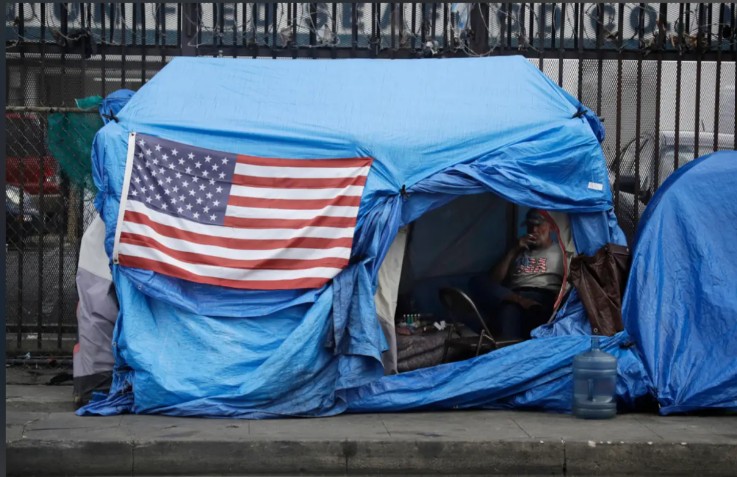

From late 2025 to early 2026, the term “America’s kill line” was all the rage in China’s media, social or official.
A keyword search of “America’s kill line” in Baidu, China’s equivalent of Google, would bring you headlines like these:
“How terrible is America’s kill line?”
“40% Americans can’t come up with $400. Kill line exposes fragile American capitalism.”
“U.S. kill line in stark contrast to China’s supportive policies.”
“U.S. kill line mirrors rising Chinese disenchantment with America.”
What was going on?
“Kill line” is a term in Chinese gaming where a combatant is so vulnerable that it is one punch away from death. As The Economist reported in its piece “China obsesses over America’s ‘kill line,’” a biology student from China studying in Seattle first adopted the term in describing American poverty in his Chinese video blog Bilibili. With a username Lao A, the student claimed to have worked in a morgue with bodies of the homeless frozen to death.
According to Baidu-pedia, “America’s kill line” has the following definition:
“This term has been extended to describe the living conditions of ordinary Americans, referring to the precarious financial situation of many Americans who have little left after deducting essential expenses. If they encounter unexpected events such as accidents, illness, or unemployment, their financial situation will fall below a critical threshold, overwhelming them with high living costs and debt, and ‘forcing’ them into homelessness.”
There were various stories told of middle-class Americans falling into abject poverty with one blow in life. A typical one from a Baidu search ran like this:
A 35-year-old engineer worked in a Silicon Valley company that had a contract with Elon Musk’s Mars project, earning $500,000 a year, with $800,000 worth stock options. He lived with his wife, a part time illustrator, and their young daughter, who went to a private school, in a $2 million home in San Francisco. They had company provided health insurance, with an $8,000 deductible and a maximum out-of-pocket limit of $12,000.
A family vacation in Yellowstone, however, changed everything.
Steering frantically to avoid a bear suddenly appearing onto the road from the bushes, our engineer crashed his Tesla S into a ditch. The accident led to the surgery of one of his legs with fractured bones, stitches on forehead of the wife, not to say ambulance, hospitalization, therapy, etc., with fees totaling $30,000 out of pocket. The insurance wouldn’t cover out-of-network service, an accident with wildlife, screws put in the leg, or extra rehab sessions.
Our engineer was then sued by Yellowstone for injuring endangered species out of negligence, he had to pay thousands of dollars in lawyer fees and fines.
After taking two months off for sick leave and the court case, the engineer got laid off, with a three-month severance pay minus taxes. The mortgage, daughter’s tuition, car loan, and Cobra premium in thousands of dollars a month, however, didn’t let up. What gave the engineer some comfort was his $800,000 worth of the company stocks, until the news came that Musk was delaying his Mars mission indefinitely. Within three days, the company stocks lost 90% of its value, and his own stock options shrank to $80,000. With the stocks falling below liquidation level, he was advised to sell or to be forced to sell. He had spent $45 on each share, now he sold at $4. In the end, he got $70,000 back.
Dragging his limp leg, the former engineer started to look for a job. 200 resumes were sent out, most without a response. The few interviews ended with HRs doubting his ability to perform with a bad leg or to catch up on new technology at 35. Meanwhile, the wife became addicted to controlled painkillers because of neck and back pains from the crash, spending whatever money available on those painkillers as well as more time with other addicts than at home. The couple began to fight, which led to a visit by children’s welfare agency. Based on their financial situation, one parent’s drug use, the court sent the daughter to a foster family. The wife disappeared.
The final nail in the coffin came when the bank auctioned off their home because of their failure to pay mortgage for three months. With loans and fees paid off and nothing left, the unemployed engineer moved into a motel but ran out of money two weeks later. Nowhere else to go, he moved into the tent camp in San Francisco. All in all, it took 180 days for a once proud tech worker, husband, and father to become homeless.
At the recent World Economic Forum, a Chinese reporter asked Treasury Secretary Scott Bessent about America’s kill line as well as ALICE in America: Asset-Limited, Income-Constrained, Employed. In his response, Bessent attributed the problems to the Biden administration and defended the record of the first and the current Trump administration in bringing down the cost for working Americans.
When touting the Trump Accounts, the $1,000 per American child government investment program, however, Secretary Bessent did admit to the financial difficulties of Americans. “Many Americans couldn’t even handle a $500 emergency,” he said, and “maybe people just put it away and it’s a rainy-day fund… it can be a component” of a bigger purchase or investment.
Along with kill line and ALICE, Chinese netizens also learned about America’s K-shaped economy, where some are thriving while others struggle or decline. To better describe it, Trump’s former chief economic advisor Gary Cohn said, “… we’ve got an interesting economy,” “We have a massive wealth effect at the top end, and we have got hardworking Americans having a very difficult time paying their bills, and they are suffering in this economy.”
Newsweek joined in with its piece “America’s ‘Death Line’ Goes Viral in China,” with a familiar set of numbers, “Roughly 67 percent of Americans are living paycheck to paycheck, according to PNC Bank’s 2025 Financial Wellness report, while a Bankrate survey found 59 percent say they could not cover a $1,000 surprise expense.”
The New York Times had a different take in its piece, “Why China Is Suddenly Obsessed With American Poverty.” It quoted Chinese netizens using kill line for their own problems, including sharply raised winter fuel costs for rural households, or that talking about America’s kill line was easier than facing one’s own reality.
Back to the Chinese media, in the Xinhua News commentary “U.S. kill line mirrors rising Chinese disenchantment with America,” the author diagnosed three factors behind the pervasive American vulnerability: “… first, extreme wealth inequality that has hollowed out the middle class; second, soaring living costs, exacerbated by economic turbulence; and third, a threadbare social safety net that fails to catch those in free fall.”
Citing Joseph Nye, the late American political scientist who coined the term “soft power” as more influential than American military might, the author continued regretfully, “By the time of Nye’s death last year, the foundations of America’s soft power had cracked.”
Discover more from Post Alley
Subscribe to get the latest posts sent to your email.