
Despite my frequent extolling of the Italian village where I now live, I know the sorry sides of the history of Italy. It gave the term “fascism” to the world. Less than a century ago, certain human beings were deprived of their rights. “Undesirables” were rounded up and deported to camps to suffer until they died. Parents were taken from their children. Families were shot in daylight and in public for merely being in the wrong place at the wrong time.
Powerful reminders are all around. Only 15 minutes away from my home in the hilltop town of Santa Vittoria in Matenano are the remains of a concentration camp which was the last stop before Jews and political dissidents were sent to Auschwitz in Nazi-occupied Poland and to certain death. A war memorial down the street mutely testifies to those who battled against the fascists and for the right to live safely and peacefully.
History is bloated with accounts of cruelty and destruction, with portions of civilized peoples celebrating the demise of other portions. It’s a maddening fact that hatred of others can be so satisfying to some.
I find myself longing for the days when I could just experience a normal day. Please give us news of a cultural event. A new scientific discovery. New advances in human health. Achievements of a city. A creative expression of the arts. During my professional life as an architect and a city planner, I tried to contribute in some measure to bringing communities together to accomplish common goals. I saw successes when citizens discussed issues with civility and focused on solutions.
As an American expat, I am deeply troubled by what I see happening in my former homeland. Current conditions in the United States seem like scenes in the 1948 film The Snake Pit. A woman finds herself trapped in a madhouse, surrounded by screaming lunatics. There is no hope of escaping a daily inundation of crazed behavior coming from all directions at once. The sounds of suffering and distress are relentless — enough to drive one insane if one was not already.
I have often felt fortunate to have left the U.S. eight years ago before American civility collapsed entirely and political tribalism grew as bitter as it is today.
History does not just repeat itself and rhyme as has been said, but some people seem to cheer the mistreatment and death of others. The laws and social compacts of an entire culture have been destroyed in less than a year. It is terrifying to watch, even from a distance.
Unfortunately, brute force is revered by a certain type of person lacking empathy and seeing the world as “us” versus “them.” Social anthropologists have chronicled these characteristics over many centuries. Lincoln’s 1861 call for “better angels” has probably failed more often than succeeded.
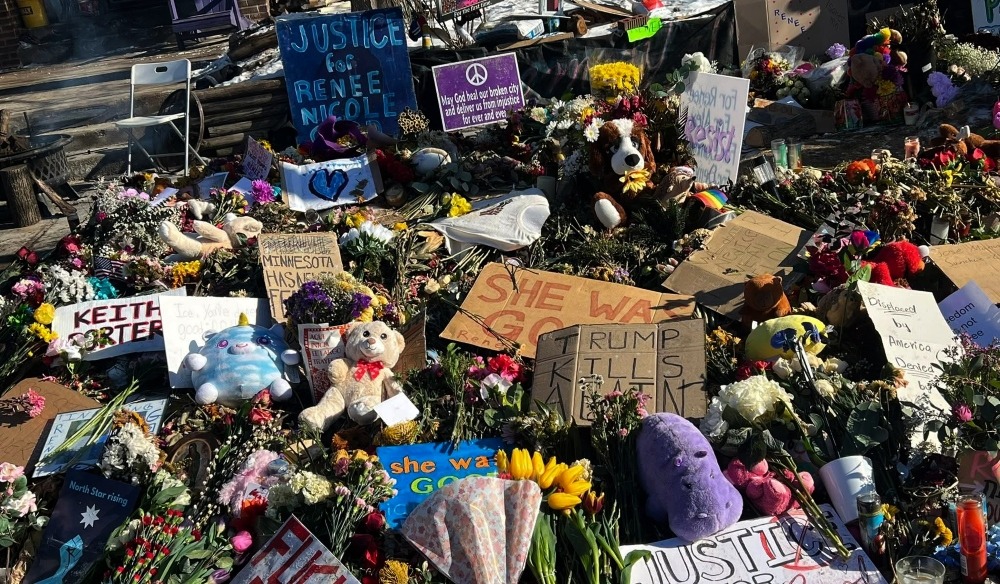
This underlying personality trait appears to be overlaid with an attitude among many Americans that white Christian males deserve to be respected above all others — especially by anyone who does not fit that norm. As with millions of others, I watched with both horror and grief the violence that unfolded in Minneapolis recently, with the killings by federal officers of Renee Good and Alex Pretti and the subsequent shielding of their brazen executioners.
I spent most of my youth in Minneapolis, a few miles from Good’s neighborhood. It resembled our own almost precisely. That was before SUVs became popular with families, but I recall parents driving their children to school in winter, as my own did from time to time. On weekends, the family would go ice-skating on one of the lakes near Good’s neighborhood.
Growing up in the “Twin Cities” of Minneapolis and St. Paul was enormously pleasant and culturally enriching. The metropolitan area was, and still is, filled with people whose ancestors immigrated from Scandinavia — cultures that value empathy and caring for others. Today, these countries are proud of how successful their social democracies have become. It is also notable that their leaders are now condemning the reckless behavior of the U.S. government in ignoring international law.
The very term associated with the state, “Minnesota Nice,” reflects this attitude toward others that is both welcoming and caring. It’s an attitude that everyone, every individual, every family deserves decent treatment. And it recognizes that immigrants from other countries have contributed to the richness of the culture.
The very public killing of Renee Good felt to me like a message to all women from white male Christian nationalists that the purpose of women is to stay home, tend children, cook, clean, and — above all — obey the man. In other words, turning back the clock a hundred years or more. Venturing out, with other ambitions, would risk physical harm. Disobeying any male command risks injury or even death. The final insult shouted by the ICE thug is the same as typically shouted by domestic abusers who beat their partners.
Federal agents beat and then shot and killed VA nurse Alex Pretti because he defied them by helping another person. Moreover, he didn’t fit their image of a strong male. They saw him as defenseless. The discovery of a holstered gun — mid-beating — only enraged them to increase the punishment.
Ironically, it was not long ago, the president lamented that the U.S. does not get more immigrants from Northern European countries. Looking at the state of the U.S. today, most Scandinavians would probably not consider it a desirable place to live. Recently, our Italian neighbors have ceased talking about America as a promised land, paved with opportunity, if not gold. They have seen this movie before, and it did not end well for the instigators.
A recent poll of people in Germany found that the vast majority of citizens no longer trust America to be an ally or mutually beneficial partner. Italy’s prime minister, who has visited the White House, joined other European leaders in condemning the threats to European security. The century-long amicable relationship between Europe and America may have come to an end. It seems the U.S. is rapidly on its way to becoming the world’s largest “hermit state.”
President Trump’s repeated threats to impose new tariffs on trading partners, his bluster about invading multiple countries, including even a NATO ally, his envy of President Obama for his Nobel peace prize hardly foster cooperation in international affairs or the global economy. I’m afraid we have not even seen the worst of it all. An idiotic AI-generated map displayed recently by the White House shows the “new United States” sweeping from the equator to the arctic.
A year ago, not long after Trump’s second inauguration, I had a nightmare in which I saw military troops from red states in a battle with the national guard in the capital of a blue state. The U.S. Army was attempting to take over and install a military government. It was a new form of civil war — American soldiers killing other American soldiers. I woke up in a sweat. Sadly, such a scenario now seems possible.
Within the European Union, leaders are discussing various measures to push back on the aggressive U.S. posture toward another EU member state, Denmark. At Davos this past month, they listened to a crazed speech by their U.S. counterpart which was full of historical ignorance, misnamed geography, insults towards individuals and countries, and bombastic assertions. Even before the randomly wandering, incoherent, self-aggrandizing talk, collective disdain was evident through the absence of a usual greeting party for a head of state.
On a positive note, Canadian Prime Minister Mark Carney has emerged as a global statesman, with his erudite, thoughtful, and impassioned words — a balm amid the daily chaos. I am also heartened by the small but growing number of Republicans in Congress, such as Thom Tillis and Don Bacon, who are calling out the administration for its egregious actions. These are small glimmers of hope, offering some light in this increasingly dark time.
Discover more from Post Alley
Subscribe to get the latest posts sent to your email.


Excellent article. I like the summation and the pointing of Mark Carney as an important voice from our side of the Atlantic. Carney, found on Fb as well as the press has become a voice of reason and a counter point of view of Trump. I’m not sure how my country will survive the next 3 years. That is truly sad.
The demise of American democracy would be a catastrophe, not just for Americans but for the entire world. Already we have seen democratic institutions in other countries under threat or in decay.
Which nation amongst all the advanced democracies will step forward and lead “ The West”? Who has the economic heft and military strength to replace America?
Anyone, anyone? Beuller?
While Italy’s Meloni government is sometimes fingered as like minded, there was a pretty solid slap back in her comment about Italy’s role in the NATO Afghanistan campaign.