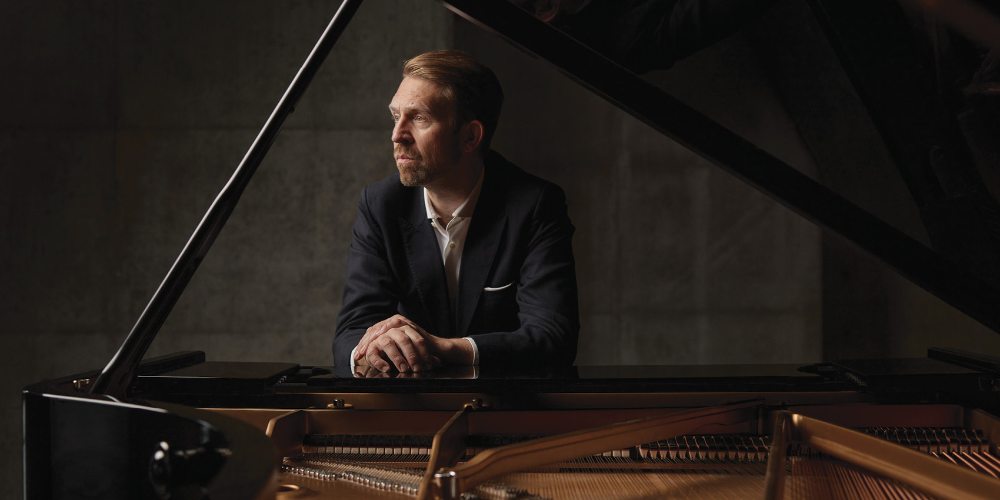

The celebrated Norwegian pianist Leif Ove Andsnes returned to Meany Theater last Friday for a thoughtful, esoteric program of miniatures.
The first half comprised a curious combination of works, spanning the early romantic era to the modern day. Andsnes led with Robert Schumann’s op. 32, and these four Klavierstücke are rarely performed, perhaps because they lack the thematic cohesion of his more familiar character works for piano. Andsnes has made a long study of Schumann’s output, recording much of it, and his clear-headed approach to this extroverted music worked well.
Andsnes continued into the next grouping without pause, a selection of short works by György Kurtág, and the change of composers caught many by surprise. Kurtág, who will celebrate his 100th birthday next month, has been adding to his collection of Játékok (“Games”) for over 50 years. Designed as “pedagogical performance pieces,” they now fill ten published volumes, and Andsnes’ carefully arranged set of seven showed off their wild variability.
The music is frequently atonal, sometimes violent, but mostly poised. Sometimes the basic idea is rhythmic; sometimes it is quotation or homage; sometimes the idea is just the harmonics of the instrument, especially after a series of massive tone clusters.
Keeping the thread unbroken into the final set of the first half, it became clear Andsnes was making a point about how these disparate examples from different epochs interrelated. The ground again shifted, this time back to tonality and the unique voice of Leoš Janáček’s On an Overgrown Path, a collection of character pieces written in the decade before Janáček became famous. These works constitute the bulk of his piano output.
Andsnes played Series I, a set of ten folk-tinged miniatures with evocative names like “They chattered like swallows” and “The barn owl has not flown away!” The Czech language can be heard in the distinctive rhythmic organization of his melodies. These lyric pieces are closer to a song cycle in character. Andsnes highlighted their inventive internal architecture with obvious affection.
Andsnes balanced the 21 somewhat unfamiliar miniatures of the first half with Schumann’s Carnaval, op. 9. This repertoire standard is a fireworks display of youthful enthusiasm, and Andsnes played the 21 quasi-variations with great elegance and restraint.
Schumann’s fiancée at this time was Ernestine von Fricken, whose family lived in the town of Asch. Seeing the same letters in Fasching (German for carnival) and in his own name, the young composer devised a way to spell the notes into themes ala Bach. It’s a sequence we’ve gotten to know by the eighth variation, but to remind everyone of the compositional genesis of the piece, Schumann wrote out three “Sphinxes,” a total of eleven whole notes: E-flat/C/B/A, A-flat/C/H, A/E-flat/C/B. In German that reads Es/C/H/A = SCHumAnn = AsCH..
These variations are rarely played in performance, because the progression sounds downright atonal. There is an intellectual key to the piece, so I’m glad Andsnes included them down at the bottom of the keyboard.
Interestingly, Schumann’s own titles for the pieces were not given in the program, as they were for the Kurtág and Janáček. I find titles like “Arlequin,” “Coquette,” “Papillons,” “Chopin,” and “Paganini” helpful in deciphering the riddles each variation presents. Better to let the music speak for itself, I thought, free of the coded labels that Schumann intended for his coterie.
Discover more from Post Alley
Subscribe to get the latest posts sent to your email.

