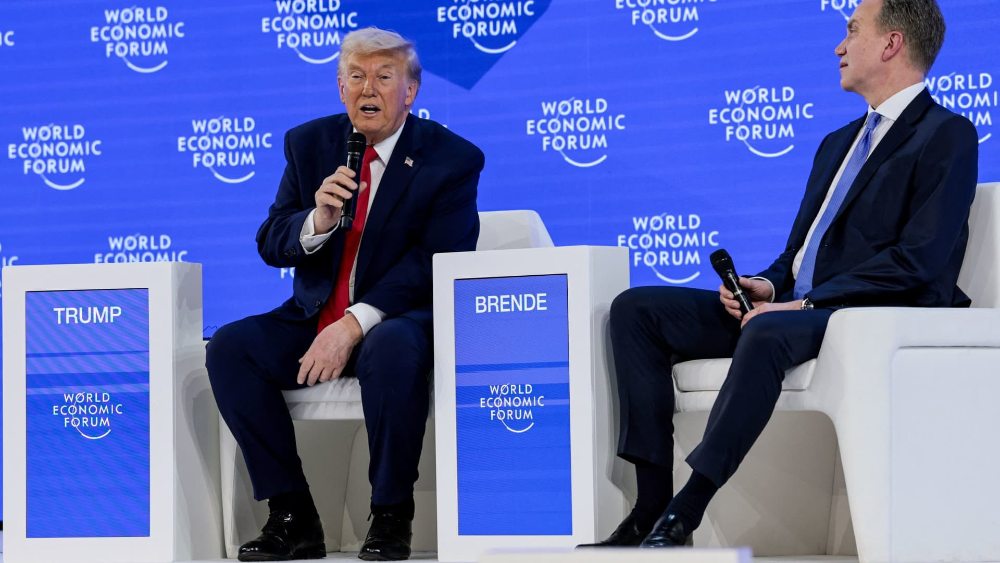

Just when you think it couldn’t be more embarrassing to be an American under the chaotic governance of Donald Trump, the president of the most powerful country on the planet went full-Godfather at the World Economic Forum in Davos, Switzerland.
In a rambling speech incorporating every grievance accumulated over the past decade, he told political and security allies of the NATO alliance that they could give him ownership of the autonomous territory of Greenland or face his wrath.
He insulted the other 31 member nations of the North Atlantic Treaty Organization as “weak” and “ungrateful” for all that he personally has done for them and insisted only the United States could protect Greenland from encroachment by Russia and China.
Trump made veiled threats to go after Canada as well for his Arctic control plan. He said Canadians “should be grateful to us” because the country “lives because of the United States. Remember that, Mark,” he said, gesturing to the audience where he believed Canadian Prime Minister Mark Carney was seated.
Carney, a former head of the Bank of England who earned a standing ovation for his widely praised Davos address a day before Trump’s, had warned that the U.S. president’s targeting of allies represented a “rupture” between Washington and the rest of the alliance, not just a difficult moment that would be quickly overcome. The Canadian leader responded to Trump’s demeaning of Canada with the statement that his country lives not because of the United States but because of “Canadian values.”
For an audience of billionaires, corporate moguls and political leaders from around the globe who know better, Trump repeated his claim to have won the 2020 presidential election and proclaimed himself the most accomplished leader ever to inhabit the White House.
He blamed his predecessor, variously referring to “sleepy Joe Biden” or “the autopen,” for today’s inflation, high interest rates, failure to lure foreign investment to the United States, giving Ukraine $350 billion (wildly inflated) to fight Russia and spurring an immigration crisis that he is now resolving with sweeping and reckless raids and deportations.
It wasn’t until he had been throwing out accusations of long-debunked conspiracies against him that he suddenly pivoted to retract his threats to use force if necessary to acquire Greenland.
“We never ask for anything and we never got anything,” Trump began after praising himself for ending all wars except for Ukraine and getting European NATO members to pay more for their defense. “We probably won’t get anything unless I decide to use excessive strength and force, where we would be, frankly, unstoppable. But I won’t do that. Okay? Now everyone’s saying, ‘Oh, good.’ That’s probably the biggest statement I made, because people thought I would use force.”
He praised NATO Secretary General Mark Rutte for crafting a “framework for a deal” on U.S. resource extraction in Greenland and for beefing up the island’s defenses against its so-far imagined predators. He announced that he intended to build a “Golden Dome” missile defense system, an envisioned network of satellites and ground-based artillery to detect and destroy incoming projectiles.
Neither Danish nor Greenlandic officials were involved in any discussions with Rutte about such a framework, and the former Dutch prime minister said little publicly about what and with whom such a deal had been negotiated.
The consensus among the relieved politicians and business leaders seemed to be that it was best not to ask too many questions. The dearth of validating information has allowed Trump to take the offramp from threatening to attack a NATO ally, an aggression that prompted the EU to threaten retaliation by scuttling a trade agreement with the United States that benefits the U.S. economy and the corporate giants who have bankrolled Trump’s elections.
Former U.S. Ambassador to Russia Michael McFaul warned after Trump’s sudden turnabout on Greenland that the confrontation has inflicted lasting damage to the transatlantic alliance.
“The costs of this victory are high. Trust between the United States and Europe has taken a deep hit. It will take a long time to renew. It also may never fully recover,” McFaul wrote in his weekly essay titled No One Likes a Bully.
“Out of necessity, NATO allies will continue to cooperate with the United States on security matters. European leaders rationally understand that they are more secure with the U.S. in the alliance than without it. NATO has survived this crisis and will endure for now,” wrote McFaul, a Stanford University professor and dean of its foreign policy institute. “Hopefully, it will remain in place for three more years, after which the United States might elect a president more committed to the NATO alliance and transatlantic partnership more generally.”
Rutte’s public flattery and support for Trump had reached nauseating levels ahead of the Davos gathering. He brooked no criticism of Trump’s intention to take the sovereign territory by whatever means necessary. That vow to annex the island, repeated on the eve of Trump’s Wednesday speech, rattled markets worldwide.
Markets were not the only negative reaction to Trump’s diplomatic thuggery. The usually servile Republican members controlling the U.S. Senate and House of Representatives stated openly their objections to invading a NATO ally.
Bipartisan pushback from Washington politicians raised fears among Republicans in Congress that a hugely unpopular move to go to war over Greenland would worsen their already dubious chances of retaining majorities in Congress after midterm elections in November. Unfulfilled 2024 campaign promises by Trump confront voters with rising inflation, a chaotic and brutal anti-immigrant deployment of federal police and soldiers, and deviation from vows to keep the United States out of foreign wars.
Trump’s obsession with “owning” Greenland in spite of the clear warning by the Danish and Greenland governments that the territory is not for sale was increasingly seen by American voters and leaders throughout NATO as a move that would be the death knell of the alliance.
The dramatic shakeup of the Davos gathering reportedly delighted Russian war hawks. Russian President Vladimir Putin struck a pose of indifference, saying the internal NATO conflict was of no consequence to him. But Russian Foreign Minister Sergei Lavrov exuded enthusiasm at a Moscow news conference over the Western alliance fracturing.
“It was hard to imagine before that such a thing could happen,” Lavrov said Tuesday, on the eve of Trump’s speech. “One NATO member is going to attack another NATO member.”
Lavrov described Trump’s plan to annex Greenland as “a major upheaval for Europe” and a sign that “the Euro-Atlantic concept of ensuring security and cooperation has discredited itself.”
Trump has been a critic of NATO since he first emerged from a serially bankrupt business empire onto the U.S. political stage with an announcement in 2015 that he was running for president. His stunning victory over former Secretary of State Hillary Clinton in 2016 led to his dismantling some of the most important diplomatic breakthroughs of President Barack Obama’s administration, including the Paris Agreement on global cooperation in combatting climate change and the Iran nuclear deal that constrained the Islamic Republic from stockpiling enriched uranium needed for nuclear weapons production.
The showdown over Greenland had the beneficial side effect of uniting the European NATO members whose disparate national interests have often divided the alliance and left it ineffective in handling some of the crises afflicting the continent. EU member states with hard-right leaders have resisted efforts to help Ukraine fight off Putin’s unprovoked invasion. The nearly four-year-old war has claimed more than a million Russian casualties, yet Putin shows no sign of pulling back.
EU and NATO states have offered varying degrees of support for Ukraine, mostly influenced by their proximity or distance from the threat of Kremlin aggression. Poland and the Baltic states of Latvia, Lithuania and Estonia, with their history of Soviet occupation and annexation, have led the campaign to aid Ukraine as a means of halting the Russian offensive before it moves on to seize their territory.
European leaders rallied around Denmark when Trump set his sights on Greenland, claiming it is part of North America and, like Canada, within his perceived sphere of influence in the Western Hemisphere.
Democratic allies’ trust in the United States to maintain the post-WWII rules-based international order plummeted after Trump sent U.S. military forces to depose Venezuelan leader Nicolas Maduro earlier this month and seize control of the South American country’s oil industry.
“On Greenland, Europe stood up, Trump blinked, and the EU learned a lesson,” the Washington Post headlined its analysis of the confrontation that dominated the first days of the Davos gathering.
Danish Prime Minister Mette Frederiksen told reporters in Brussels on Thursday that the leaders of the European Union member states “learned something” in the course of the perilous standoff with Trump. It required unity among the 27 EU states and “our willingness to stand up for ourselves” to protect their security from the unprecedented attempt by Trump to seize Greenland.
Polish Prime Minister Donald Tusk made the point more bluntly in urging firmness among the often squabbling European allies as vital “for our partners in Washington to understand the difference between domination and leadership.”
European leaders expressed relief after Trump backed down from his bellicose threats—at least in the meantime. The president told reporters on Air Force One during his flight back to Washington on Thursday that he would have more detail in “a couple of weeks” on the alleged agreement reported by Rutte.
Rutte, who the European media have begun calling the ” Trump Whisperer,” has said little about the reported “framework of a deal.” What Trump has said about the deal appears to be reported assurances that U.S. troops can be deployed and American bases built on the island—opportunities to direct NATO defenses in Greenland that have been permitted under a defense pact with Denmark signed in 1951.


In response to the statement “European leaders rallied around Denmark when Trump set his sights on Greenland:”
It seems unlikely that Rutte would have thrown Denmark under the bus this way without consulting the NATO powers of Germany, France and the U.K.
What if NATO just kicked the US out?