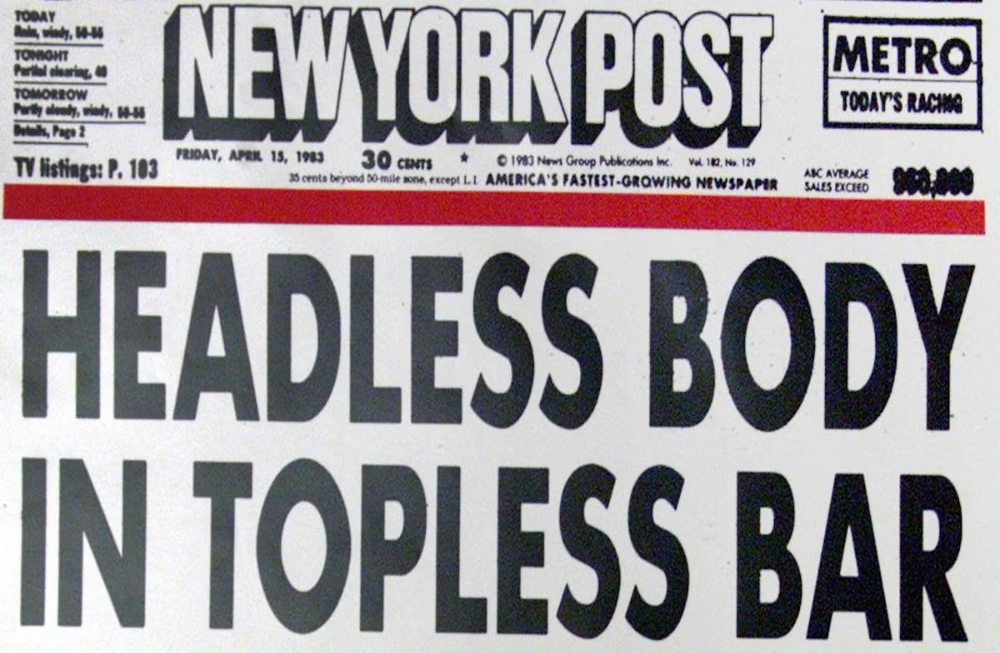

News headlines can either say “read this story” or “skip it; it’s not worth your time.” Reporters don’t write their own headlines; that task typically falls to a hard-working copy editor who remains anonymous. But heds (the newsroom term) do matter. They’re important to a writer’s or publication’s success or failure.
Many of us can quote unforgettable heds — not only the New York Post’s “Headless Body in Topless Bar,” but the New York Daily News’ “Ford to City: Drop Dead.” Then there’s the Chicago Daily Tribune’s “Dewey Defeats Truman” about the event that never happened.
There are unforgettable historic headlines like the one on Dec. 7, 1941: “War! Oahu Bombed” or April 30, 1945’s “Hitler Dead;” Aug. 9, 1974’s “Nixon Resigns,” and July 21, 1969’s “The First Footsteps” when Neil Armstrong stepped onto the moon. More recently we can recall Nov. 4, 2008: “Mr. President,” above a story reporting election of Barack Obama.
Newspapers refer to the use of oversized heds as “going to the wood.” That phrase comes from the fact that, in the days of hot metal, headlines for breath-taking stories sometimes made use of larger-than-one-inch (72-point) letters, carved out of wood.
Writing eye-catching heds is a skill — more inspiration than perspiration. There are primers that ask: What makes a great headline? They reveal that such heds use strong, active verbs; they’re simple, direct and occupy a finite space. Good heds pique readers’ interest, making them want to know more.
A recent example is the intriguing headline above Maureen Dowd’s opinion piece in the New York Times attacking Health and Human Services Secretary Robert F. Kennedy Jr.: “Vax Quack/ Lacks Facts.” The clever hed was certain to draw readers to Dowd’s column and inform them on R.F.K’s conspiracy vaccination theory.
At the opposite end of the headline-writing skill are humdrum heds, dull headlines that describe business as usual. Think of the predictable hed that read: “Supreme Court hears arguments.” It ought to be malpractice when a headline fails to depict a story correctly, doesn’t stick to the facts or when it gives away the ending.
When I wrote columns, I was indebted to talented copy editors, among them Seattle Times wordsmiths Rich Dilworth and Ivan Weiss. Although they wrote anonymously, they crafted heds that I still treasure, the ones that drew readers wanting to learn more. A sampling: April 28, 1991 “Potty Parity Stalls in Olympia;” May 1, 1991 “Season of Sneezes and Coffers;” Oct. 9, 1991 “How Many Lawyers Do You Need to Fry Spam?” and May 24, 1995 “Pick a Peck of Pickled Problems,” about snafus encountered by Screenwriter Howard Lev when he prepared Mama Lil’s pickled peppers.
My columns collected other intriguing headlines like Feb. 23, 1996 “Spirited Hunt Had Chance of a Ghost,” June 23, 1995 “The Needle? Yes, It’s Still Standing” and July 28, 1991 “Seattleites Setting Sales This Summer” or June 28, 1991 “Presto, Change-O! Is the Market Saved Now?”
One of my all-time favorite heds is “Humungus Fungus Debate Amongus” which appeared May 31, 1992 reporting on a mushrooming controversy. In its way, summing up a story in a couple of words is somewhat akin to writing poetry while doing a crossword puzzle.
The most unleashed headline artists are those who work on sports copy desks. Sport writing allows — even benefits — from outrageous puns and analogies. It’s hardly a surprise to find that some team will “bowl over” another contender en route to post season. Rather than just eliminate a rival, the winning team may dismantle, trash, spoil, or raze an opponent. Sports hed writers have been given license to kill, wipe out, demolish, and annihilate. When watching a sports contest, it’s fun to imagine the next day’s lead headline. Will the copy editor trash, crush, or merely finish off the opposition?
Copy editors are the true unsung heroes of the journalism trade. Would that there were news industry kudos and awards for inspired heds, those that most scream “look at me.”
Discover more from Post Alley
Subscribe to get the latest posts sent to your email.


Headlines that make a feeble attempt to say “read this story”, by simply omitting content don’t work for me. “This local city’s solution to a certain problem, shocked one official!” Egads, forget it. The implication is that I wouldn’t bother to read the article if I knew what it was about, and that’s good enough for me.
I think this has grown to be commonplace in the Seattle Times only in recent years. The cited examples are guilty enough of this, but at least they’re provoking rather than just coy.
Hub Fans Bid Kid Adieu is a favorite, although from the New Yorker, not a newspaper.
The New York Times Opinion section had a clever hed on Maureen Dowd’s piece in this morning’s paper. Maureen was writing about Melania’s doc. The hed reads “Slovenian Sphinx/Flick Nixed!