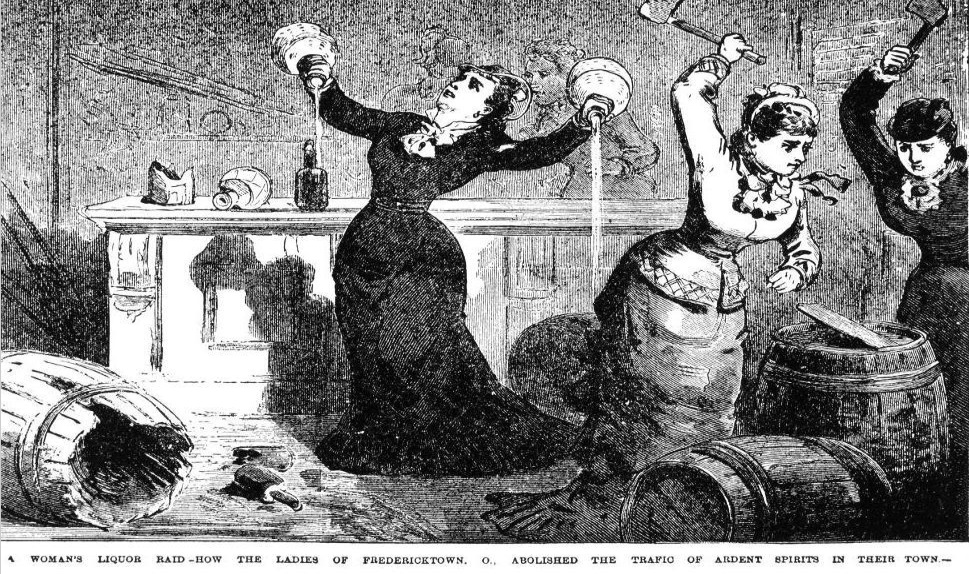

This month (today, actually), Washington schools will again mark a day with a curious name: Temperance and Good Citizenship Day. To modern sensibilities temperance and good citizenship make strange bedfellows, and yet the school requirement is still on the books. A little history is revealing.
The state law was passed in a different epoch, 1923, the Roaring ‘20s. Instruction on January 16 was to teach:
- the advantages of temperance to the individual and to the nation,
- the biographies of great leaders in temperance and good citizenship,
- the effect of alcoholic and narcotic poisons and drugs upon the human system,
- and the necessity for, the duty of obedience to, and respect for the laws of our state and nation on the part of all citizens.
Recall that two social movements—temperance and women’s suffrage—flourished at this time, and they overlapped. Both were hugely successful as evidenced by two amendments to the U. S. Constitution: the 18th on Prohibition and the 19th recognizing the right of women to vote. And they took effect nationwide in the same year, 1920.
Washington was ahead of the curve. Our state went dry four years before the nation, and its women won the vote ten years before the nation.
The temperance movement came first, a century before in the early 1800s, and it was driven by both civic and religious motives. Benjamin Rush, a signer of the Declaration of Independence, was a temperance advocate who wrote in a popular tract that “spirits are anti-Federal companions of all those vices calculated to dishonor and enslave our country.” The alcoholic had lost self-control and was under the command of a force “extraneous to himself,” he said. This was good for neither the polity nor the person.
The temperance movement became a crusade. Carrie Nation smashed saloon windows with a hatchet and founded a shelter for battered women and children. Both saloon protests and shelters spread nationwide under the banner of “home protection.” It was the family against the bottle, and the woman against the drunkard. And alongside it was the battle for women’s suffrage.
Frances Willard, head of the Women’s Christian Temperance Union, was blunt about the connection between the two movements: “The ballot is the weapon by which temperance is to be won.” In Washington, temperance and suffrage advocates like Mary Hutton in Spokane, Emma Ray in Seattle, and Emma Smith DeVoe in Tacoma argued that women needed the vote in order to protect the home, the school, and the workplace from alcohol. Suffrage was a tool for temperance, and temperance was a tool for social and moral uplift. Poverty, absenteeism, prostitution, street fights, and violence against women were the personal and civic harms associated with drinking, and women’s suffrage was needed to heal them.

By 1923, the temperance and suffrage movements were united in victory with two amendments under their belts, and Washington lawmakers passed the law requiring schools to observe Temperance and Good Citizenship Day. The law remains in force, but it has evolved.
The law was amended in 1969, 2013, and 2018. The legislature changed its focus from liquor to the rights and duties of citizens, especially voting. But the law’s name wasn’t changed. Washington’s superintendent of public instruction, Randy Dorn, explained to school administrators in 2013:
“The original language of the 1923 Washington State law included specific language regarding education of the effects of alcohol and drug use; however this language was removed when the law was revised in 1969. While many interpret “temperance” to mean prohibition, instruction on “temperance” may include information about prohibition, but it is not a specific requirement of the law. The 2013 Legislature added the expectation that Temperance and Good Citizenship Day include opportunities in our schools for eligible students to register to vote at school. Many districts recognize this day by discussing temperance in connection with good citizenship, specifically addressing self-restraint….”
The law and the day are now focused squarely on voter registration. Schools must on January 16 make registration available to eligible students who will be 18 years of age or older by the next general election:
“Each year on Temperance and Good Citizenship Day social studies teachers must, as resources allow, coordinate a voter registration event in each history or social studies class attended by high school seniors. This event is part of the Future Voter Program. Teachers must make voter sign up and registration available to all students.”
And temperance? I can’t explain why the legislature left it in the law’s title since it no longer describes the law’s contents. However, maybe, just maybe, it reflects the structural link between self-restraint and democratic governance. Democratic governance, after all, is also known as self-government.
Let’s see. Humans are not angels, obviously. The historical record makes this awfully clear. And if humans were angels (we’re not), no government would be necessary (it is). This is James Madison’s famous reckoning in The Federalist. To counter human shortcomings, provisions had to be built into the Constitution (Madison calls them “auxiliary precautions”): checks and balances, separation of powers, and a bill of rights that tells majorities what they cannot do.
These guardrails are meant to control both the people and the government and to prevent tyranny, sectarian violence, and injustice; or, stated positively, to protect liberty and rights, peace and dignity. Madison then underscores the need for such precautions:
“In all the very numerous assemblies (legislatures, councils), of whatever characters composed, passion never fails to wrest the scepter from reason. Had every Athenian citizen been a Socrates, every Athenian assembly would still have been a mob.”
There’s a lot to be said for self-control. Democracies require it lest they collapse inward, undone by righteous interest groups unbending in their beliefs and inflammatory demagogues who fuel their passions. If temperance can mean self-restraint, humility, tolerance, and the ability to work with people whether you like them or not, then count me in. I’ll raise a toast to Temperance and Good Citizenship Day.
Discover more from Post Alley
Subscribe to get the latest posts sent to your email.


Great article. We all have a long way to go towards understanding tolerance and being tolerant.
Woman not Wo,men for w c t u
WA dry referendum 1919
Earlier WA like 18th Amendment outlawed liquor Traffic.
Norman Clark wrote an excellent book on prohibition in the state of Washington which he revised on the second edition and I can recommend it. Often confused between the 18th amendment and laws against possessing liquor or drinking liquor which the 18th amendment did not do it law, it outlawed the manufacturer and sale of liquor or what or what the reform movement called the liquor traffic.