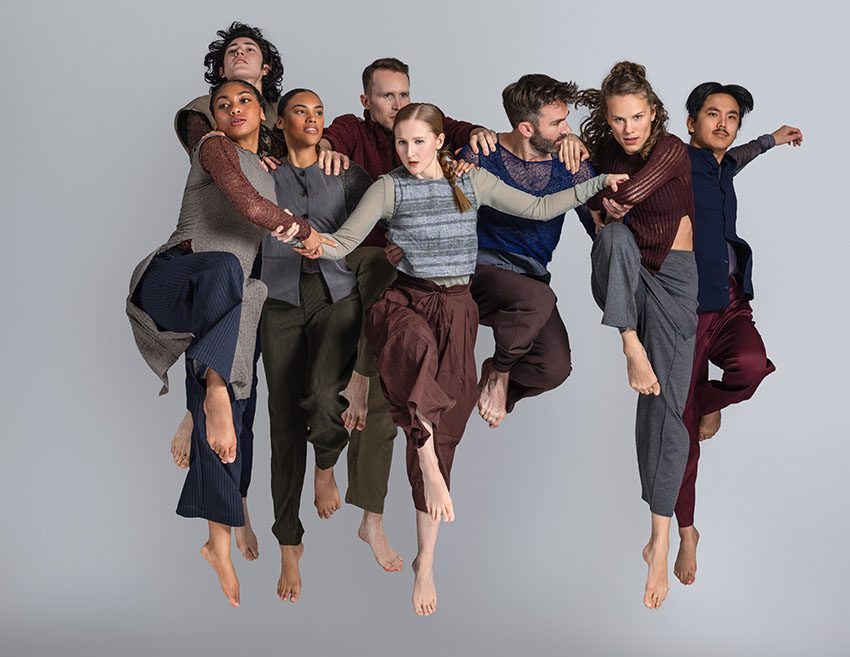

In early 1936 Martha Graham, at age 40 an acknowledged American dance original, received an invitation. There was to be a dance festival prior to the 1936 Olympics in Berlin. Would she come with her company to perform? The games were the international coming out party of the new Germany and its Nazi lords.
Graham declined. She cited the oppression of artists and their work in that country and the Jewish dancers in her company who would not be welcome. At the very end of that year, she debuted “Chronicles,” an extraordinary group work that evoked the specter of fascism looming over the Western world.
Sixteen years later dancer/choreographer Bella Lewitzky, a unique atist from California, was called before the House Committee on Un-American Activities facing accusations of being a communist. She refused to “name names” and was blacklisted. Afterwards she spoke the now-famous words, “I’m a dancer, not a singer.”
A select group of dance artists are now faced with a challenge that echoes those of Graham and Lewitzky. They were contracted to perform in this 2025-26 season at the Kennedy Center prior to its name change, and the installation of a new administration which fired those who ran the center’s dance program.
For many of us, the decision would be clear. The current Trump-Kennedy Center is not the one we contracted with. It now represents a regime that has repeatedly demonstrated its hostility to many in the arts and to freedom of expression. By performing there we would signal our support of an authoritarian institution and an oppressive federal government.
Performing at the Kennedy Center is, or was, a prestigious gig, one that often came with a substantial fee. It is hard for a dance company in the non-profit world to easily accept such a loss.
I can imagine those scheduled to perform in the remainder of the season may have been asking themselves, or been asked, why they continue to be listed as performing there. Included are American Ballet Theater, New York City Ballet, San Francisco Ballet, and ironically, the Martha Graham Dance Company. Only one company has canceled: Doug Varone and Dancers, the least well known. Varone was to appear in April. Last week he withdrew, forfeiting his $40,000 fee that I hope will be mostly covered by donations from those who support his decision, including a modest one from me.
Of his cancellation, Varone said in part, “we can no longer permit ourselves nor ask our audiences to step inside this once great institution.” The two performances in DC were to be the last before Varone dissolved his company.
I expect all three ballet troupes will perform as they stand to lose a big pay day with contracted responsibility to dancers and support staff and with large operating expenses. They have high-powered boards with fiduciary responsibility over the company’s budgets and may have major supporters some who do not agree with a decision to cancel, some with concerns that the company might be denied future engagements.
This raises the question of what responsibility artists have to make decisions solely on “moral” grounds. I would guess that the ballet companies see themselves as not “political,” their responsibility only to perform their works to as wide an audience as possible.
Using the example of Hitler’s Germany, non-Jewish modern dance artists, most famously Mary Wigman and Harold Kreutzberg continued to perform in Germany throughout the 1930s and through World War II. Ballet continued though stultified by the government, avoiding any overt experimentalism. It’s hard to imagine American Ballet Theater and New York City Ballet doing the same, but given the choice of working or not, who knows what they, or we, would do.
The great 20th century choreographer Jerome Robbins was harried by the Un-American Committee for his left-wing activities and resisted until threats were made, by Ed Sullivan among others, to reveal his homosexuality. It was such a different time that Robbins, fearing his career would be ended, named names. He was mostly held harmless over the rest of his life, or people who worked with him held their noses, and he became an
extraordinarily successful artist. Those he named, more minor figures without his great gifts, fared not nearly as well.
Now what would Martha Graham do if she were still alive? One would think she would have moved quickly to cancel her engagement at the “new” Kennedy Center, no matter how lucrative. How could such a unique voice, such a gutsy woman who worked so hard to articulate her singular vision give her imprimatur to authoritarians who would stifle those who would not genuflect before them?
I recently read Deborah Jowitt’s biography of Graham. I hoped that it would provide an easy answer to this question. It did not.
There was certainly a mercenary aspect to Graham, doing what enabled her to do her work. According to Jowitt she saw herself as apolitical, a work like “Chronicle” notwithstanding. Would she see Trump and his thugs as unimportant to her view of life and art? Distasteful as they might be, were they to be tolerated, even exploited when possible? Would their time pass and she remain eternal?
I fear that come summer at the end of the Kennedy Center’s current season, Varone’s refusal to perform may stand alone among these dance groups for his brave act of moral rectitude.
Discover more from Post Alley
Subscribe to get the latest posts sent to your email.


Thank you for this thoughtful article. As a decades-long subscriber to ballet and modern dance at the Kennedy Center, I wrestle with whether to attend this season. Because my subscription tickets were purchased almost a year ago, not attending would mean throwing away a considerable amount of money. Also, it is not easy to see great dance in the D.C. area, and I am not young; I long to see as much as possible. Finally, over the years I have worked my way to a prime seat that I will lose when revulsion at what is happening in our country makes it impossible for me to renew. I wish all the companies that I long to see would cancel and solve this dilemma for me—while making their own ethical stands against what has happened at the Kennedy Center .