
The potential consequences of President Donald Trump’s unprecedented and unconstitutional exfiltration of Venezuelan dictator Nicolas Maduro range from the unpredictable to the unspeakable.
While Maduro was widely considered a brutal and illegitimate president of the South American country, Trump’s ordering of his stealth removal wasn’t motivated by an attempt to restore democratic leadership in Caracas, rather by his desire to impose U.S. governance at least long enough to exploit Venezuela’s massive oil reserves.
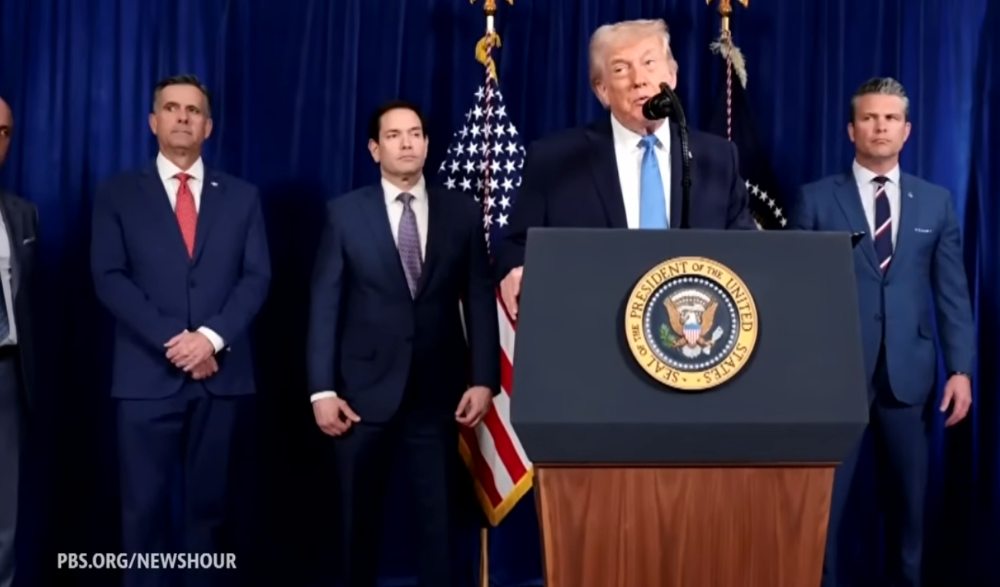
At a press conference shortly after the effective execution of regime change, Trump brushed off concerns that Saturday’s actions would necessitate deployment of U.S. troops — “boots on the ground” — to stabilize the country and govern its deeply divided population.
“We’re not afraid of it,” Trump said of sending American troops into another foreign war. “We don’t mind saying it, but we’re going to make sure that that country is run properly. We’re not doing this in vain.”
U.S. oil companies will take over Venezuela’s oil fields and industry, Trump said, citing the country’s oil wealth as a factor in his decision to depose Maduro.
Asked how long U.S. operatives would remain in Venezuela now that Maduro has been ousted, Trump said, in effect, as long as it takes.
“We’re going to stay until such time as the proper transition can take place,” Trump told reporters from a property in Palm Beach, Florida. “We’re going to run it, essentially, until such time as a proper transition can take place.”
Operation Absolute Resolve led by Delta Force special operations troops captured Maduro and his wife Cilia Flores from their beds in the middle of the night and flew them to New York to face charges of drug trafficking and illegal weapons use.
Trump quickly denied that his administration planned to have exiled opposition leader and Nobel Peace Prize laureate Maria Corina Machado flown in to assume the Venezuelan leadership now that Maduro has been removed.
Machado, he said “lacks the support” and “respect” necessary to serve as president. Trump said Maduro’s vice president, Delcy Rodriguez, had been sworn in as interim leader. That spurred speculation that Rodriguez may have collaborated with the U.S. forces to take Maduro and Flores to the United States to face prosecution. However, Rodriguez issued a demand for the safe return of Maduro shortly after her installation.
While few tears were shed over Maduro’s political demise, the United States’ unlawful and unauthorized hostile action in Venezuela has signaled to other powerful countries ruled by authoritarians that there are no longer any guardrails confining the use of deadly force to attack, occupy and loot a sovereign state.
If the leader of a country as wealthy and well defended as the United States chooses to wield that power to launch a new colonial era, why wouldn’t Russian President Vladimir Putin dispense with the irritation of U.S.-mediated peace talks and finish his Ukraine invasion with a culminating strike on Kyiv to take out Ukraine’s president and other legitimately elected leaders?
What’s to stop Chinese President Xi Jinping from sending his military, the world’s largest, to forcibly reunite the mainland with democratically governed Taiwan and extend the Communist Party’s rule over the more prosperous and free people of the island province?
What deters North Korean lunatic Kim Jong Un from lobbing one of his nuclear weapons at the United States? What country or international alliance has the constructive influence in pursuit of world peace if the United States so fully abdicates from that role?
Trump was joined at his press conference by his military, intelligence and diplomatic Cabinet members to announce the “successful” execution of the unauthorized mission. There were no reports of human casualties on the side of U.S. troops or any assessment of the number of Venezuelans killed in the preliminary bombardments of bases and ports.
The operation lasting about three hours was carried out without congressional authorization of the use of force against another country, as required by U.S. law. Neither was there advance notification to the “Gang of Eight” — the top Democrat and Republican from the House of Representatives and the Senate and both parties’ leaders of the Senate and House Intelligence Committees.
Democratic congressional leaders immediately expressed outrage at Trump’s defiance of his constitutional obligation to get congressional approval of hostile action against a sovereign state, which Venezuela remains despite Maduro’s illegitimate claim to be president.
Sen. Tim Kaine (D-VA), who sits on both the Senate’s Armed Services and Foreign Relations committees, said the operation constituted “a sickening return to a day when the United States asserted the right to dominate the internal political affairs of all nations in the Western Hemisphere.”
Kaine alluded to the 1823 Monroe Doctrine, recently incorporated into the Trump administration’s National Security Strategy released in November. The president conceded that his administration has “superseded it by a lot. By a real lot. They now call it the Don-roe Doctrine.”
“Where will this go next?” Kaine asked. “Will the President deploy our troops to protect Iranian protesters? To enforce the fragile ceasefire in Gaza? To battle terrorists in Nigeria? To seize Greenland or the Panama Canal? To suppress Americans peacefully assembling to protest his policies? Trump has threatened to do all this and more and sees no need to seek legal authorization from people’s elected legislature before putting servicemembers at risk.”
“Maduro is an illegitimate ruler, but I have seen no evidence that his presidency poses a threat that would justify military action without Congressional authorization, nor have I heard a strategy for the day after and how we will prevent Venezuela from descending into chaos,” U.S. Rep. Jim Hines (D-CT), ranking member on the House Intelligence Committee, said in a statement.
Sen. Andy Kim (D-N.J.) declared on social media that “Trump rejected our Constitutionally required approval process for armed conflict because the Administration knows the American people overwhelmingly reject risks pulling our nation into another war.”
U.S. Rep. Adam Smith ( D-WA), ranking member on the House Armed Services Committee, called Trump’s action “deeply concerning” for the grave uncertainties left for Venezuelans in a politically polarized country still without legitimate leadership.
Like many politicians from both parties, he praised the military for successfully carrying out its orders. But he pointed out that Trump campaigned on being a president who would not involve the United States in new wars after the losses and lessons from U.S. invasions of Afghanistan and Iraq.
“Our military is really good at what it is assigned to do but we are not in the nation-building business,” Smith said.
“What is Trump’s goal here?” Smith said in a CNN interview. “The easiest way to say it is he wants Venezuela’s oil.”
Trump said as much during his hourlong press conference.
“We’re going to have our very large United States oil companies, the biggest anywhere in the world, go in, spend billions of dollars, fix the badly broken infrastructure, the oil infrastructure, and start making money for the country, and we are ready to stage a second and much larger attack if we need to do so,” Trump said.
Arizona Democratic Sen. Ruben Gallego, an Iraq War veteran, blamed Trump’s Supreme Court appointments during his first administration for what he cast as the president’s abuse of power.
“This mind-blowing attack is the direct result of a Supreme Court MAGA majority, and Chief Justice John Roberts Jr. specifically, who granted him broad immunity never envisioned by the Framers. He has taken that and run with it—now headfirst into war,” Gallego wrote on social media.
Some Republicans currently in Congress praised the operation deposing Maduro, while those who have left elected office were more critical of Trump’s “betrayal” of his election promises to stay out of foreign conflicts.
U.S. Rep. Carlos Gimenez (R-FL) said in a CNN appearance that U.S. Justice Department indictment of Maduro for alleged “narco-terrorism” justified the action in bringing him to be arraigned in New York on those charges, presumably on Monday.
Gimenez cited similar grounds cited in the cases of previously deposed foreign leaders including Panamanian dictator Manuel Noriega, Al Qaeda mastermind Osama bin Laden and Libyan strongman Muammar Gaddafi, the latter two killed in the U.S. operations.
Discover more from Post Alley
Subscribe to get the latest posts sent to your email.