
In order to make America great again — which means, evidently, going back to the royal prerogatives of George III — the Supreme Court’s conservative majority seems on the brink of creating a system in which Justice Ketanji Brown Jackson foresees “having a President come in and fire all the scientists and the doctors and the economists and the Ph.D.s and replacing them with loyalists and people who don’t know anything.” Kind of like what we have now. Only more so.
The court gets an opportunity to do this when it decides the case of Trump v. Slaughter, which it will do before the end of this term. Rebecca Kelly Slaughter was a member of the Federal Trade Commission (FTC). Legally, she could only be fired for cause, but without alleging any cause, Trump fired her anyway. Slaughter sued to get her job back. A lower court found in her favor. The Trump administration appealed to the Supreme Court. This wasn’t one of the many cases the Court decided on its “Shadow Docket,” without oral argument or legal reasoning. The Court held oral arguments on December 8.
Most observers seemed to think that the majority was ready to vote for Trump. This meant most justices were ready to scrap a 1935 decision, Humphrey’s Executor, that found a President couldn’t just fire an FTC commissioner. (Humphrey had been that commissioner.) In the early years of the New Deal, President Franklin D. Roosevelt had fired him. If he had been fired illegally, Humphrey would be entitled to back pay. After Humphrey died, the executor of his estate sued to get the money. (Hence “Humphrey’s Executor.”) The Court ruled unanimously in the executor’s favor.
Roosevelt was trying to make significant changes in American law and government in order to pull the nation out of its slump. The Court initially stymied him, declaring one law after another unconstitutional. Later, of course, it rubber-stamped nearly everything FDR’s administration tried to do. (New Deal legislation relied heavily on the Constitution’s Commerce Clause. Once the government got on a roll, the court didn’t rule against it in a Commerce Clause case until 1995.)
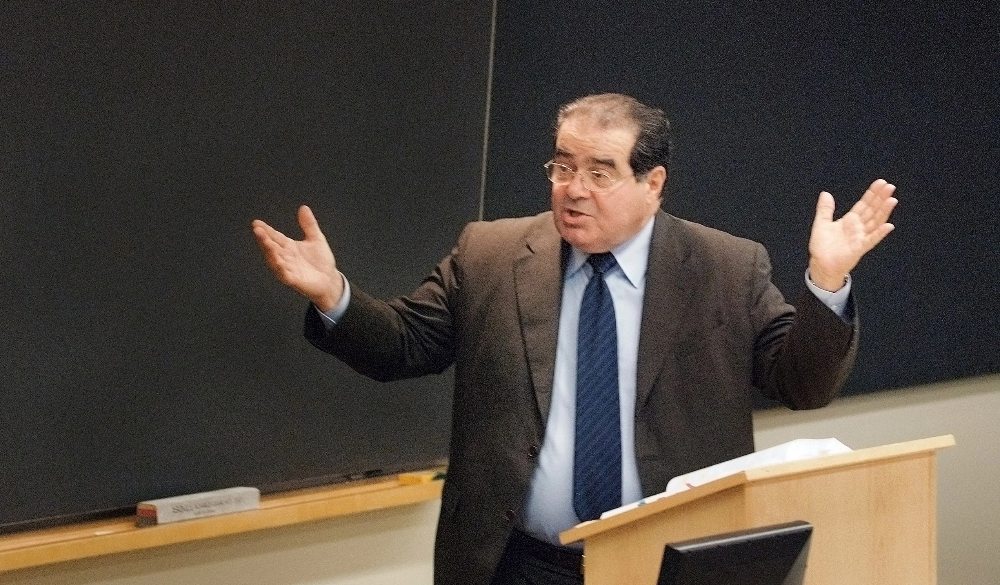
As the Court ponders (or pretends to ponder) Slaughter, is the late Justice Antonin Scalia getting a kind of posthumous revenge? His dissents seem to be all over this case. The Solicitor General actually cited a Scalia dissent as authority during oral argument. When Congress creates an independent body with some legislative powers, he argued, “it’s — it’s — it’s creating junior varsity legislatures, which would be unconstitutional under Justice Scalia’s dissent in Mistretta.”
Mistretta had pled guilty to conspiracy to distribute cocaine He was sentenced under guidelines established by the Federal Sentencing Commission, which had been established by act of Congress. He argued that the commission had been established unconstitutionally. All the justices but Scalia ruled against him. Scalia argued that by establishing the commission, Congress had unconstitutionally delegated its own legislative powers.
Scalia wrote, “By reason of today’s decision [upholding the commission’s constitutionality], I anticipate that Congress will find delegation of its lawmaking powers much more attractive in the future. . . . I foresee all manner of ‘expert’ bodies, insulated from the political process, to which Congress will delegate various portions of its lawmaking responsibility. How tempting to create an expert Medical Commission (mostly M.D.’s, with perhaps a few Ph.D.’s in moral philosophy) to dispose of such thorny, ‘no-win’ political issues as the withholding of life-support systems in federally funded hospitals, or the use of fetal tissue for research. This is an undemocratic precedent that we set — not because of the scope of the delegated power, but because its recipient is not one of the three Branches of Government.”
That isn’t the only lone dissent that seems to be influencing conservative justices. There’s another in a case decided, like Mistretta, at the end of the Reagan years. “Rarely has a solo dissent in a Supreme Court case eventually triumphed,” writes Erwin Chemerinsky, Dean of UC Berkeley Law, “but that is likely to happen as a majority of the justices appear poised to accept the ‘unitary executive theory’ of presidential power. This is the view that the president has authority over the entire executive branch of government, including the ability to fire heads of agencies and any government employees.
“But it should be remembered that when the court considered the unitary executive theory in the 1988 case of Morrison v. Olson, the justices, by a vote of 7-1, emphatically rejected it. Only Justice Antonin Scalia dissented and embraced it. His view is now likely that of the six conservative justices on the Supreme Court.”
Morrison involved the constitutionality of an independent counsel established by Congress but exercising prosecutorial powers. There, Scalia quotes the Constitution’s ambiguous and vague statement that “[t]he executive Power shall be vested in a President of the United States.” Scalia then argues that a key question is or should be, “Does the statute deprive the President of the United States of exclusive control over the exercise of that power? Surprising to say,” he continues, the majority “appears to concede an affirmative answer . . . but seeks to avoid the inevitable conclusion that, since the statute vests some purely executive power in a person who is not the President of the United States, it is void.”
The question naturally arises: What about a President who abuses his power? “Is it unthinkable that the President should have such exclusive power, even when alleged crimes by him or his close associates are at issue?” Scalia asks. Don’t be silly. “A system of separate and coordinate powers necessarily involves an acceptance of exclusive power that can theoretically be abused.” It’s kind of like arguing that the occasional schoolroom massacre is a price worth paying for a largely unlimited right to keep and bear arms. In effect, ydu can’t make an omelet without breaking eggs.
Chief Justice John Roberts has been widely quoted referring to Humphrey’s Executor as a “dry husk.” (Guess how he’s going to vote.) And recall — which hasn’t been widely reported — that he was repeating a phrase that had just been used by the Solicitor General, arguing the administration’s case. This came at the beginning of the argument. One could infer that the Trump side and the Chief Justice were on the same side from the get-go. And one could therefore suspect that for at least some justices, the oral argument was just theater.
The Humphrey’s Executor court was a conservative body trying to block a power grab by a liberal chief executive. If the Slaughter court sends Humphrey’s Executor to the ash heap of history, it will be trying to enable the power grab of a conservative chief executive.
The Court majority will, of course, do constitutional back flips to pretend that the decision is based firmly on Constitutional text and logic. Don’t believe it. Instead, try a little thought experiment. What if the current president is a reincarnated version of FDR. Do you think the current majority would be eager to give him carte blanche?
Discover more from Post Alley
Subscribe to get the latest posts sent to your email.


Great piece! The fallacy of the unitary executive theory is that it assumes, with absolutely no support in the Constitution or the Federalist Papers, that the grant to the president of executive powers the Constitution enumerates (namely the veto, pardons, customs, commander in chief, faithfully executing the laws Congress has enacted, etc.) ALSO means that the president has somehow also been silently granted all the executive powers that the Constitution DOESNʻT enumerate. The absurdity of this position (and the reason no court until now has ever embraced it) can be seen in the Constitutionʻs parallel grant of legislative powers to Congress. But not *all* legislative powers, only those powers the Constitution enumerates — namely “the powers granted herein.” The other two branches of government are legislating all the time, with executive orders and with judicial decisions. The Constitution created separate institutions sharing powers, not rigid separations of powers *except where the Constitution enumerates specific powers as being granted to one of the three branches exclusively.” This has enable Congress, the president, and the federal courts to accept the existence of independent agencies for well over a century. The FTC was created in 1914, for example. So: a simple, absurd mistake by Scalia will soon completely revolutionize US government. It would be laughable if it werenʻt so transparently wrong, wrong, wrong. And by creating a king in place of the the detested one the Founders and the Framers risks their lives to overthrow, the current Court will have all of them spinning in their graves in rage.
Agreed.
I wonder how this same court will deal with Venezuela and the EXCLUSIVE grant to Congress to initiate war. Sigh…