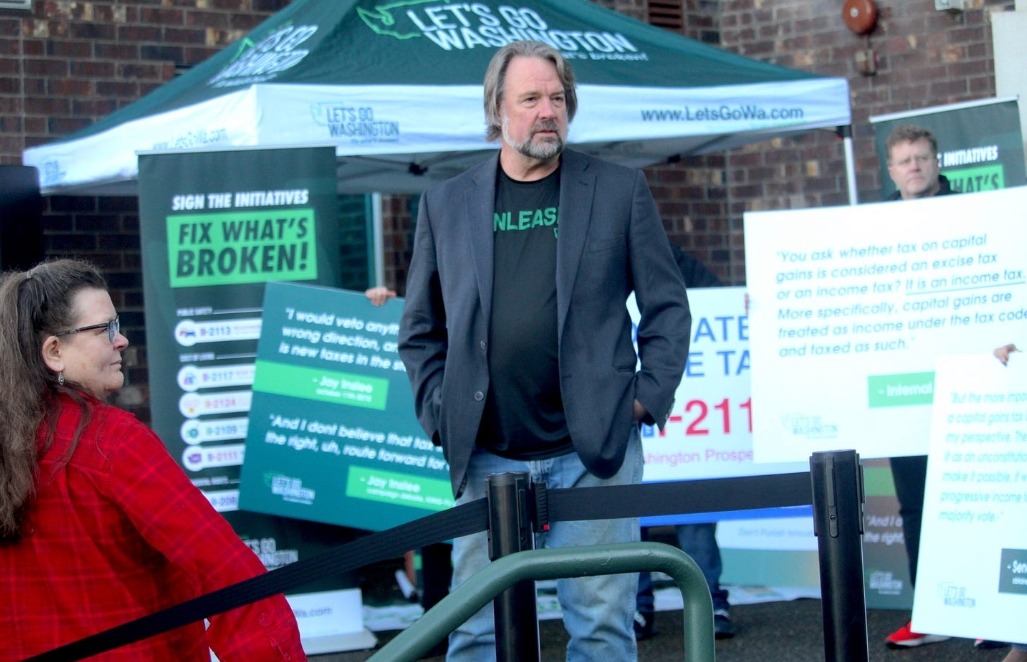

As we were perusing the latest financial disclosures from Let’s Go Washington (LGW), the conservative initiative machine that faces an impending deadline to qualify two ballot measures to the Legislature, we noticed a big new donor.
LGW got a check for $300,000 last month from an organization called Washington Rising, which has an interestingly anonymized website. The site is just a landing page with a donate button. There’s no “about us” page and no contact information, and their website registration is also a dead end. LGW’s disclosure of the donation lists an address in Tennessee, which looks kinda fishy. Washington Rising isn’t registered as a political committee with the Public Disclosure Committee, nor did we find it listed in the Secretary of State’s data on Washington corporations and charities.
That check represents nearly 10 percent of the more than $3 million LGW has taken in this year as it tries to qualify the two ballot measures. Most of the rest of the money comes from known players on the right, including LGW founder Brian Heywood and trucking magnate Steve Gordon. Money is particularly important in initiative politics because most campaigns rely largely on paid signature gatherers.
The group has until Jan. 2 to collect 308,911 valid signatures of registered voters. The Secretary of State recommends turning in about 390,000 to qualify because many signatures are duplicates or otherwise invalid.
We’re told LGW has 335,000 signatures in hand for Initiative 638, which would ban trans athletes from girls’ sports, and 307,000 for Initiative 001, which would roll back the Legislature’s controversial rewrite of the Parents Bill of Rights.
LGW tells us that they have a connection with Washington Rising through Amanda McKinney, a Yakima County commissioner who is mentioned in the text of the organization’s landing page. We reached out to McKinney but didn’t hear back before it was time to send out this edition.
The site’s broad rhetoric echoes talking points of LGW and other right-leaning groups opposed to Washington’s current progressive establishment, with a particular emphasis on the state’s agricultural sector. For example: “Washington Rising is a call to action — a movement to restore balance after decades of one-party dominance in our failing cities that has paralyzed rural communities and attempted to dictate our destiny, overriding the unique needs and voices of rural Americans who deserve the freedom to shape our own future.”
Let’s Go Washington put a suite of six conservative ballot initiatives before the 2024 Legislature. Majority Democrats in the Legislature allowed votes on three of them, including the Parents Bill of Rights, to keep popular ideas off the ballot that fall. The other three — which would have repealed the Climate Commitment Act, the capital gains tax, and the mandatory tax that supports the state’s long-term care insurance program — all failed at the ballot after an avalanche of spending from the left to protect those programs. A fourth initiative that would have rolled back various limitations on the use of natural gas passed but was thrown out by the courts. (Paul Queary)
Digging into the underground economy
Shady employers might be shortchanging the state and workers out of millions in tax dollars thanks to accounting tricks that are drawing eyes in Olympia.
Folks with the Department of Labor & Industries told the House Labor & Workplace Standards Committee as much earlier this month during their report on the above. One figure in particular stood out to us. As many as one in four workers in 2023 were “misclassified” as independent contractors and, as such, likely cost the state up to $59.8 million in payroll taxes per year on average.
Here’s another stat that won’t sit easy with state budget writers. In 2025 alone, some 2,000 employers were entirely unregistered — which allowed them to skimp out on about $298.2 million in taxes, insurance premiums, penalties, and interest. On average, as many as 14 people worked under them. L&I estimates a lot of that money was paid in cold hard cash — the lion’s share of it in the construction industry.
Make no mistake, this is bad for the workers being paid under the table too. Said workers don’t get unemployment insurance, sick leave, paid time off, or any of the adjacent benefits that come with being a true-blue employee.
The situation is likely worse than we know. This year alone, the department postmarked more than 1,000 infractions to unregistered employers. Those efforts were part of a tag team that included the state’s Department of Revenue and the Employment Security Department, whose audits helped sniff out the aforementioned parties. Most of the 341 unregistered businesses DOR caught over the past year were out-of-state.
As for solutions? L&I’s folks didn’t have any easy answers. They’ve recommended that lawmakers could hike penalties on repeat offenders’ knowingly hiring unregistered subcontractors or repeatedly “misclassifying” workers. They could also imbue L&I with greater authority to deny such parties new licenses and registration.
With that kind of money on the line, lawmakers have every incentive to weigh those options as they scramble to fill the budget gap. A further report from L&I on the matter is due Dec. 31. (Tim Gruver)
Washington still can’t figure out how much weed we’re growing
The Liquor and Cannabis Board has asked for $9 million from the legislature for a new cannabis traceability system. It’s been 13 years since cannabis was legalized in Washington, and if the system is put in place, it’ll be the fourth time the LCB has tried something new. So why is a working system taking so long?
There’s sort of a monopoly in the weed traceability industry, and the software in it continuously seems to fail. BioTrackTHC was the first system Washington tried to use. It’s one of the two main systems that states with legalized cannabis use, but had accuracy problems when Washington used it.
The other industry leader is called Metrc, which New York is moving to in place of BioTrack. BioTrack and Metrc signed a partnership agreement earlier this year and the verdict still seems to be out among cannabis reporters. The second system Washington tried to use was MJ Freeway, which had similar problems to BioTrack and was eventually bought out by BioTrack. See what we’re saying about monopoly vibes? MJ Freeway was replaced with the current system, CCRS, which is homegrown by Washington state (please laugh) but is a temporary solution that relies on self-reporting and still has accuracy problems.
The system detailed in LCB’s new request has the potential to make cannabis producers unhappy. LCB is looking at implementing a seed-to-sale system, which uses tags to track plants through the production process. In states using seed-to-sale, producers purchase and apply the tags with their own money and labor to remain in compliance. Back in 2018, cannabis license fees increased by $300 to help fund a new traceability system. Those fees, while pretty low, paired with the high tax rate, oversupply, and potential costly tagging system are a recipe for anger.
For some extra context, this newest system was requested by JLARC, the auditors for the Washington Legislature. They were asked to figure out whether licensed pot growers were cranking out more weed than licensed sellers could sell in 2023. We reported on the results back in June, but if you need a refresher, Washington is estimated to be producing two to three times more cannabis than it sells, with lots of disclaimers that the data is incomplete because of inaccuracies within CCRS, the current traceability system. Having a working traceability system allows tax collectors to verify that they’re collecting the right amount, makes for easy recalls if the weed is bad, and promotes understanding of the illegal market. Believe it or not, data is also nice to have while making legislation. (Rowan Herbst Minino)
These articles also appear in Washington Observer.
Discover more from Post Alley
Subscribe to get the latest posts sent to your email.


Don’t you love how Heywood is cultivating the Steve Bannon look?