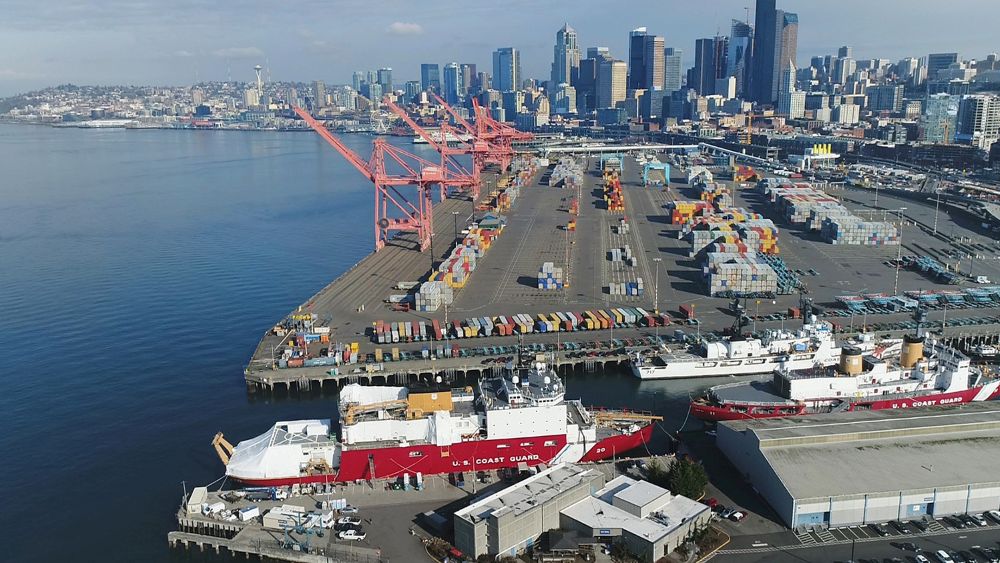

After six years of frustration, the Northwest Seaport Alliance (NMSA) is seeing a glimmer of hope in putting the shuttered Terminal 46 back into cargo operations. On Tuesday, the Alliance, which operates the Seattle and Tacoma ports, signed a 12-month agreement with a global infrastructure investor to seek opportunities for new cargo and industrial uses at the largely empty terminal just south of the central waterfront’s Ferry Terminal.
The agreement gives Brookfield Infrastructure Group exclusive rights to develop maritime business opportunities at the 86-acre terminal, with a focus on international container cargo, in partnership with NWSA.
Commissioners enthusiastically approved the agreement. Terminal 46, on the Duwamish River near SODO, is a “rare gem,’’ said Seattle Port Commissioner Toshiko Hasegawa. “We could not be more excited to see this explored. This is an important step in the right direction.”
Brookfield describes itself as “one of the largest owners and operators of critical global infrastructure networks which facilitate the movement and storage of energy, water, freight, passengers and data,” with $1 trillion in assets. In the transportation field, Brookfield invests in shipping terminals, warehouses, industrial properties, and energy, along with railroads and transportation equipment leasing.
Terminal 46, on the Duwamish River near Pioneer Square, was once one of Seattle’s premier terminals, long operated by Hanjin Shipping Co. until the company collapsed in 2017 during the global maritime recession. Another shipping line briefly took over the terminal, but due to declining cargo volumes shifted operations elsewhere in the Seattle harbor. Since 2019, business has been limited to occasional cargo and auto storage.
Peter Stone, Brookfield senior vice president, told the Alliance commissioners that his firm has been working with Alliance CEO John Wolfe and staff for several months, studying a variety of options for reopening the terminal. Under consideration is direct management of the terminal by the Alliance, rather than leasing to third parties as is common.
Efforts over the next year will be focused on developing a specific business proposal, but Stone offered no details. “We think we’ve got something,’’ said Stone, expressing confidence in the regional economic climate.
In a recent interview, Wolfe of the Alliance alluded to the pending Brookfield deal and possibility of direct terminal operation. “I’m willing to give it a try,’’ Wolfe said. “We’ve got to shake things up a little bit.”
Local longshore union leaders were equally enthusiastic. The union has strongly lobbied the Alliance and Seattle commissioners to preserve T-46 for cargo uses and to reject other uses — such as the U.S. Coast Guard’s proposal to acquire much of the terminal for patrol vessel berths. The Coast Guard is in the midst of a major renovation of its Pier 36 base just south of T-46.
Cargo volumes in both the Seattle and Tacoma harbors have struggled to return to pre-pandemic levels. Parts of the BNSF rail yard have shut down for lack of business, and Terminal 30, another Duwamish River terminal, recently closed due to legal problems and low volumes. As a result, longshore workers’ hours in Seattle have declined sharply.
In a nod to the unions, the Brookfield agreement sets a goal of developing container operations “utilizing human-operated cargo handling equipment,’’ not automated machines such as those in increased use at other ports around the country. “We love that,’’ said Herald Ugles, a former president of the longshore workers’ union Local 19.
Although not a promise that cargo will start flowing again, the deal offers the first sign of hope after several false starts over the years. “Terminal 46 has always kept me up at night,’’ said Tacoma Commissioner Deanna Keller.
But significant challenges lie ahead. Trump Administration trade policy has shattered long-time partnerships with China, the Alliance’s largest trading partner, and imposed tariffs that have increased the costs of imported goods. Other West Coast ports are aggressively fighting for market share. For instance, the Vancouver, BC, port is embarking on a major expansion to lure more Asian cargo.
Discover more from Post Alley
Subscribe to get the latest posts sent to your email.


Respectfully, there is already ample (vacant) container capacity south of Terminals 46 & 36. A better option would be to develop an urban community like Vancouver’s Granville Island to anchor the South end of our newly transformed Central Waterfront and compliment newly unveiled Pioneer Square.
A mix of housing, light industrial, a destination Fish Market (like the new Sydney Fish Market) and restaurants would create more jobs and vitality to the City than a parking lot for containers.
Greg Nickels is correct.
I believe we should be broadening our understanding of “industrial lands”. Many light manufacturing and industrial uses close evenings and weekends and such a neighborhood can be compatible with residential above.
Some years ago Erica Barnett wrote a terrific article on this very subject of mixed residential-industrial neighborhoods and it’s still very relevant today.
Read
http://publicola.com/2018/05/09/3853/
And then take a visit at the low rise
https://schnitzerproperties.com/property/cloverdale-business-park
I can imagine (and I think others could as well) living in apartments above a business park like that (in more traditional ped-oriented form) because it’s actually quiet during evenings and weekends.