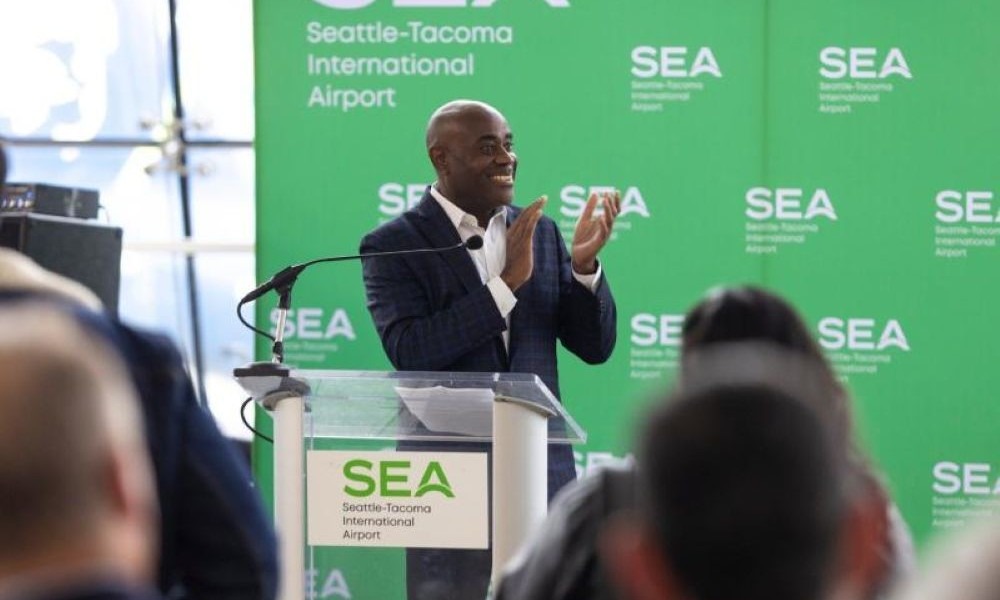

Lance Lyttle has left his job after nine years leading Seattle-Tacoma International Airport. His new job is at the airport in Orlando, Florida. He is leaving Sea-Tac at a critical juncture in its 75-year history: $5 billion in capital projects underway, a return to record passenger growth, and looming decisions about the airport’s last major expansion.
If the job keeping millions of Sea-Tac passengers happy was not enough, Lyttle had to deal with the crushing impacts of the COVID pandemic, fierce competition between Alaska and Delta airlines, skyrocketing construction costs, and restless airport communities unhappy with airplane noise and air emissions.
Oh, and protesters triggered by President Trump’s Muslim ban storming the terminal in 2017. Also, a ground crew worker’s brazen theft of a Horizon Airlines plane in 2018, which crashed fatally on Kentron Island. And a cyberattack last year that froze much of the airport’s computer systems.
Lyttle leaves Seattle for a bigger airport that delivers millions of visitors to Walt Disney World and other tourist destinations in central Florida. Orlando International Airport is run by a single-purpose airport authority in a community that embraces the airport and favors expansion, he said. “I think they have a fantastic community that works very well and supports the airport,’’ Lyttle said. “The community wants the airport to grow. That’s very attractive.”
Steve Metruck, Port of Seattle executive director, praised Lyttle for his “vision’’ and focus on maximizing the airport’s limited facilities while working to improve customer service. Metruck credited Lyttle for his efforts to create partnerships with airport communities, efforts that have won broad praise from city leaders. To replace Lyttle, “we need someone who can take over the baton going forward,” Metruck said.
Lyttle takes over Orlando International Airport, Florida’s largest with 57 million passengers a year, and with ambitious expansion plans. The Jamaica native arrived in Seattle after posts in Atlanta and Houston, as Sea-Tac gained the title of one of the nation’s fastest-growing airports. Lyttle was a finalist for the Orlando job three years ago. He was edged out by Kevin Thibault — a favorite of Gov. Ron DeSantis – but who resigned recently due to a family illness.
At 14,000 acres, Orlando has plenty of room to grow. By contrast, Sea-Tac moved nearly 53 million passengers on just 2,500 acres and has no room to expand outward. Sea-Tac’s terminal-expansion plan is mired in protracted environmental review, and the state has stalled efforts to site a new regional commercial airport.
Lyttle’s tenure as Managing Director has been marked by near-continuous remodeling and renovations of the main airport terminal and the North Satellite, now called North Concourse, for Alaska Airlines, replacing the 1970s-style architecture with more efficient space and technology. Those steps will help to move more passengers on the same footprint, but passengers are often frustrated and confused by the maze of construction barriers.
After years of COVID-related delays and costs reaching $1 billion, the International Arrivals Facility was completed in 2022, a major step forward in accommodating growing overseas air travel. In a sweeping reconfiguration of the north end of the terminal, construction is underway on Alaska Airlines’ Gateway project. Also nearing completion is the expansion of Checkpoint 1 at the south end, along with a billion-dollar upgrade of baggage handling systems. A new four-story addition is now rising at the C Concourse, creating new space for retail businesses and offices.
Under Lyttle , expansion has been notable for efforts to attract local, minority, and women-owned firms to operate airport concessions. Along with parking, food and beverage sales are a major source of airport income. A major focus of his efforts was improved customer service. Lyttle was well-known for walking the airport floors picking up trash and checking cleanliness of restrooms. He aggressively pursued Skytrax World Airport awards, winning its top U.S. airport ranking in 2024.
A major challenge has been reining in soaring construction costs, which accelerated during COVID. Materials and labor costs play a big role, but Lyttle also took steps to reform the airport’s project management bureaucracy to better control costs. Lyttle credits the airport staff with the airport’s success. “I’ve been blessed with a fantastic, talented team,’’ he said. His deputy, Arif Ghouse, the former Paine Field director, was named interim director.
Lyttle, however, never seemed entirely comfortable living in the Seattle area, far from his family in Jamaica. He notes that in Orlando, he is only an hour away by plane. In addition to the Orlando post, he had sought other airport jobs in past years.
In Orlando, Lyttle looks forward to working for an authority responsible solely for aviation, managed by a board composed of local city officials and gubernatorial appointees. By contrast, the Port of Seattle also has a major seaport, fishing, cruise, and real-estate operations, overseen by five elected commissioners. “The focus in Orlando is on nothing else but aviation,” Lyttle said. “That’s very attractive.”
An outsized part of Lyttle’s job in Seattle was managing relations with the airport’s 36 airlines, who pay to lease space in the terminal and hand over landing fees based on each airliner’s landed weight. Another major component of airport revenue is the federal Passenger Facilities Charge (PFC), charged to passengers as part of their ticket price.
As travel increases, airport managers must referee the heated competition among airlines for more space, even as they pressure the airport to keep costs low. For example, Alaska Airlines, Sea-Tac’s biggest customer, for years opposed the Sea-Tac’s terminal gate expansion plans, called the Sustainable Airport Master Plan (SAMP). This was at a time when Atlanta-based Delta Airlines was rapidly expanding its service to establish Seattle as its Asian hub. Executives from Delta, the biggest U.S. airline, constantly dogged Port management and commissioners to speed up construction of the IAF and add more aircraft gates.
Alaska’s tune has changed, however, as it joined the One World airline consortium and
acquired Hawaiian Airlines and its Asian destinations. Alaska now heartily endorses expansion. “One of the great things about having two or more airlines is that it gives you more options for passengers and more destinations. That’s something we welcome,’’ Lyttle said. “They are going to compete and compete hard.”
Alaska Airlines praised Lyttle for “partnering with Alaska to deliver generational investments” including the North Concourse, Gateway, and C-Concourse projects. The airline’s leaders “look forward to engaging with the Port as it undertakes a robust search for an experienced candidate to lead Alaska Airlines’ largest hub airport,” said Shane Jones, an Alaska senior vice president.
Delta also called for the Port to conduct a “thorough and comprehensive search to find a world-class leader’’ for the airport. “This is a pivotal moment for the airport’s future, as the region is experiencing robust population and economic growth,” said spokesperson Berj Alexanian, reinforcing the airline’s push to expand airport capacity.
Lyttle’s personal engagement with SeaTac, Burien, Des Moines, Normandy Park, Tukwila, and Federal Way is credited with a marked decrease in tensions with the airport communities. Burien, Des Moines, and Normandy Park waged a long and costly battle against construction of the Third Runway, completed in 2008.
He created the SEA Stakeholder Advisory Round Table in 2018 with representatives of the six cities, along with airlines and the FAA. Its charter was to create a dialog with the
communities, share airport information, and work on common problems such as airport growth, noise, air emissions, and other issues. A big step forward was achieved when the Port joined with the cities on common legislative agendas with Olympia and Washington, D.C., on noise, environmental, and funding topics.
“He’ll be missed,’’ said Burien City Council member Jimmy Matta, reflecting on the inherent tensions between communities who depend on airport jobs yet live with constant overflights and air emissions. “The challenge is, how to make sure everybody feels they are part of the conversation. He does a good job,’’ Matta said.
Normandy Park Mayor Eric Zimmerman cited a successful effort by the airport and communities to persuade the FAA and airlines to reduce late-night use of the Third Runway, closest to residential areas. Lyttle also was effective in encouraging airlines to use flight paths and change ground operations to minimize residential impacts. “Since Lance Lyttle, it’s a very big difference,” Zimmerman said.
Lyttle leaves Seattle with an urgent call to move ahead with the stalled expansion in its master plan — 19 more gates in a new stand-alone terminal – and to resolve the long-term question of siting a new commercial regional airport before Sea-Tac runs out of room. By contrast, most major U.S. airports are expanding to handle a boom in air travel. Seattle’s master plan has yet to gain federal environmental approval, despite more than six years of studies. The port will need to complete a year-long state environmental review before the projects even come to the Port Commission for action, unless stalled by lawsuits.
The state ended its search for a new airport site in the face of community opposition and is now conducting a more general review of long-term transportation needs. Without more gates, passengers will face more traffic congestion, longer lines, and likely higher ticket prices.
To Lyttle, the issue is not about pushing passenger growth, but ensuring a better travel experience for the demand that already exists. “We have to have that second campus,’’ Lyttle said. Otherwise, “the level of service is going to be terrible.”
But going forward, the Port will have to balance those economic pressures against the
environmental impacts — greenhouse gas emissions, health effects of ultra-fine jet-fuel
particles, and aircraft noise — that are common to every major airport. In response, the airport is funding research into non-fossil jet fuel and other measures to reduce impacts.
The Port of Seattle will soon launch a nationwide search for Lyttle’s successor. Commissioner Ryan Calkins said the key qualifications will include experience in capital construction, safety, customer experience, and community relations. But Lyttle will be a tough act to follow, he said. “Lance was a transformational leader at the airport,” he said. “We couldn’t have asked for a better leader.”
Discover more from Post Alley
Subscribe to get the latest posts sent to your email.


Good to see Mr Lyttle get the high praise he earned.
Thanks for reading. I want to note that the Checkpoint 1 project is actually at the south end of the terminal (as everyone who passes through there is aware). For the record, the airport now prefers the use of SEA (its air-system identifier), rather than Seattle-Tacoma International Airport. Also, the satellites have been renamed to North Concourse and South Concourse.
Lance was a great leader. I met him at the going away party of his predecessor, Mark Reese 9.5 years ago. I asked him about how he addressed community concerns when he was director of Houston Intercontinental. I was impressed about support for community engagement. While he had plenty to juggle in Seattle, today’s announcement of a Delta Jet on fire in Orlando shows there will always be challenges to face as airport director. We greatly appreciated the time he spent here.
Read that in December SEA won $14M settlement with Clark Construction. Will SOM redesign the main steel elements or just change the gate spacing for larger planes? The SEA design vehicle and fleet mix change is my interest.