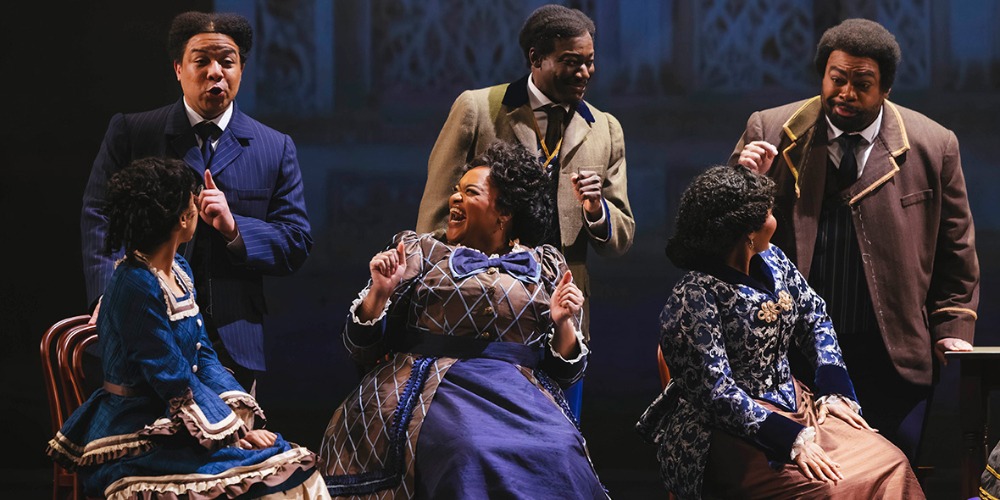

I counted at least 30 different spirituals woven into the fabric of Jubilee, an opera commissioned by Seattle Opera’s outgoing General Director Christina Scheppelmann and based on a musical of the same name by Tazewell Thompson and Dianne Adams McDowell. Sunday afternoon’s matinee was well received, in part because of the familiarity of these foundational works of American music.
Thompson had long dreamed of creating a theater piece about the Fisk Jubilee Singers, the postbellum African-American choir that single-handedly brought what we now call the “spiritual” to a worldwide audience. He collaborated with choral arranger Dianne Adams McDowell to create a voice-only musical, which premiered at Washington DC’s Arena Stage in 2019.
Thompson, the director and librettist of the opera Blue (given here in 2022), felt his musical was well suited for operatic treatment, and cast about for a company to commission the transformation. Seattle’s Scheppelmann agreed, and composer Michael Ellis Ingram was engaged to create an orchestral backbone to the score while sublimating McDowell’s superb choral arrangements into an opera. This was a tall order, and it succeeded in many ways.
Act One opens in 1871, backstage at a theater in Nashville, where the 13 members of the Fisk Jubilee Singers are warming up before a performance. The group had been assembled by Fisk University’s treasurer, George Leonard White, as part of a fundraising effort to stave off bankruptcy. White, a white missionary and the school’s music director, is inspired by the slave songs the singers share with each other and convinces them to showcase this “soul music” before paying audiences.
The tale unfolds through a maze of beautifully realized choral settings narrated by Ella Sheppard (an excellent Lisa Arrindell). She takes on various roles, like a condescending southern hostess who hustles the group out the back door after a performance with leftover food for payment. Also, she enacts George Leonard White himself. Notable set pieces include the discovery of slave chains, shackles, and muzzles unearthed in the singers’ vegetable garden (“Nobody Knows The Trouble I’ve Seen”), and a savage beating the group suffers at the hands of a white mob, effectively mimed and violently realized in the orchestra.
The act concludes with preparations for a command performance before Queen Victoria, and a brilliant bit of business in White’s attempt to rehearse “Didn’t My Lord Deliver Daniel.” Maggie Porter (soprano Aundi Marie Moore) refuses to participate, making clear her intention to become a prima donna. She then sings an excerpt of the aria “Pace, mio Dio,” from Verdi’s “La forza del destino” in a kind of dream tableau. This was the only music in the score which was NOT derived in some way from McDowell’s spirituals (apart from a stray quote from Rozsa’s overture to Ben Hur).
A brief, anglicized version of “Swing Low, Sweet Chariot” raises the Act 2 curtain in London. After taking in the sights (“Twelve Gates To The City”) the group performs before Victoria, again depicted by Ella Sheppard. The queen is transfixed by their musicmaking (“Steal Away” and “Go Down, Moses”) and muses over the singers, how they sound and the color of their skin. Somehow this candid and uncomfortable monologue doesn’t seem meanspirited, and her favor assures packed houses all around England. Time shifts forward here, to the end of their third and wildly successful tour of Germany. Exhausted and sickened by the punishing concert schedule, the group finally crosses the Atlantic toward the United States.
“Wade In The Water” forms the basis of multiple monologues among the women, and transforms into a seductive duet between the illicit lovers Georgia Gordon (mezzo-soprano Natalie Lewis) and Frederick Loudin (tenor Martin Luther Clark). Similarly, the upbeat “Plenty Good Room” serves as a kind of relay for the men, each of them passing the baton at “Just choose your seat and sit down!”. Perhaps it was this kind of verse taking, the semi-uniformity of the costuming and the fact that very few of the 13 characters were introduced by name that kept me uncertain of who was who.
We see into the group’s future upon their return to America, first at the Apollo Theater in Harlem, where the men perform “Sun Don’t Set In The Morning.” Their music now incorporates movement, clearly referencing later groups like the Spinners, and as if not to be outdone, the women move like proto-Supremes (“My Lord Is So High”). It’s easy to see the connection here between Spiritual and Gospel, Gospel and Soul.
The finale is built around “Over My Head (I See Glory),” and “Do Lord, Remember Me.” Here, the Fisk Jubilee Singers, one by one, give accounts of their lives. As photographs of the 13 historical members are projected beyond, the orchestra drops out, leaving the chorus on their own, resolving to unison.
This is a rare creature, an opera about a chorus. Composer Ingram undertook a near impossible task: respect the lapidary choral arrangements of the musical while providing enough of an orchestral sound world to transform the work into an opera. Opera is character driven, of course, so here too he was facing headwinds. His orchestrations were certainly played to fine effect by the pit orchestra, which responded well to conductor Kellen Gray’s graceful baton. Given the assignment, I think Ingram succeeded.
Jubilee tells a compelling story, and it must be seen. That said, it seems to me there is an even stronger opera within, one with the same DNA, that could be remade from scratch.
Discover more from Post Alley
Subscribe to get the latest posts sent to your email.

