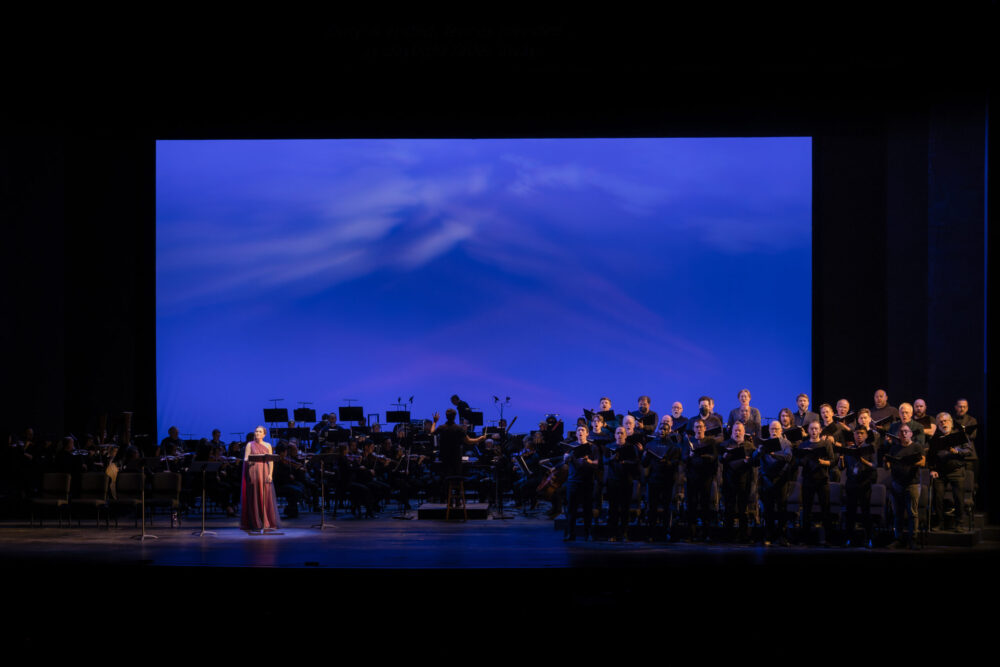

With a uniformly strong cast in fine vocal fettle and a well-rehearsed orchestra and chorus (led by conductor David Afkham,) last Friday night’s concert presentation of Daphne rose to Olympian heights. No Seattle Opera production in recent memory has boasted such top-to-bottom excellence.
Premiered in 1938, Daphne is filed in the “Late Strauss Opera” drawer, sometimes code for “Rehash of his Earlier Masterpieces.” Indeed, its mythic, pastorale setting suggests the 74-year-old Strauss hadn’t yet done with Greek drama. Strauss had started strong with Elektra and Ariadne auf Naxos, but revisiting these ancient legends must have seemed anachronistic after the Great War. Yet Strauss persisted, adding Die ägyptische Helena, Daphne, and eventually Die Liebe der Danae to his body of work.
Reminiscent though it may be of his earlier compositions, Daphne is in no way a rehash. This is a concise one-act gem, a masterpiece of vocal writing and orchestration, and the perfect vehicle for showcasing this excellent cast and orchestra.
Soprano Heidi Stober brought to the role of Daphne a full range of emotion. The brightness of her voice allowed her to modulate seamlessly between Daphne’s innocent ruminations and the ecstatic close of her opening aria. As a divine living among mortals, Daphne repulses the advances Leukippos (tenor Miles Mykkanen), a shepherd and childhood playmate. Mykkanen, whose expressive face and lyric sound brought to mind the great Fritz Wunderlich, proved a perfect partner in their duet, another knockout.
The Wunderlich connection for me: The late tenor appears as Leukippos on the 1964 Karl Böhm recording, so it was a thrill to hear a performance of similar stature and quality presented at McCaw Hall.
The true star of Daphne was the orchestra, integral in its role in setting scenes and defining character. As at a symphony concert, the instrumentalists sat onstage, rather than in the pit. However, for those of us in the stalls, the lower strings and brass were hidden by the men’s chorus, who sat on risers at the front of the stage. This was fantastic during their interjections, especially the trumpet-like tenor section, but I envied the audience members sitting in the loge or balconies who could hear the actual trumpets.
Daphne’s mother Gaea (mezzo-soprano Melody Wilson,) was somewhat miscast in a contralto role and sounded less like mom and more like an older sister. Mocking Leukippos for his unrequited love, two maids (soprano Meryl Dominguez and mezzo-soprano Sarah Coit) dare him to join them at the upcoming summer feast wearing Daphne’s dress. Strauss’ obvious model here was the opening to Act III of Wagner’s Gotterdämmerung.
The four shepherds (baritone Ilya Silchukou, tenor Martin Bakari, Baritones Micah Parker and Michael J. Hawk) function like the maids in Elektra, and the quartet sniped at the principles like hectoring crows. Daphne’s father Peneios the fisherman (bass Matthew Rose) was the vocal standout of the evening. His dark sound (reminiscent of Gottlob Frick) commanded major attention.
Finally, Apollo enters disguised as a mortal, having been lured to the feast by the odors drifting across the river. Tenor David Butt Philip, brought vocal steel to that role, but not at the expense of beauty. As he falls for Daphne and reveals to her the meaning of her presence at the feast, Strauss quotes extensively from his own Don Juan (which he wrote 50 years before.)
After another thrilling finish to an evenly-matched duet, things take a darker turn. Even with Jonathan Dean’s excellent supratitles, the absence of stage action left me more dependent on the orchestra to orient things emotionally. With Leukippos’ challenge of Apollo and his subsequent death, Strauss takes us into ever more chromatic harmonic territory.
Apollo begs forgiveness from his brother Dionysus and his father Zeus to give him Daphne in the form of a laurel tree, and the musical landscape clears. The closing pages of the score, representing Daphne’s transformation, may be the most sublime music Strauss ever penned, crowned with her exquisite vocalise.

