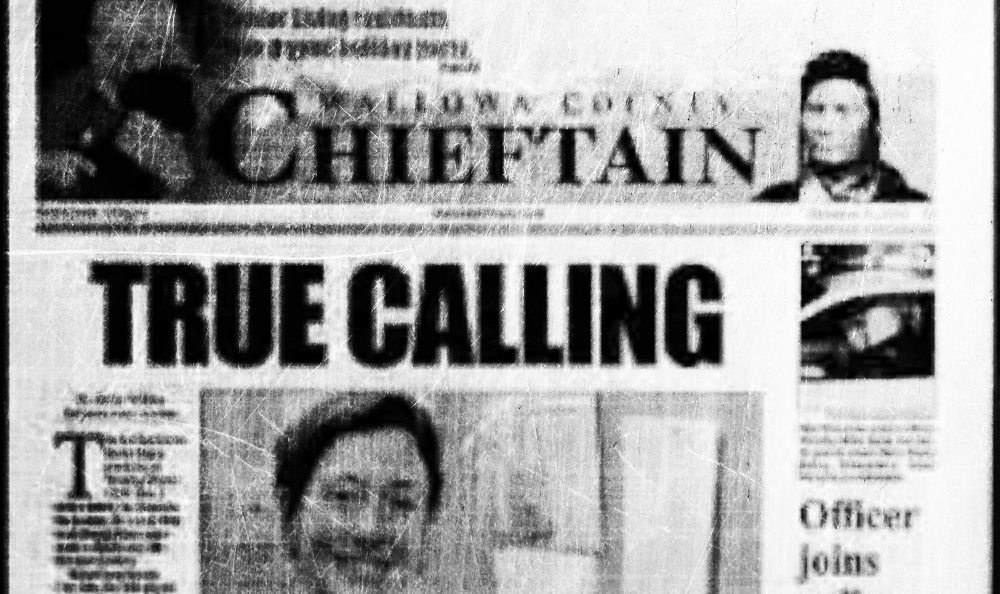

Thinking about the demise of the print edition of the Wallowa County Chieftain and the loss of local newspapers across the country, I think of the longtime publisher and editor of the Chieftain, Gwen Coffin. From 1941, when he moved from Chicago to Enterprise to take over the Chieftain until 1970, when he turned things over to his son-in-law, Don Swart, Gwen kept one eye firmly on what was going on in the world and the other eye firmly on things in Wallowa County.
Gwen grew up poor in Colorado, made his way to Chicago and law school, and moved here and bought the newspaper thinking that he’d have a dual career in newspaper and law. That didn’t happen: he stayed with the paper and forgot the law.
He took over the paper mid-1941 and had not really settled in when Pearl Harbor and the Second World War overtook everything. I once went to the Chieftain’s “morgue” of past papers and went through all the War years. The front page always had a group photo of the boys who were leaving for training (sometimes a half-dozen, sometimes two dozen) and, later in the War years, small front-page notices on one of them who had been promoted, or been killed or gone missing in action.
In the middle of the paper, there were stories on rationing and the women at home, on a US training flight bomber that had crash landed at the golf course, and the normal run of
weddings, basketball games, and obituaries, Gwen put his editorials on the back page, and they often reflected praise for the War effort at home and abroad, and
condemnations of “war profiteers” across the country.
On April 8, 1943, Gwen wrote this: “Much of the resentment on the West Coast toward the Japanese was not the outgrowth of the war but arose during peacetime as the Japanese achieved some success and prominence in their pursuit of agriculture and trade. Many employers preferred to see the Japanese remain in the ranks of the low paid wage earners. Others were resentful at the sight of Japanese prospering….
“It is foreign to our conceptions of democracy, however, to distinguish between peoples on the basis of color or nationality. There should be only one test for the right to share in the opportunities which this country provides, and that is the test of belief in our democratic ideals and government, and a willingness to work with other Americans to further those ideals and to support this government.”
He opined that we would not be proud of the incarceration of the West Coast Japanese in internment camps. Gwen’s was a decidedly progressive view of government. Maybe that was another reason for Gwen quitting the city for Wallowa County—much like I would do 30 years later.
Gwen was a hunter and a fisherman who embraced early environmental views. He became friends with Supreme Court Justice William O. Douglas, who, in a famous opinion on dams on the Snake River, said that fish too had rights. Douglas had land and cabins up the Lostine River, and they hunted and fished together. I’m sure too that Gwen and his wife, Gladys, did not approve of the Justice’s treatment of women. The county, I was told by Gail Swart and others, all loved William O.’s first wife, and did not take to any of the later ones.
Gwen was a successful advocate for a new hospital; he exposed illegal slot machines and he opposed the Vietnam War from its beginnings. Wallowa County was still heavily New Deal Democratic when I arrived in 1971. But he was a respected man who could be disagreed with amicably, and he provided a forum for community conversation and understanding that is sorely missed today.
The online consolidations have proved poor substitutes. We don’t know the marriages, births, and deaths, the police beat, or the high school athletic and FFA heroes. We’ve lost the common ground that has attracted and kept many of us here to this day.
With no replacement in sight.
Discover more from Post Alley
Subscribe to get the latest posts sent to your email.


What’s curiously absent from consideration in this essay is the virtual duopoly on advertising revenue thereby breaking the economic model for local news.