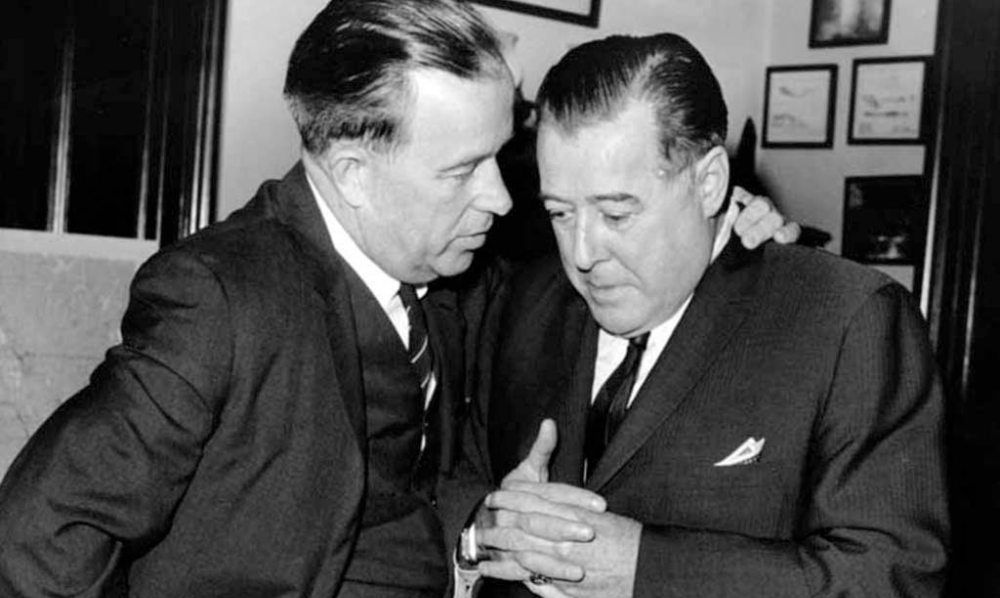

The problem telling Maggie stories nowadays is that you must stop and tell folks who Warren G. Magnuson was. He served this state in Congress for 44 years, 36 years in the Senate. I thought of Magnuson this week, thinking that I should have thought of him every time I turn on a light switch on a dark, raw midwinter day.
An early memory is of Magnuson billboards featuring the senator’s visage and the slogan “Keeps Our State Moving.” President Kennedy poked fun envisioning Maggie coming to the Senate floor late in the afternoon, mumbling about offering an insignificant amendment, “and Grand Coulee Dam gets built.”
Franklin D. Roosevelt built the 550-foot-high dam. But Maggie secured money to build its great third powerhouse, which heats and lights homes in this region during winter. Maggie was eventually chairman of the Senate Appropriations Committee. In 1962, Time magazine described Maggie as “a skilled politician with few pretensions to statesmanship.”
He wielded power backstage in the Senate while living a colorful life center stage. Why think of him now? Because Magnuson made government work for the people, and build the infrastructure that has allowed the nation and Pacific Northwest to flourish. Today, the Trump Administration is attacking that infrastructure with a wrecking ball.
Magnuson sponsored the Corporate Public Broadcasting Act of 1967. That entity, the Corporation for Public Broadcasting, just went out of business. The 1964 Civil Rights Act, with its public access provision, was crafted in the Senate Commerce Committee chaired by Magnuson. In the process, Maggie had to break up a wrestling match between segregationist Sen. Strom Thurmond, R-South Carolina, and liberal Sen. Ralph Yarborough, D-Texas.
Maggie was also renowned for his malaprops. The president of France, Georges Pompidou, was “Poopidou.” The imperious chairman of the International Olympic Committee, Avery Brundage, was introduced at a Senate hearing as “Mr. Average Brundy.” When an environmental hearing witness slammed the Boeing SST project, Maggie exclaimed: “We can’t all go live at Walden Pond. Even Walden only lived there two years.”
Magnuson had a scare in 1952 when a Lutheran minister, Richard Christensen, held him to 52 per cent of the vote. He undertook a total image transplant with help from young aides — Gerry Grinstein and Gerald Johnson, the best known — he labeled as his “bumblebees.”
The buzz over oil spills in coastal waters led to Magnuson’s best known “little amendment.” Attached to renewal of the Marine Mammals Protection Act, it forbade supertankers beyond Ediz Hook (near Port Angeles). An oil port booster, Dixy Lee Ray, our last truly awful governor, called Maggie “a dictator.” In turn, he mocked her at the 1980 Democratic State Convention. Dixy stomped out. Later Magnuson, a lover of good drink, told Tacoma Democrats that smaller oil tankers could supply “every distillery on the Coast.”
The Senator went on to oppose making Hanford a dump for “spent” but highly radioactive fuel rods from nuclear power plants. He was a longtime booster of the nuclear reservation, but delivered memorable pronunciations of the Fast Flux Test Facility, a test reactor at Hanford.
Earlier in his Senate tenure, Maggie was an intimate of Lyndon Johnson, and advocate for Great Society programs that are now on the chopping block 60 years later. In personal life, Maggie and a widow named Jermaine Peralta, 18 years his junior, preceded the young people by living together outside bonds of marriage. They slept over at the White House after a social affair. The day’s first tour saw the couple, in evening dress, coming down the stairs. LBJ ordered that they wed and acted as chief witness.
Magnuson told a story on himself to the Seattle Post-Intelligencer Ed board. The couple had a free weekend after a speech at WSU and went to check in at a motor inn in Idaho. The suspicious clerk requested proof they were man and wife. Maggie produced a marriage certificate from his billfold, signed by Johnson. The disbelievering clerk suggested that they go to another place down the highway with looser moral standards.
As a powerful member and later chair of Senate Appropriations, Magnuson delivered millions of federal dollars to cancer research at the University of Washington. Maggie delivered more than a billion dollars in aid after the Mount St. Helens eruption. (Today, Trump wants to slash FEMA assistance.)
Magnuson waged a campaign too far in 1980, weakened by diabetes and slowed to a shuffle. My mother said, “I love the dear man but he can hardly walk anymore.” Republican Slade Gorton retired the old senator. “Slade Gorton has a great pair of legs but Magnuson gets things done,” Rep. Al swift argued in a futile TV spot. Gorton won going away with it in a GOP/Reagan year. Gorton advertised himself as “Washington’s next great senator,” paying tribute to Maggie.
The Magnusons took up residence in the west side of Queen Anne Hill, a totem pole decorating their front lawn. Years earlier, I had broken the news to him of Scoop Jackson’s death, and was first to hear the familiar refrain, “If I knew I would have lived this long, I would have taken better care of myself.” Nicknamed the “gold dust twins,” the pair served together for 38 seniority-enhanced years.
He was a character with character. Today, Patty Murray, who occupies Maggie’s old Senate seat, is serving her sixth term and is closing in on a 36-year tenure. Thus, Washington has for 80 years enjoyed power in the “other” Washington.
This article also appears in the Cascadia Advocate.
Discover more from Post Alley
Subscribe to get the latest posts sent to your email.


Ah, yes, Maggie and Scoop. Those were the days. Wouldn’t mind seeing some of that kind of “behind the scenes” politics come back. When congress actually accomplished things without the need to skewer the opposition. When discussions and disagreements were friendly and lacked the vitriolic and acidic rancor of today. Given the inability of congress to “literally slap its’ ass with both hands,” let alone even find it, I fear we may never see that kind of productivity and movement for the good of the PEOPLE again. I my humble opinion, our government has forgotten the premise of this nation as state eloquently by Lincoln at Gettysburg, “…and that government of the people, by the people, for the people, shall not perish from the earth.” I sometimes fear we are dangling by a thread.
Nowadays, people keep yammering about “transparency”, but the saying that sticks in my mind is, “People don’t really want to see how the sausage is made, “ meaning that the backroom wheeling and dealing can be unseemly to the public, but often is the only way to get things done.
I met Senators Jackson and Magnuson in the parking lot of the Everett Safeway store in 1964. I think Jackson was running for his second term. I encountered them as I was walking out of the store with my mom and shook both of their outstretched hands in passing. They both were in suits, no entourage, greeting shoppers coming out of the store so a brochure could be placed in their grocery bag.
Retail politics at its finest.
I knocked on doors for Maggie’s last campaign as many did for him. When doing so and mentioning his name, folks asked that you come in and talk more about him. He was revered by the seniors and most talked about him as if he were their neighbor.
His legislative accomplishments, the will to do it and way to do it will never be replicated for many reasons.
While I respect a few remaining in the senate, the uniqueness of Maggie simply will not enter the Senate chambers again. The giants have left their mark and if history remains, they will be written about, albeit not often enough.
Here is an excerpt from my book Connecting Washington and China — The Story of the Washington State China Relations Council:
“Maggie had long cared about China and its people. As soon as he was elected to the House of Representatives in 1937, he started working to eliminate the provisions of the “Chinese Exclusion Act” of 1862 from U.S. immigration laws. That he succeeded in accomplishing in 1965. In 1940, after the Japanese invasion of China, especially the Rape of Nanjing, Rep. Magnuson was instrumental in banning the export of scrap steel to Japan. Scrap was leaving through Seattle and other West Coast ports. Soon after Mao proclaimed the founding of the People’s Republic of China in 1949, Maggie began advocating normal relations with China.
Suspected and referred to as a Red and a Communist, Maggie never wavered from his view, “We can’t write off 700 million people because they’ve been united under a Communist regime. We should bring them into the United Nations and make trade—and pacify the Pacific Rim with commerce.” As early as1958, he told Seattle Post-Intelligencer that it should write editorials in favor of trade with China because “the most stupid policy we could follow is to pretend 700 million people in the world don’t exist.” A famous and mysterious 1973 photo of Maggie laughing with then Chinese Premier Zhou Enlai was perhaps the most poignant image of his friendship with China.”
I’d love to see a complete list of Maggie’s bumblebees and their accomplishments. One of Maggie’s greatest achievements might be his skill in selecting and launching so many civic achievers.
I met Senator Magnuson in the early 1970s, while sitting in the Northwest Airlines’ Frequent Flyer Lounge in SeaTac. I was reading a paperback (yes, a book!) about the American Revolution and the Senator sat down across from me. A Lounge employee came over and said “two Senator” holding up two fingers. He nodded and a shot of vodka appeared shortly thereafter. He asked me if I would like to hear how the American Revolution ended, and of course I said “yes.”. He then proceeded to give me a history lesson on how Cornwallis surrendered from a ship and then refused to come to the surrender ceremony. In retelling the story, I was taken how indignant Magnuson was that Cornwallis did not do the honorable thing with George Washington. We smiled at each other.