
Ed: Reprinted with permission from Salish Current
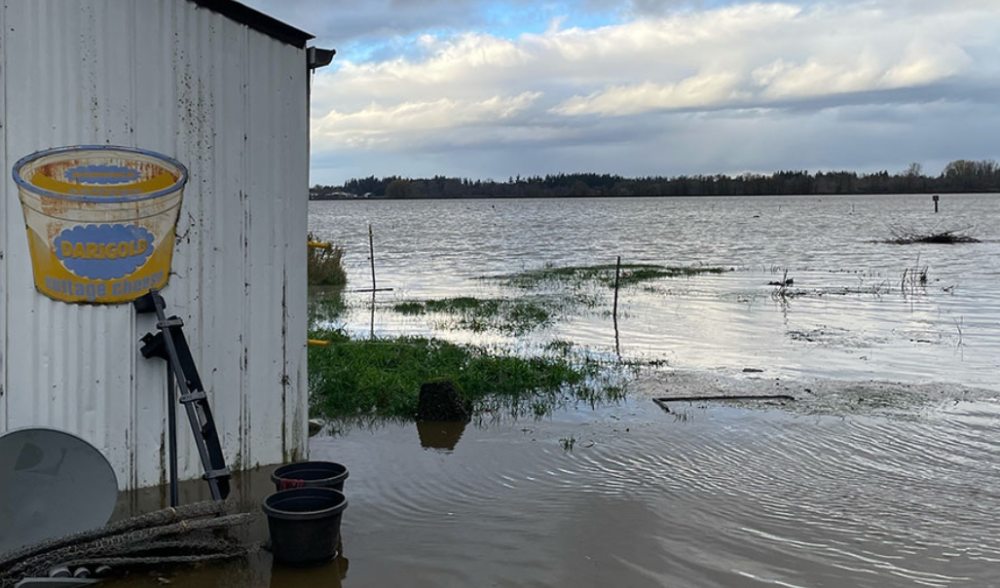
As the past few weeks — and years — have shown, floods in Northwest Washington are only getting worse in terms of frequency and size.
Communities across the state are facing long-term relief and recovery efforts after what Gov. Bob Ferguson called “undoubtedly one of the most devastating in our state’s history.”
Environmental experts are warning that flood events are only going to worsen in coming years. Living with them, they say, will require policy change and a mindset shift that focuses more on working with nature than controlling it.
Kaia Hayes, land and water policy manager at the Bellingham-based environmental nonprofit RE Sources, said the causes behind worsening floods are twofold. “We’re contending with a bit of a two-headed hydra right now. One of them is the legacy effect of the last century of land-use decisions. The other is the compounding effect of climate change,” she wrote in an email. “We’ve made modest gains in correcting for these mistakes as we understand the ramifications better, but they aren’t enough to close the widening gap.”
To understand those flood factors, University of British Columbia professor Younes Alila said it’s important to first understand how a watershed works. A watershed is essentially a bunch of storage facilities — lakes, groundwater, wetlands, mountains — where rain or snow melt can be stored temporarily before being released slowly. Similar to the human body, he added, the watershed and its stores only have so much capacity for stress.
“It has a certain capacity of resilience, but if we continue abusing the human body by being sedentary, not doing physical activities, and eating a bad diet, we may not get sick in a week, a month, a year or a decade, but over time, the body will crumble,” he said. “The watershed behaves in the same way.”
Heating up
Robert Mitchell, a hydrology professor at Western Washington University, works with numerical modeling to study how Western Cascade basins, including the Nooksack, are responding to warming climates. He’s found that as temperatures rise, winter precipitation will increasingly fall as rain instead of snow and will melt more of the snowpack. The snow usually holds some of that water and forces it into the ground, so the end result is less of a buffer to soak up atmospheric rivers.
Mitchell said that dynamic has been on full display during recent flooding. He pointed to the Mount Baker Ski Area, which among other resorts had delayed opening due to low snow levels, as an example.

“There was a lot of precipitation, but it hasn’t been cold enough to generate snow, so there was just a lot of exposed landscape,” he said, adding that water was able to move through quickly and create the damage that it did. “Going forward, there’s going to be a longer time frame by which there is not snow at those elevations.”
Warming climates are also causing atmospheric rivers to happen more frequently and at greater magnitudes. In other words, more water is being dumped on an already weakened system. That, in turn, leads to increased potential for sediment to build up in streams from landslides, another magnifying factor for floods. “We’re predicting near the end of the century, kind of worst-case scenarios, 30-40% greater magnitude and stream flow at where the basin is discharging into the lowlands,” Mitchell said.
Houston-based meteorologist Matt Lanza added that modern scientific records, Indigenous history and paleoecology — the study of past ecosystems — all point to bigger events that will overwhelm the system. “People really need to understand that this is not just the weather, that, ‘Oh, it rains here every year. We get a flood every now and then’ — no, these are legitimately events that are going to continue to escalate as time goes on,” Lanza said.
Poor decisions?
Experts say a number of historical decisions are coming back to bite Northwest Washington’s environment, ranging from urbanization and agriculture to clear-cut logging and damming.
“Development or infrastructure measures we’ve taken in the past have really locked us in a very specific path where we just kind of self-reinforce the current structure of development and management,” UBC PhD student Mauricio Carvallo Aceves said. “We’re trying to undo decades and centuries of a certain way of developing, a certain way of thinking about land use and natural resources.”
Lanza said prime examples in Northwestern Washington and Southwestern B.C. range from constricting flows on the Nooksack and the choice to drain Sumas Lake — now Sumas Prairie — in the ‘20s.
After three decades of research, Alila has concluded that one factor, more than any other, is the largest contributor to increased flooding and drought in the Pacific Northwest: clear-cut logging. “Why? Because we’ve been doing it excessively over a very large watershed.” he said. “If you fly, using Google Earth, over the landscape of southern BC, northern Washington state, you will find…we have been losing very fast our most powerful natural protection against flood risk and drought risk, and that is the forest cover.”
In the past, forest canopy shades the snow on the ground, causing it to melt slowly and have a better chance of infiltrating the soil. The forest also acts as a sponge, sucking up moisture for growth. Removing that, Alila said, also removes the forest’s full capacity storage for water.
“They do clear cutting because it’s the cheapest way for them to log. But that cheaper way of logging, comes at a big expense to the ecosystem, to the environment and to downstream communities,” he said. Alila is not anti-logging but a proponent of less-environmentally harmful practices, like selective tree logging and focusing logging in areas with less impact.
The bigger picture
The 49th parallel may be a clean, straight line separating the U.S. and Canada, but it doesn’t take into account real-life topography and watersheds. That can be especially problematic given that decisions in one part of a watershed inevitably produce effects elsewhere in the ecosystem.
“The U.S., Canada — it doesn’t matter. It’s all connected and linked. It’s just who’s in charge on one side of the border or the other? That’s not a practical way to solve water issues.” Lanza said. “Every action has a reaction, right? So you need to make these choices and decisions understanding that they’re going to impact other communities.”

Past attempts have been made to improve watershed management efforts between British Columbia and Washington after major flooding in 1990 and 2021. Neither produced any real results.
Solving flood risk going forward, however, will require real collaboration between jurisdictions, whether that be cities, counties or countries. While that may seem futile give past efforts and the current geopolitical tension between the U.S. and Canada, Carvallo said the two have a unique opportunity for change as much of the structural defenses like dikes, levies, sea walls, are nearing the end of their lifespan. “There is a very important, wonderful opportunity to do something better,” he said.
Wonderful opportunities
Experts agree that there is a long laundry list of solutions to help mitigate and prepare for future floods, ranging from buybacks from property owners in high-risk zones or retrofitting buildings to be more resistant to creating a reservoir to hold additional water and wetland restoration.
Deciding which of those to pursue, however, is difficult. “If there’s one thing that I’ve learned as a scientist, it’s that the science is easy,” Mitchell said. “It’s the politics and making these happen can really be challenging.”
Carvallo said municipalities should approach solutions proactively and in a way that is mindful of existing inequities. Ignoring those factors, he added, risks leaving people in an even more vulnerable state.
“There will most likely be winners and losers in almost every case,” he said. “Should we be buying out people that have mansions over a cliff on the ocean and that have more than enough resources to relocate themselves? Should we be offering the same kind of help to the people that have repeatedly chosen to rebuild it in the same location?”
Hayes said policies that restore the watershed will be more impactful than anything else. “Nothing we’ve invented can come close to replicating that — dollar for dollar, policies that focus on restoring the key pieces of these systems that we’ve lost will create the broadest and most lasting impacts for communities,” she said. “In tandem with this, it makes sense to see what science-based, human-engineered solutions are appropriate to take us the rest of the way.”
Alila said building bigger and better infrastructure alone won’t solve the problem. That approach, he added, focuses on treating the symptoms of the issue rather than the root problem, which is the headwaters. Instead, he advocates for utilizing natural assets like wetlands, lakes, flood plains, soils, forest cover and mountains.
“All of these are natural assets designed by mother nature to make life more sustainable, more livable when it comes to floods, droughts and landslides,” he said. “Why can we not design regulation and policy that take advantage of these natural assets?” Mitchell, meanwhile, said some of the natural solutions won’t have the capacity on their own to absorb enough water but can be one cog in the machine.
Carvallo believes future progress will require a societal reckoning as more areas realize that its not if but when in terms of climate disasters. “There’s no such thing as no risk or being completely safe from any and all natural hazards. But ultimately, there is a societal conversation about what it is that we want to protect and what are the acceptable losses that we can deal with,” Carvallo said.
This article is an edited reprint from Salish Current.
Discover more from Post Alley
Subscribe to get the latest posts sent to your email.


Excellent article. It’s pretty clear from many sources that politics and business demands are two very big problems that need to be solved. Politicians are often over focused on their own political fortunes; hence, will take the route to problem solving (or not) that least affects their political chances going forward. It’s also true that business income and success is often based on easier access to properties that they can develop, even when there is excessive danger of flooding or fires in those locations. As mentioned in the article, the science is easy, and we’ve known because of said science for a long time that we are in danger of avoiding nature in our growth decisions at our own peril. Even though the national leadership in D.C. says differently right now, we are faced with extreme issues of safety. At the very least, we in our state of Washington need to act accordingly.