
Editor’s Note: This is the last story to appear in Post Alley by Junius Rochester, who passed away November 18 after a long career chronicling stories in the Pacific Northwest, many of which appeared on this site. A memorial gathering is in the works.
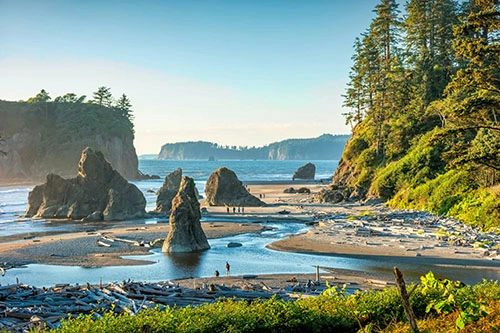
An accessible wild park, Olympic National Park, is nearby. Sturdy pioneers probed it; military and civilian explorers took closer looks; animal life remains along its byways.
The Olympic Peninsula’s interior forests were given status as a National Monument by President Theodore Roosevelt just after the turn of the century. His cousin, President Franklin Roosevelt, visited Lake Crescent Lodge in 1937. A year later the 900,000-acre Olympic Park was created. One of the last great primitive tracts in North America, its fringes are accessible from Hood Canal, Lake Quinault, or Port Angeles.
Olympic National Park’s awards and popularity have not abated the desire of loggers to cut old growth. The U.S. Forest Service is under fire for allegedly being too generous in that regard, and in some instances, gypo loggers removed great trees by stealth and deceit.
The Olympic Peninsula’s early pre-history belongs first to the volcanic upheavals of nature, and second to the Native populations. Its major rivers were arteries of Native activity until the late 1800s. Names of those frenzied cold streams have preserved Native monikers: for example, Elwha, Quileute, Quinault, Dosewallips, and Hamma Hamma.
The Natives believed that a great bird-god ruled the peninsula’s interior. British Captain John Meares, aboard the ship Felice in 1788, may have also believed in the presence of deities as he named its highest peak after the home of Greek gods: Mt. Olympus.
The first white men to take a close look at the great peninsula were part of a July 1885 expedition led by Lt. Joseph P. O’Neil. It took O’Neil a month to trudge and stagger his way to Hurricane Ridge, today a pleasant and scenic 30-minute drive from Port Angeles.
The most famous Olympic trek was led by Scottish mountain man Jim Christie in 1889-90. Christie’s five-man party followed the Elwha River southward in the dead of winter. Losing mules, supplies, and almost their lives, the intrepid adventurers emerged at shimmering Lake Quinault six months later.
That journey is movingly described in Robert L. Wood’s book, Across the Olympic Mountains, The Press Expedition, 1889-90, (Mountaineers Press). The book is a welcome salute to the peaks, waterfalls, valleys, glaciers, salal bushes, bear, elk, deities, and goblins of this magical corner of the state of Washington.
Discover more from Post Alley
Subscribe to get the latest posts sent to your email.


Your commentary will be missed, Mr. Rochester.
RIP
Times I spent with Junius were always enjoyable. An historian, writer, teacher, raconteur, and a generous spirit, Junius was a friend to many. He lived a long, full and rich life. I’m going to miss him.
Our beautiful Pacific Northwest has lost a champion who found the most interesting little bits of history and shared them.
I will miss his wonderful stories.
It was my please to lead Junius on a trek across the Olympics in 1989 following the 1889 Press expedition route. It was an honor to have him to myself for 50 miles and 7 days. I loved his stories and have never felt more appreciated.