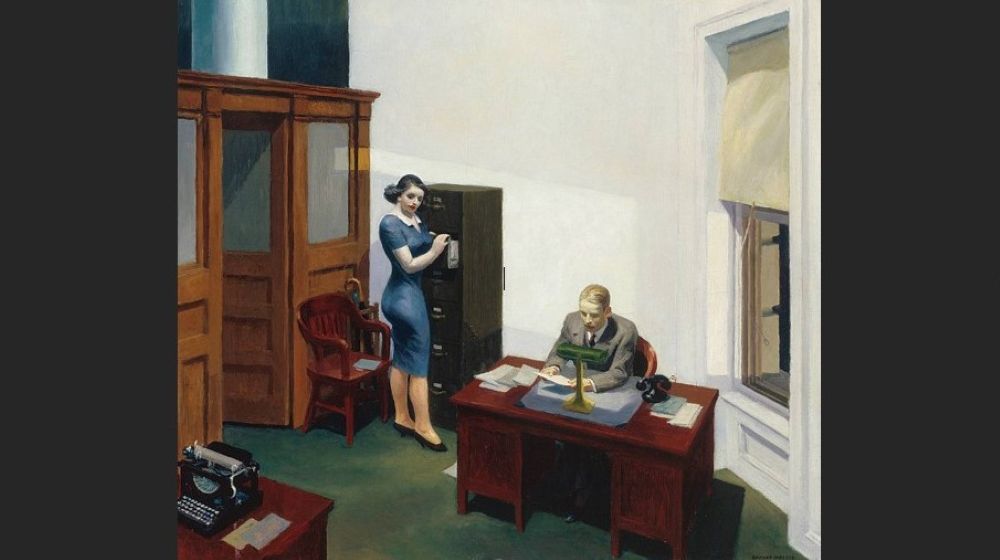

Let’s say you do have a job. Congratulations — you’re already beating the odds.
Then your boss shows up in this headline: Microsoft’s AI CEO Wants Employees in the Office Working at Open Desks (Business Insider)
Not only does the CEO, Mustafa Suleyman, require employees to work from the office more than other Microsoft employees, but he also prefers open floor plans, where employees sit at open desks grouped into “neighborhoods” of 20 to 30 people. The arrangement is “much better for collaboration,” in Suleyman’s words. “Everyone can see everyone else who’s in,” he told BI. “It just creates a lot more informal collaboration. It’s so much better.”
Sigh. I don’t mind in-office work. Many jobs benefit from it. But open floor plans? What fresh hell is this? This zombie idea refuses to die, no matter how much data stakes it through the heart.
I’ve worked in an open office. They are: productivity killers, stress amplifiers, collaboration myths, and surveillance-adjacent performance theater. According to Business Insider:
- In some surveys, face-to-face collaboration drops 70 percent after moving to open layouts;
- Another study showed negative mood spikes 25 percent;
- Stress response increases 34 percent;
- Sick days increase 62 percent;
- Neurodivergent and introverted workers suffer disproportionate harm.
Open offices flatten difference. They force everyone into the same overstimulated mold. And they kill the two things modern work depends on: focus and psychological safety.
But in a wounded job market? Employers can say: sit in the fishbowl or leave. And people comply because the alternative is unemployment.
This — not productivity — is the real driver.
A strong labor market improves working conditions. A weak one erodes them. Microsoft’s open-desk fantasy is Exhibit A.
When I was a full-time employee in Corporate Communications at Microsoft in 2011, we had a new, eager-beaver VP come in, determined to shake things up. He had recently toured the Bloomberg newsroom and thought he could re-create that. So, he moved all of us from a building where we had cozy private offices that allowed actual conversations and real collaboration, and moved us to a single big room.
It was a disaster. There was no “newsroom buzz” because it wasn’t a real newsroom. It was home to a bunch of corporate drones. Every conversation could be overheard, so no one talked. Most people wore headphones. The rest went to the coffee shop to work.
The VP behind this? Never to be seen.
Discover more from Post Alley
Subscribe to get the latest posts sent to your email.


The unfortunate thing about being a non-tech worker in Seattle is that every other employer borrows their bad ideas trying to fit in with the cool kids. In 2019 we were stacked on top of each other in our office. We did not have completely open floor plan but they kept shrinking the cube size and lowering the divider walls…Now in 2025 we have plenty of space, partly due to our collapsing economy and “right-sizing” the workforce, but also that hybrid work is here to stay.
Why does tech insist on open floor plan? My guess is they’re nostalgic for the days of being scrappy start ups, not the bloated bureaucracies they are. Why force everyone into a giant room when absenteeism goes up and collaboration goes down? Why do bosses think we will mind meld and absorb information from each other like amoebas??? “Data-based decision makers” they are not.
https://www.hermanmiller.com/designers/propst/
https://www.wsj.com/lifestyle/workplace/robert-propst-inventor-cubicle-work-6c170bed
Also, Bob hired my former employer, Bill Miller, who ran Shelter Research Institute, in PT, to design an ‘Open Home’ POC in East Sammamish in 1981.
Did you know Bill or Bob?