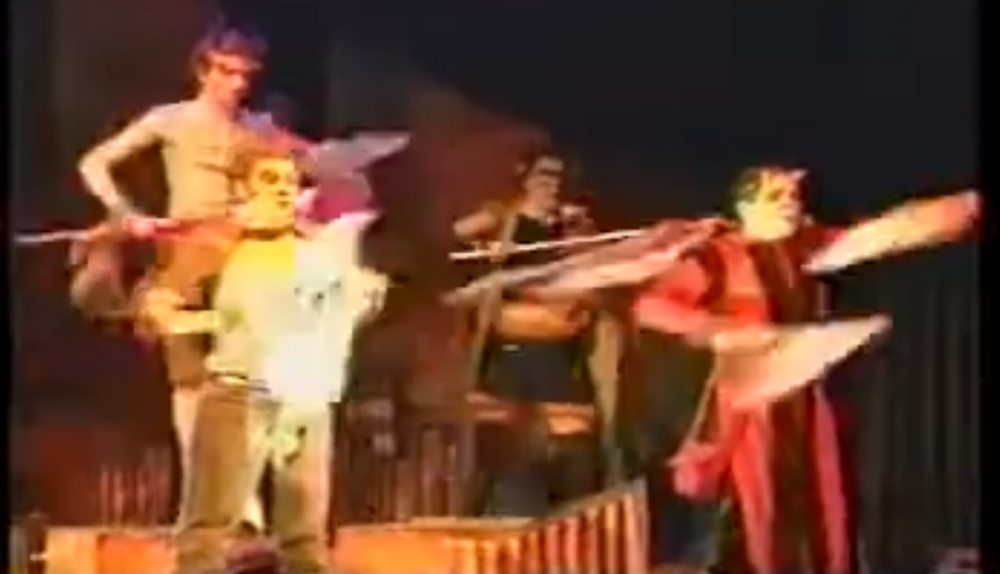

Twenty-five years ago, an open call went out to the music and arts community in Olympia: anyone who was interested in creating a rock opera from scratch, was welcome to collaborate on the project—no experience needed. More than 50 creatives of all ages, genders, and sexual orientations came together and, in less than a year, produced the script, music score, and stage set of the anti-capitalist, anti-authoritarian, and pro-queer show The Transfused.
The rock opera embodied the values that the Olympia scene stood for: rebelliousness, community, a low barrier to participation, and creating art for the sheer fun of it, without the expectation of becoming rich and famous.
Although a quarter century has passed, these values and the premise of The Transfused makes the project relevant again in a world that increasingly veers towards authoritarianism, outsized power by the ultra-rich, and anti-queer laws.
“It continues to resonate with people, including younger generations,” Kelsey Smith says. “The kids of the people who created or saw The Transfused back then, want to perform it at school, so the creators are now trying to rewrite the script and remaster the music.”
Smith, with Elaine Vradenburgh, founded the Olympia Music History Project (OMHP), a digital collection of 38 recorded and transcribed interviews with the people who made up the Olympia music scene between 1980 and 2002, including several Transfused co-creators such as Freddie Havens, Nomy Lamm, Rachel Carns, and Radio Sloan, Kill Rock Stars Records founder Slim Moon, and Tobi Vail of Bikini Kill, who also conducted interviews. Ten more interviews are currently in progress.
Why now, all these decades later? “I think people don’t always realize they are IN history,” Smith says. “They look back and say, that was extraordinary!”
And although the commodification of their scene is not supported by many people, as Smith points out, the City of Olympia has become interested in the tourism aspect of the music legacy. People from all over still visit Olympia for it, Smith says. “Recently, we even had comic artists from Indonesia here.”
The OMHP has been funded so far with grants totaling more than $50,000 from the City of Olympia, which started allocating one-tenth of one percent of the sales tax to the cultural sector in 2022. While Seattle might be known as the Grunge Capital, Olympia’s contributions to the Pacific Northwest music scene, including the feminist punk Riot Grrrl movement, are significant. “We have a list of over 300 people, so it’s hard to decide who to interview,” Smith says. “That’s why we prioritize the people who have been historically excluded, who have a different perspective, such as queer, BIPOC and disabled voices.”
Olympia was always different, Smith feels—more inclusive, open, and welcoming than Seattle. “You didn’t have to know how to play to be in a band, whereas Seattle had bands that were THE bands. It was very hierarchical. Here, people played across genres and levels of experience. And they danced. They let their freak flags fly.”
North of Olympia, in Seattle, several music aficionados are also, in different ways, documenting a scene that took the world by storm many decades ago. What makes all these projects remarkable is that they don’t focus on the big names and the world-famous exhaustively-covered grunge scene but celebrate the other music scenes and “the unsung heroes,” as Rachel Crick of Poser Productions puts it.
In 2021, a health scare prompted Crick to consider what she had done with her life. She had two degrees in photography and a wealth of experience in the music scene: she had worked at radio station KISW, was co-editor at The Flavor, a Seattle based hip hop magazine, and drove bands like The Screaming Trees and Pearl Jam around when she was a College Music Rep for Sony Music in the Pacific Northwest.
“I wanted to tell the story of the music community I grew up in, because grunge didn’t happen in isolation—so many people helped make it possible,” Crick says. “It is important to tell the whole story.”
That became As Many Weirdos As Possible, the first initiative of Poser Productions, a community-centered arts organization that aims to preserve cultural history through photo portraits and storytelling. A team of seven photographers tracked down and photographed more than 300 people who made and supported music in the PNW music scene between 1985 and 1995—from musicians and journalists to bouncers and even the pizza delivery guy—at locations that were meaningful to them. All the participants wrote their personal narratives on a sheet of paper.
These stories are not meant to be historical records, Crick says. “They are not life stories but anecdotal narratives, moments in time that shed a light on what it was like to live in the PNW music community during this era.”
A six-week exhibit at Base Camp II on 3rd Avenue in April 2024 featured 100 photos and stories from CZ Records founder Daniel House, emcee/poet Chenelle Marshall, and Mother Love Bone guitarist Bruce Fairweather amongst others. The show drew more than 1,500 people, who were often deeply touched to see the stories and faces from such a formative time again.
“People left in tears,” Crick recalls. The exhibit felt like a reunion for many, including for her. “It made me feel reconnected. We’re losing people and places in Seattle, but we can still preserve the stories and the art forms—they live in our hearts.”
To foster this sense of community, Poser Productions has expanded: in 2023 and 2024 the non-profit organized Weirdosfest!, a small-scale festival that showcased upcoming local bands, storytelling events are held throughout the city, and a three-volume photo book is in the works.

The feeling “that we’re losing touch with something very real and so meaningful” also motivated John Vallier, a former drummer and now curator at the University of Washington Ethnomusicology Archives, to start assembling unique music collections from the Pacific Northwest in 2009, after an eight-year break in Los Angeles. “I came back to Seattle and it had changed a lot in that time.”
In the basement of the Suzzallo building on the UW campus in Seattle, where all the collections of the Seattle Sounds Archiving Project (SSAP) are stored, he points to two boxes with tapes from all the shows in The Crocodile between 2002 and 2007, “after grunge, when Seattle had an identity crisis and was trying to figure out what it was.”
One rack is reserved for hundreds of cassette tapes local bands sent to DJ Stephen Rabow, in the hopes he would play them on his popular show Local Tape Extravaganza, in 1982 on radio station KZAM and in 1983 on KYYX. Next to it are shelves full of recorded interviews with local jazz musicians, including Ray Charles and Quincy Jones, by Paul de Barros.

In addition to this Jackson Street Jazz collection, there is a collection about punk poet Jesse Bernstein, who was a local celebrity in Seattle until his death in 1991, a hip-hop collection, and 350 boxes with tapes from local recording engineer Kearney Barton, who recorded The Sonics, The Wailers, and Ann Wilson before she started the band Heart. Vallier has 50,000 items digitized now, with many more to go.
“An audio time capsule,” Vallier says. “I wanted to acknowledge the people who have come before and their diverse musical contributions, so they wouldn’t be forgotten, and educate younger people about where we’ve come from.”
The vibrant punk rock and Seattle jazz scene was unique in the country, he adds, and in an era of increasing gentrification and mass-production, when US cities start to look the same, “it’s more important than ever to remember we have a unique cultural identity.”
The collections don’t only have significant meaning for the people who lived through this famous music era of the PNW—Vallier, who teaches the classes Seattle Sounds and Grunge is for Lo$ers, finds that his students are very interested in “the punk rock, DIY, and anti-authoritarian ethos” of that time.
“They definitely have more to be angry about and protest against. We had Reagan but we also had affordable housing and not a lot of distractions. I feel these kids push back against this onslaught and delete social media, and are craving a connection with the physical instead of the virtual reality.”
Kelsey Smith notices the OMHP project also has provoked a lot of interest from the younger generation. “Working together in person, rising above the current situation to do better, trying things and failing and trying again, these things all resonate with young people. Smart phones have made it daunting to just try and fail.” She hopes the interview project will encourage people “to do their own thing in a time when creative expression and community are crucial.”
But when rents of apartments, concert venues, and community spaces are sky-high, creatives are leaving cities, demanding jobs don’t leave much time or energy to work on creative endeavors, and funding for the arts is drying up, is it still possible to recreate a vibrant, meaningful music scene?
Poser Productions received grants from 4Culture and ArtsFund to support its work. Still, Crick says, finding a space large enough to exhibit 100 photos in Seattle proved challenging. She blames big tech companies like Amazon for not giving back after “taking away everything—all these warehouses, galleries, and artists. And they didn’t do anything to preserve what they were taking. All this money and none of it goes to preserving history.”
UW curator Vallier faces other modern-day challenges: streaming and licensing agreements. He tried to negotiate with Apple, Amazon, and local label SubPop, but says the big distributors are not interested, which is why he focused on unique collections. Like Crick, he feels the City of Seattle could have done and should still do more to preserve its music history.
“Why are there no plaques at the RKCNDY, the Re-Bar, the Vogue, the OK Hotel? Why don’t we have a Jimi Hendrix Airport? How cool would that be?” Maybe, Vallier guesses, there is concern “about embracing something that went against the grain, was anti-authoritarian.”
(The City of Seattle stopped responding to a request for an interview when informed of these questions.)
All these factors make it harder to fuel a large-scale movement that changes the world but Vallier, Crick and Smith point out that smaller scenes are being built on the solid foundation of the PNW’s music legacy, in large part because of the involvement of younger generations.
“I don’t know if it’s a radical style, but it is something vibrant and meaningful to this generation,” Vallier says. “And all music matters.”
Besides the unprecedented level of financial support from the City of Olympia, Smith mentions that “outside of the big names” the outburst of creativity never stopped in Olympia—there are music shows in a house or venue nearly any night of the week and two new all-ages venues, Decay and The Mortuary, “are entirely driven by young people.”
Crick adds there are lessons to be drawn from the DIY ethic and the large sense of community that made the Seattle music scene happen in the 80s and 90s. “COVID, aging, and technology have made us more isolated, but we can learn to be with our community again, to go out and support our clubs and give our friends opportunities.”
Discover more from Post Alley
Subscribe to get the latest posts sent to your email.


During a brief career doing arts reporting on KCTS (1980-81) I produced a ‘Band of the Week’ feature mixing live performance with band interviews (this was before MTV had debuted). I also produced two half hour documentaries on two very talented (and quite different) acts. Danny Deardorff was a singer/songwriter with muscular dystrophy who performed from a wheelchair. HiFi was a five man rock band led by Iain Matthews, who’d had global success in a number of British bands. Both documentaries won significant awards for arts programming. Although the Seattle bands of the 1990s clearly had far more global impact, it’s worth remembering that there has always been exceptional musical talent emerging from this corner of the country, going back at least as far as Quincy Jones and Jimi Hendrix.